
A focused six-to-twelve-month plan built around spaced-repetition vocabulary, targeted grammar drills, timed reading practice, and regular mock tests gives most upper-intermediate learners a realistic shot at passing JLPT N1. The core JLPT N1 study plan works because it treats N1 as a timed, testable skill rather than an abstract fluency goal.
Do these three things this week:
- Take a full-length timed diagnostic test to find your baseline.
- Pick one SRS deck (Anki, N1-specific) and start ten cards a day.
- Book your first mock test on the calendar, six to eight weeks out.
Budget 10 to 20 hours a week. Learners starting from a solid N2 base who follow this pattern consistently tend to see their section minimums stop being the scary part of the exam by month four or five.
Key Takeaways
Passing JLPT N1 requires 6 to 12 months of structured, phase-based study combining SRS vocabulary, timed reading drills, and a final mock-test sprint driven by error analysis.
| Point | Details |
|---|---|
| Diagnostic first | Run a full timed practice test before choosing resources so your plan targets real gaps. |
| Core resource stack | Shin Kanzen Master, Nihongo So-matome, Nihongo Tango Speed Master, and Anki cover grammar, vocab, and kanji. |
| Timeline structure | Four phases over 6 to 12 months: foundation, intensification, deep practice, mock sprint. |
| Weekly commitment | Plan for 10 to 20 hours weekly, scaling upward as mock-test season approaches. |
| Guided support | Japanese Explorer’s JLPT preparation course maps diagnostics and mock-test bootcamps onto this same timeline. |
Where to Find N1 Practice Materials
- Official JLPT past papers for authentic timed practice.
- Shin Kanzen Master and Nihongo So-matome series for core textbook study.
- NHK News Web Easy progressing to full NHK News for listening and reading immersion.
Table of Contents
- How Do You Assess Your JLPT N1 Baseline?
- What Are the Best Resources for JLPT N1?
- What Does a 6-to-12-Month N1 Timeline Look Like?
- What Should Your Weekly Study Routine Look Like?
- How Do You Improve N1 Reading Speed and Accuracy?
- How Should You Train Listening for JLPT N1?
- How Many Vocabulary and Kanji Should You Target for N1?
- How Do You Run Mock Tests and Prepare for Exam Day?
- How Does a Structured Course Fit This N1 Plan?
- Ready to Follow This Plan With Guidance?
- Sources
- FAQ
How Do You Assess Your JLPT N1 Baseline?
Start with a full-length, timed diagnostic before you touch a single grammar book. Guessing your level wastes months. A real diagnostic, run under exam conditions, tells you exactly where the gaps are.
- Find an authentic N1 practice set, ideally official past papers or a placement test like Japanese Explorer’s Japanese language placement test.
- Set a timer for each section and don’t pause it, even to look something up.
- Score yourself immediately after, section by section.
- Log the result before you forget the details.
Record these fields for every attempt:
- Raw score per section (Language Knowledge, Reading, Listening)
- Time spent per section versus the allotted time
- Error type per missed question (vocabulary gap, grammar misread, timing, context misuse)
Pro Tip: Keep a running error log in a spreadsheet from day one. The categories you tag today become your study priorities in month three, when memory of “why I got this wrong” has faded.
What Are the Best Resources for JLPT N1?
Five resources cover nearly everything you need, and using them in the wrong order wastes months. The Shin Kanzen Master (新完全マスター) series is the backbone for grammar, reading, and listening. It’s dense and unforgiving, which is exactly what N1 demands. Nihongo So-matome (日本語総まとめ) is gentler and works well as a warm-up before Shin Kanzen Master or as a review pass afterward.
For vocabulary, Nihongo Tango Speed Master pairs well with Anki, the spaced-repetition app that should carry your daily vocabulary and kanji load. Build or download an N1 deck and commit to it daily rather than in bursts.
N1 vocabulary demands run to roughly 10,000 words and 2,000 kanji, a scale that makes isolated flashcard memorization inefficient without contextual reading to back it up.
For listening and reading immersion, start with NHK News Web Easy and graduate to full NHK News as your comprehension improves. Use Shin Kanzen Master in months one through six, past papers from month six onward, and NHK progression throughout.
What Does a 6-to-12-Month N1 Timeline Look Like?
A 6 to 12 month timeline breaks cleanly into four phases: foundation, intensification, deep practice, and a final mock-test sprint. Learners with limited N2 mastery should lean toward twelve months, while those closer to a strong N2 can compress toward six.
| Phase | Months | Primary Focus |
|---|---|---|
| Foundation | 1 to 3 | Diagnostic test, core grammar review, SRS setup, easy listening |
| Intensification | 4 to 6 | Shin Kanzen Master grammar/vocab, daily Anki reviews, NHK Easy |
| Deep practice | 6 to 12 | Timed reading drills, native NHK News, past-paper sections |
| Mock sprint | 10 to 12 | Full mock tests every 1 to 2 weeks, error-log remediation |
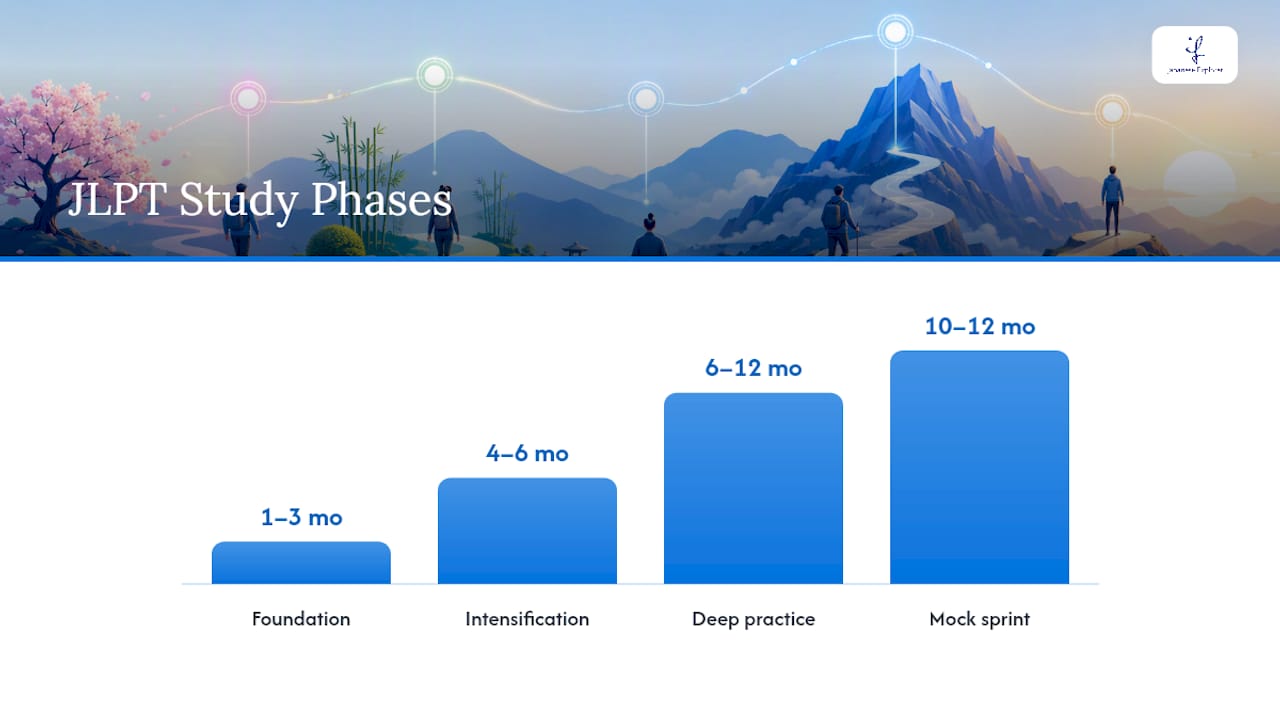
Each phase ends with a checkpoint: complete the assigned book section, hit your Anki review target, and take one timed mock or practice section. An accelerated three-month option exists for learners already near N1 level. It compresses the phases into roughly three to four weeks each and requires 20 or more hours a week, mostly spent on mock tests and error correction rather than new material.
This staged approach mirrors the 12-month template many successful candidates follow, with foundation work early and mock-test intensity concentrated at the end.
What Should Your Weekly Study Routine Look Like?
Your weekly routine should assign a skill to each day rather than mixing everything daily, which keeps sessions focused and easier to sustain.
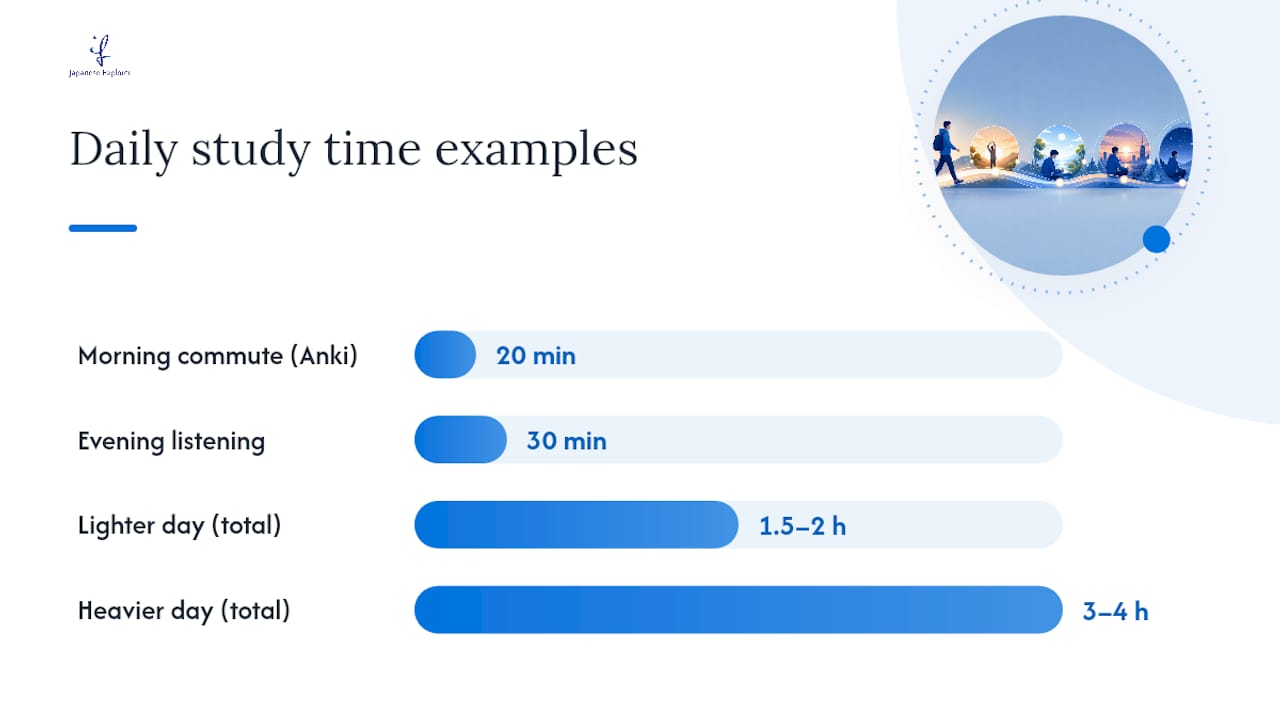
For a lighter 1.5 to 2 hour day:
- Morning commute: 20 minutes of Anki reviews.
- Lunch break: one Shin Kanzen Master grammar unit.
- Evening: 30 minutes of NHK News Web Easy or a short listening drill.
For a heavier 3 to 4 hour day, add a full timed reading passage and an extra 30 minutes of native audio.
Across the week, dedicate distinct days to grammar, reading, listening, vocabulary review, and one full mock or timed practice session, with one lighter review day to consolidate. This matches the sustainable 90 to 120 minutes daily commitment that most steady passers report, scaling up as mock-test season approaches. If your schedule is unpredictable, adjust the study plan structure around your fixed anchors, like a commute, rather than forcing a rigid template that breaks the first busy week.
Pro Tip: Consistency beats intensity every time. Twenty minutes daily for six months outperforms one marathon weekend session, and it’s far easier to sustain without burning out.
How Do You Improve N1 Reading Speed and Accuracy?
Reading is the most common bottleneck at N1, and the fix is tactical, not just “read more.” Read the questions before the passage. This tells you what to hunt for instead of absorbing every sentence equally.
- Skim the first and last paragraphs closely. They usually carry the main argument.
- Skim middle paragraphs for structure and slow down only where a question points you.
- Time yourself per passage and track whether you’re over or under pace.
Common pitfalls include overreading every word, mentally translating instead of processing in Japanese, and missing shifts in register or tone. Fix each by drilling timed passages specifically, not by reading more untimed material.
How Should You Train Listening for JLPT N1?
Listening improves fastest through active drills, not passive background exposure. Micro-drills work well here.
- Repeat short audio segments and check comprehension against a transcript.
- Practice dictation on tricky sentences to catch what you’re actually missing.
- Do targeted practice questions that mimic N1 format, not general conversation clips.
Add shadowing, speaking along with native audio in real time, to build comprehension at natural speed. Progress from NHK News Web Easy to full native NHK News as your ear adjusts, and structured pedagogy on active listening techniques supports this same progressive approach.
Pro Tip: N1 listening questions often ask about a speaker’s opinion or attitude, not just facts. Practice summarizing what each speaker believes, not just what they said.
How Many Vocabulary and Kanji Should You Target for N1?
N1 demands roughly 10,000 vocabulary items and 2,000 kanji, a volume that punishes rote memorization without context.
- Target 15 to 20 new Anki cards daily during foundation and intensification, dropping new intake to near zero once mock-test season starts.
- Use sentence-based cards, not bare word-to-translation pairs, so vocabulary sticks in context.
- Prioritize kanji compounds and on-yomi-heavy readings, since N1 tests these far more than isolated character recognition.
- During the mock sprint, shift Anki time entirely to review, not new cards, to protect retention under pressure.
Sustained daily SRS with context sentences, paired with weekly forced-recall mock questions, accelerates retention more reliably than cramming isolated word lists.
How Do You Run Mock Tests and Prepare for Exam Day?
Mock-test season should run the final two to three months, with full timed mocks every one to two weeks under real exam conditions, no pausing, no dictionary.
- Take a full mock, score it immediately, and log every error by type.
- Convert each error into a specific study action that week, not a vague “review more” note.
- In the final two weeks, taper new material entirely and focus only on review and light mocks.
On exam day, allocate time per section deliberately, guess rather than leave blanks since there’s no penalty, and prioritize sleep and a real meal beforehand over last-minute cramming. Error logging turns each mock into targeted progress instead of just a score.
How Does a Structured Course Fit This N1 Plan?
A guided course removes the three biggest blockers in this plan: an accurate diagnostic, honest weekly feedback, and realistic mock-test simulation.
- Instructor-led diagnostics catch blind spots a self-graded practice test often misses.
- Weekly feedback on writing and speaking keeps grammar mistakes from calcifying unnoticed.
- Structured mock-test bootcamps in the final phase mirror real exam pressure with review built in.
Japanese Explorer’s JLPT preparation course maps directly onto this timeline, with diagnostic placement early and mock-test intensity concentrated where the plan calls for it, taught by bilingual instructors who work within the Association for Japanese-Language Teaching framework.
What Instructors Wish Every N1 Candidate Knew
The hardest habit to change isn’t grammar. It’s trading consistency for intensity, then burning out by month three.
Skipping review sessions, listening passively without drilling, and ignoring timing during reading practice are the three pitfalls that derail otherwise strong learners. Fix them early, and steady, unglamorous progress will get you further than any cram week ever could.
Ready to Follow This Plan With Guidance?
Studying alone works, but a structured JLPT N1 study plan moves faster with weekly feedback and a mock-test schedule someone else is holding you accountable to. Japanese Explorer runs small-group and online JLPT preparation courses that follow this exact phase structure, diagnostic first, grammar and vocabulary intensification next, mock-test bootcamp at the end, taught by bilingual instructors at 10 Anson Road, Level 22, International Plaza, right above Tanjong Pagar MRT.

If you prefer studying from home, the online Japanese course runs on the same curriculum with flexible scheduling around work or family commitments. For those who want in-person practice and peer accountability, check the small-group class schedule and pick a start date that lines up with your diagnostic result. Reach out to find which format fits your current level and timeline before you commit to a full year of self-study guesswork.
Sources
- JLPT N1 Study Guide: Conquer the Hardest Level (2026) | JLPTLord
- JLPT N1 Study Guide: grammar list & practice test | JP YoKoSo
FAQ
How Can You Study Effectively for JLPT N1?
Combine daily SRS vocabulary review, targeted grammar work from Shin Kanzen Master, timed reading drills, and regular full-length mock tests, using an error log to direct what you study next.
How Many Hours of Study Does It Take to Pass JLPT N1?
Most learners study 10 to 20 hours a week over 6 to 12 months, with heavier weeks during the final mock-test sprint.
Is It Hard to Pass JLPT N1?
Yes. N1 requires a total score around 100 out of 180 with minimum scores in each section, so weak performance in even one section can fail an otherwise strong result.
Is N1 Harder Than N2?
N1 is significantly harder than N2, demanding roughly 10,000 vocabulary words and 2,000 kanji along with denser reading passages and faster, more nuanced listening content.