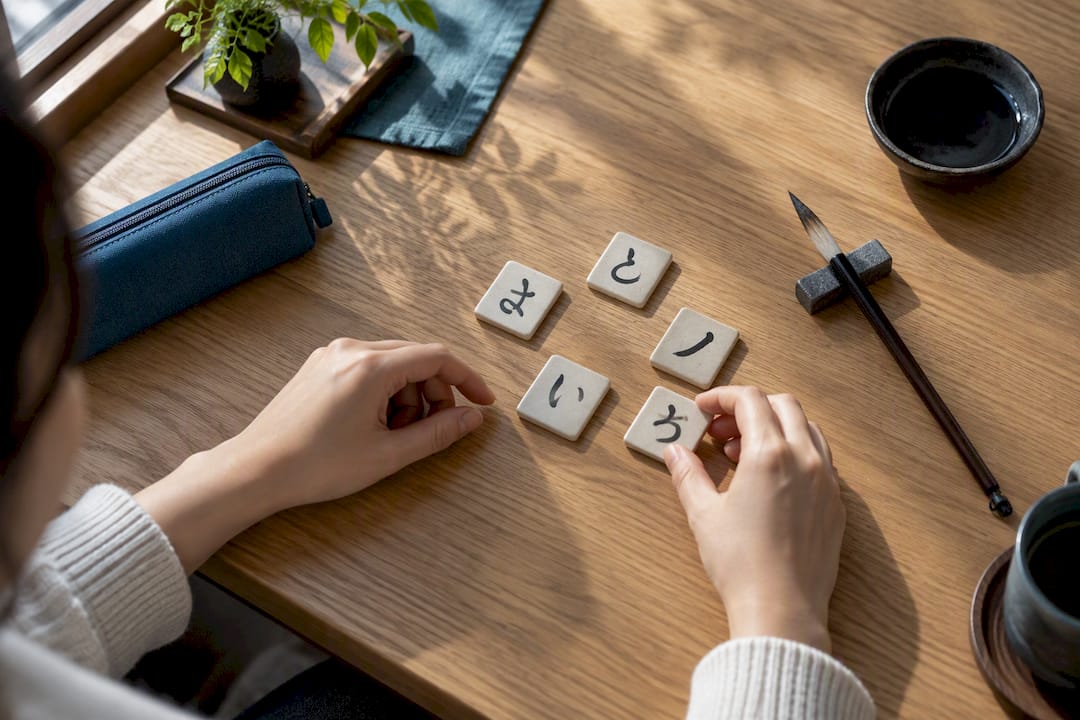
Japanese writing combines hiragana, katakana and kanji. Hiragana is used for grammatical endings, particles and many everyday words. Katakana is often used for loanwords and foreign names. Kanji carries meaning within words, and its reading depends on the word and context.
This guide explains how the scripts work together and what to practise as a beginner. You can also explore our guides to Japanese writing practice and learning Japanese.
Hiragana(平仮名)
Hiragana is one of the two kana scripts. Learn to recognise a character, connect it to its pronunciation and read it within words. Hiragana also appears beside kanji as a reading aid called furigana.
A sentence can combine kanji and hiragana. For example, 気持ち includes the kanji 気 and 持 followed by hiragana ち. It should not be described as a word written entirely in hiragana.
Compare these spellings:
- にほん: a hiragana spelling of Nihon.
- 日本: a kanji spelling of Nihon, meaning Japan.
- きもち: a hiragana spelling of kimochi.
- 気持ち: the same word written with kanji and hiragana.
Practise reading a word aloud as well as writing its characters. Your course materials can show which words to learn at your current level.

Chart: Pmx and contributors; original artwork by Karine Widmer. Wikimedia Commons, CC BY-SA 3.0. Artwork unchanged.
Katakana(片仮名)
Katakana is another kana script. Many of its sounds correspond to hiragana, but the written shapes differ. It is often used for foreign names and loanwords, as well as emphasis and some sound expressions.
The examples below show words written in katakana:
- アメリカ: Amerika, America.
- ビール: bīru, beer.
- サッカー: sakkā, soccer.
- キャンディー: kyandī, candy.
A sentence containing one of these words usually also uses hiragana or kanji. For example, ビールを飲む combines katakana ビール, hiragana を and む, and kanji 飲.
Use the chart to compare the written shapes, then practise reading katakana in complete words.

Chart: Pmx and contributors. Wikimedia Commons, CC BY-SA 3.0. Artwork unchanged.
Kanji(漢字)
Kanji characters were adapted from Chinese writing. A kanji can carry meaning as part of a word; it is not simply a symbol for one sound or necessarily a complete word by itself.
How to Write Kanji
Study the written form, meaning and reading of a word together. Follow the forms and stroke order shown in your Japanese learning materials. You do not need to memorise every possible reading of a character before using an ordinary word.
The Japan Foundation’s Irodori learning guide practises kanji through words, sentences and typing. Its activities provide an example of learning the reading and meaning in context rather than treating characters as an isolated list.
Kanji: The Chinese-derived Script
Keep the Japanese word and its reading together when you study. Recognising a character from Chinese can be useful background knowledge, but check how the word is written and read in Japanese.
Kanji alongside kana
Ordinary Japanese text combines scripts according to the words and grammatical forms being written. For example, 日本 uses kanji, while 気持ち includes both kanji and hiragana. Reading the whole word matters.
Useful practice includes recognising a word, reading it in a sentence and checking its meaning. A reading aid can help you encounter a word before you have memorised all of its characters.
How do the Japanese writing systems work together?
Japanese writing does not require choosing one script for every situation. A single sentence can combine kanji, hiragana and katakana. Look at the role each part plays in the word or sentence.
Children in Japan study kana and kanji during elementary school. Kanji and katakana are not first introduced only in junior high school: MEXT’s elementary Japanese curriculum includes reading and writing kana and learning grade-assigned kanji from the early years.
For adult learners, follow the sequence in your course and discuss the starting level with the teacher. You can begin with kana and common words, then build reading and writing practice around material suitable for your level.
Japanese Typography (Horizontal and Vertical)
Japanese can be written horizontally or vertically. Check the direction of the particular text before reading it. You may encounter vertical text in books and publications as well as horizontal text in digital messages and learning materials.
Practise with the format used in the exercise or text in front of you. Neither layout makes the language automatically easier or guarantees a particular learning result.
How can I practise Japanese writing?
Choose a manageable set of words from your lesson and practise recognising, reading and writing them. Ask for feedback if you are unsure of a character, word or sentence.
Practise characters within words.
Read the word aloud, look at its spelling and practise writing it. Check the result against your learning material.
Learn the reading used in the word.
Kanji may have different readings in different words. Study the reading that belongs to the word you are learning, rather than assuming one reading works everywhere.
Use learning resources suited to your level.
A chart can support kana practice, while a course book or guided exercise gives you words and sentences to work with. The Japan Foundation’s introductory learning materials include kana before later kanji-word activities; this is an example of a structured sequence, not a promise of fluency within a fixed number of weeks.
Conclusion
Start by recognising how hiragana, katakana and kanji appear within words and sentences. Practise the material appropriate to your level and ask a teacher about the next step if you have already studied some Japanese.
If you want a class in Singapore, compare the current course outline, fees and schedule through Japanese Explorer. Progress depends on your starting point and practice, so a course package should not be treated as a guarantee of proficiency.