
The fastest reliable way to handle your Japanese level placement is to take a multi-skill online test that reports a JLPT or JF/CEFR equivalent, then follow up with an instructor-reviewed speaking check. That combination catches the gap between what you can recognize on a screen and what you can actually say. Use the result to enroll at the matching course level, and if your speaking or writing lags behind your reading and listening scores, ask for a short oral review before you commit. A placement test tells a school where to seat you. It is not the same as a formal certification exam.
TL;DR:
- Taking a multi-skill online test combined with a speaking check provides the most accurate placement for your Japanese level, especially for production skills.
- Most placement tests assess recognition of kanji, vocabulary, grammar, reading, listening, and often include a speaking or writing sample to confirm practical ability.
- Results are typically reported against JLPT or JF Standard scales, with JLPT N3 indicating lower intermediate skills and N2 or N1 signaling advanced capabilities.
- To ensure placement accuracy, perform the test in a quiet environment, respect proctoring instructions, complete all components, and seek an instructor review if scores are borderline.
- Prioritize the speaking check over test scores; a brief conversation with an instructor often reveals more about your true level than recognition-based assessments alone.
Table of Contents
- What Online Placement Tests Actually Measure
- Which Standardized Tests and Scales You’ll Run Into
- How to Take a Placement Test So the Result Is Accurate
- Making Sense of Your Score and Picking a Course
- Why This Placement Approach Holds Up
- Common Mistakes That Throw Off Your Placement Result
- Why Most Placement Advice Undersells the Speaking Check
- Sources
- FAQ
What Online Placement Tests Actually Measure
A placement test is not one quiz. It is usually a bundle of short sections, each checking a different skill, because a learner who can spot kanji on a multiple-choice screen does not always hold a conversation. Most placement systems built for course enrollment, rather than certification, cover four or five areas in sequence.
- Kanji and vocabulary recognition to gauge how much written material you can decode.
- Grammar and sentence structure to check whether you can build accurate sentences, not just recognize correct ones.
- Reading comprehension using short passages that mirror what a textbook chapter might ask.
- Listening comprehension, often the section that trips up self-taught learners who studied mostly from apps.
- A speaking or writing sample, added by many schools because recognition tests alone cannot confirm you can produce language on demand.
Listening and spontaneous speaking tend to predict how someone actually performs in a live class far better than grammar multiple-choice does, according to placement guidance from Northwestern’s Asian Languages Curriculum. A student can memorize particle rules and still freeze when asked to answer a simple question out loud.
Expect the full process to take between roughly one hour to several hours, depending on how many components are included and how far the test needs to probe. A test aimed only at beginner tiers moves quickly. One built to distinguish intermediate from advanced speakers takes longer, since it has to test edge cases at every level.
Before you commit to any test, check for three trust signals: whether an instructor reviews the results (not just an algorithm), whether the school states an honor code for test conditions, and whether it publishes a time limit per section. Their presence usually means the placement process was designed for accuracy, not just speed.
Which Standardized Tests and Scales You’ll Run Into
Most placement results get reported against one of a handful of recognized scales, and knowing what each one measures saves you from misreading your own result.
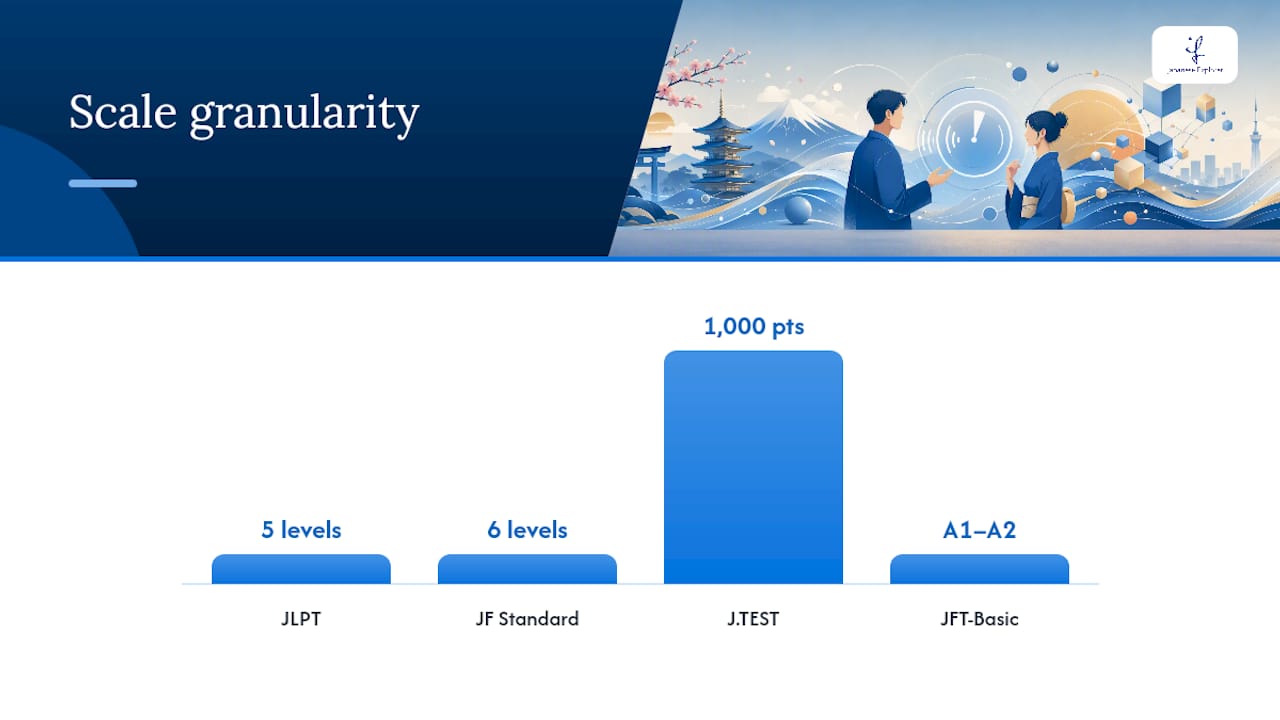
The JLPT (Japanese Language Proficiency Test) is the reference point most schools default to. It runs five levels, from N5 at the entry end to N1 at the advanced end, and JLPT’s own level summary describes N5 as covering basic expressions and character recognition, while N1 signals near-native command of grammar, vocabulary, and reading across varied topics. In practical course terms:
- N5–N4: beginner to high-beginner courses, focused on core grammar and survival conversation.
- N3: the pivot point, roughly a lower intermediate to intermediate course, where students start reading unsimplified text.
- N2–N1: upper intermediate through advanced, where classes shift toward nuance, formal registers, and abstract topics.
Some schools also report a JF Standard equivalent alongside the JLPT number. The JF Standard, maintained by the Japan Foundation, uses a six-level CEFR-aligned framework built around “can-do” statements. Instead of asking “do you know this grammar point,” it asks “can you order food, negotiate a contract, or debate an opinion in Japanese.” The Japan Foundation’s own summary frames this as a better predictor of real-world readiness than recognition-only scoring, which is exactly why more course-placement tools have started layering it on top of JLPT bands.
Quick fact: J.TEST scores learners on a granular 1,000-point scale spanning levels F through Special A, according to J.TEST’s own scoring description, giving finer resolution than the five broad JLPT tiers.
Three other tests show up depending on your goal rather than your classroom level. JFT-Basic targets work and residency applications, mapping to roughly CEFR A1 to A2, and is administered regularly across multiple countries. J.TEST serves learners and employers who want that finer 1,000-point resolution rather than a five-tier label. BJT (Business Japanese Proficiency Test) is computer-based, available in a number of countries including Singapore, and measures workplace communication specifically, per its official test description. If your goal is a general conversation or intermediate course, JLPT or JF Standard framing is what matters. If your goal is a work visa or a corporate role, JFT-Basic or BJT is the more relevant reference.
How to Take a Placement Test So the Result Is Accurate
A placement score is only useful if it reflects your actual ability, and that depends as much on test conditions as on your Japanese. Follow these steps in order:
- Set up your environment first. Find a quiet room, confirm your internet connection is stable, and put on headphones before the listening section starts, not halfway through it.
- Read every proctoring instruction before you begin. Skipping instructions to save time is the most common cause of a wasted attempt.
- Respect the honor code. Most institutions explicitly forbid textbooks, dictionaries, or outside help during placement, because using them produces a score that overstates your real level, per Northwestern’s placement guidance.
- Complete every speaking or video component, even if it feels optional. Programs that add a recorded submission or a short oral interview by video call often adjust final placement based on that segment, according to UCLA’s Asian Languages Center placement procedures.
- Skip the test entirely if you’re a true beginner. Many programs let brand-new learners register straight into the first beginner course rather than sit through a test built to distinguish intermediate levels from each other.
Pro Tip: If a placement test offers an optional 5-minute oral interview, take it. A five-minute conversation resolves more placement uncertainty than an extra twenty multiple-choice questions ever will.
Making Sense of Your Score and Picking a Course
A number or letter grade only matters once you translate it into a course decision. Broadly, N5 to N4 or CEFR A1 to A2 points to beginner course groupings, N3 or B1 lands you in intermediate territory, and N2 to N1 or CEFR B2 through C2 belongs in advanced or specialized tracks.
The trickier case is a split result. If your reading and listening land at N3 but your speaking stalls closer to N4, that gap is common among self-taught learners and app-first learners especially, since apps train recognition far more than production. In that situation:
- Request an instructor review or a short trial lesson rather than accepting the algorithmic score at face value.
- Treat the productive skill (speaking or writing) as the deciding factor when scores conflict, since placement guidance from UCLA notes that a brief instructor-led speaking check is the most reliable way to avoid landing in a class too advanced for your actual output.
- Ask about the validity window for your result. Some programs treat a placement score as current for a single term, others for up to a year, so confirm before you assume last year’s result still applies.
Once your level is confirmed, the practical next step is straightforward: enroll in the matching level, request a brief teacher interview if you’re between tiers, or work through a short preparatory module if you’re borderline. Japanese Explorer’s course structure breaks down what each stage actually covers, which helps you sanity-check whether your placement result matches the syllabus you’re about to sign up for. If your goal and timeline matter as much as your current level, this guide on matching a course to your goal is worth a look before you commit to a term.
Why This Placement Approach Holds Up
Some Japanese language schools base their curriculum on the Association for Japanese-Language Teaching and have classes led by bilingual, certified instructors who treat placement as a starting conversation, not just a score. That matters because a test result on its own can’t tell a teacher how you handle hesitation, tone, or an unexpected follow-up question. Combining a multi-skill online check with instructor review is exactly the approach this article has laid out. It’s how Japanese Explorer applies its own placement test to route learners into the right conversational or business course, whether they’re joining in person or through the school’s online Zoom classes. If your placement result feels off after the test, that’s the moment to ask for a human to weigh in, not just accept the number.
Common Mistakes That Throw Off Your Placement Result
The most frequent mistake is treating a placement test like a school exam to cram for. Reviewing grammar tables the night before inflates your recognition score without touching your actual speaking ability, which sets you up for a class that moves faster than you can follow.
A second common problem is skipping the speaking or video component when it’s marked optional. Learners who skip it often get placed on reading and listening scores alone, then discover in week one that they can’t keep up with spoken pace in class.
Testing on a rushed schedule causes a third round of misplacement. Squeezing a 90-minute placement test into a lunch break invites careless errors on the listening section, which is the hardest to recover from once you’ve missed the audio cue.
Finally, some learners assume a single test result is permanent. Skills fade or improve between the test date and enrollment, especially after a long gap. If more than a few months pass, a quick retest or a short instructor conversation before your first class keeps your placement honest.
Why Most Placement Advice Undersells the Speaking Check
The conventional wisdom treats placement as a scoring problem: take the test, read off the number, pick the matching course. That undersells how much productive skill drifts from receptive skill, especially among learners who built vocabulary through apps and spaced repetition systems rather than conversation. A JLPT N3 reading score tells you almost nothing about whether you can hold a real exchange at that level.
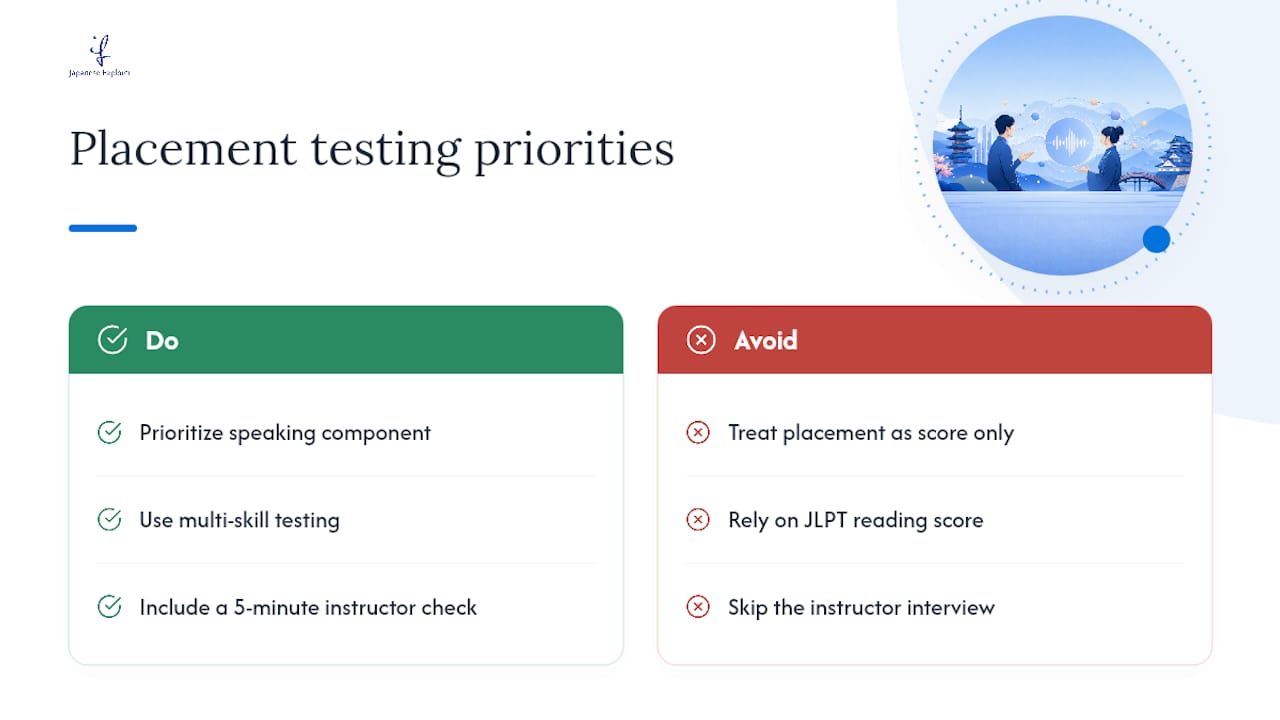
What the research actually supports is narrower and more useful: multi-skill testing beats single-skill testing, and a short human-reviewed speaking check catches misplacement that no algorithm resolves on its own. The instructor interview UCLA and Northwestern both build into their placement flow isn’t a bureaucratic extra step. It’s the part doing the real correction work.
If you take one thing from this guide, prioritize the speaking component over the score itself. A five-minute conversation with an instructor will tell you more about your true level than another round of grammar drills ever will, and it’s the difference between a course that stretches you and one that leaves you underwater by week two.
— Paul
Sources
For official level definitions, the JLPT level summary is the primary source for N1 through N5 descriptors. For can-do based competence framing, see the JF Standard. Work and residency test-takers should check JFT-Basic scheduling, while business-focused learners can review J.TEST scoring or the BJT format directly. Learners weighing broader test-scheduling logistics for language certification abroad may also find useful parallels in Francopass’s guide to language exam preparation, which covers similar test-day planning for a different language.
- N1-N5: Summary of Linguistic Competence Required for Each Level | JLPT
- JF Standard summary | Japan Foundation
- Japanese language placement guidance | Northwestern ALC
- The Japan Foundation Test for Basic Japanese (JFT-Basic)
- J.TEST practical Japanese proficiency test (English)
FAQ
What Do JLPT N1 Through N5 Mean?
JLPT levels run from N5, covering basic expressions and character recognition, to N1, which reflects advanced command of grammar, vocabulary, and reading across varied topics, according to the official JLPT level summary.
Is N5 Enough to Get by in Japan?
N5 covers only basic expressions and simple daily phrases, so it supports very limited day-to-day interaction rather than independent living or working. Most learners aiming to function comfortably need at least N3 level ability.
Is N3 Japanese Closer to CEFR B1 or B2?
N3 generally aligns closest to CEFR B1, marking the shift from basic survival Japanese into handling everyday situations with more independence. Schools that report JF Standard equivalents alongside JLPT often confirm this same B1 pairing.
How Do I Find Out My Real Japanese Level?
Take a multi-skill online placement test that checks reading, grammar, and listening, and complete any speaking or writing component it offers. If your productive skills seem to lag behind your reading and listening results, request a short instructor review before you enroll in a course.