The Japanese JLPT test runs in Singapore twice a year, on Sunday, July 5 and Sunday, December 6, 2026, according to the official JLPT calendar. Registration and local logistics are handled by the Japanese Cultural Society of Singapore (JCSS), your first stop for Singapore-specific deadlines, fees, and test-center assignments. For global rules and official sample questions, jlpt.jp is the authoritative source.
Before you do anything else, run through this quick checklist:
- Check JCSS for the Singapore registration window (it opens and closes weeks before the test date).
- Prepare your ID — your NRIC, passport, or Employment Pass, exactly as it appears on your registration form.
- Download official sample questions from jlpt.jp to understand the question format before you commit to a level.
- Confirm your test center once your voucher or admit slip arrives from JCSS.
Key Takeaways
The JLPT in Singapore runs on July 5 and December 6, 2026, with registration managed by JCSS and study success depending on balanced, section-aware preparation from official materials.
| Point | Details |
|---|---|
| 2026 test dates | July 5 and December 6; confirm Singapore session availability with JCSS each year. |
| Registration hub | JCSS handles all Singapore applications; check their site for exact windows and fees in SGD. |
| Pass criteria | You must meet both the overall pass mark AND each section’s minimum score to pass. |
| Study foundation | Start with official JLPT sample questions at jlpt.jp before investing in any textbook. |
| Japanese Explorer | Offers JLPT prep courses (in-person and online) for adult learners in Singapore targeting N5–N2. |
Table of Contents
- What are the official JLPT test dates and deadlines for Singapore in 2026?
- What do the JLPT levels N1 through N5 actually test?
- How is the JLPT structured, and how does scoring work?
- How do you register for the JLPT in Singapore?
- Where is the JLPT held in Singapore, and what are the test-day rules?
- What does the JLPT cost in Singapore, and how do certificates work?
- What are the best study materials for JLPT preparation?
- How should you build an effective JLPT study plan?
- The JLPT is a milestone, not the whole map
- Japanese Explorer supports your JLPT preparation in Singapore
- Sources
- FAQ
What are the official JLPT test dates and deadlines for Singapore in 2026?
The JLPT is held twice yearly on fixed Sundays worldwide. In 2026, those dates are July 5 and December 6. One important caveat: overseas cities, including some in Southeast Asia, may offer only one of the two sessions depending on local demand and venue capacity. Singapore has historically offered both sessions, but you should verify with JCSS each year.
Key timeline to plan around
- Registration opens: Typically 3–4 months before the test date (check JCSS for exact Singapore windows).
- Registration closes: Usually 6–8 weeks before the test date; late applications are not accepted.
- Test voucher / admit slip: Issued by JCSS after payment is confirmed, normally a few weeks before the exam.
- Results released: Score reports for overseas test-takers are generally issued several months after the test date. Japan-based results come out faster; overseas timelines vary by local host.
- Certificates mailed: Official certificates are sent by post after results are published. Duplicate certificates can be requested through jlpt.jp if the original is lost.
Pro Tip: Registration windows close faster than most learners expect. Set a calendar reminder the moment JCSS announces the opening date, and complete your application within the first week.
The Japan Foundation administers the JLPT overseas through local host institutions like JCSS, while JEES handles the domestic Japan administration. Because each local host sets its own registration procedures, the Singapore process may differ slightly from what you read on international forums.
What do the JLPT levels N1 through N5 actually test?
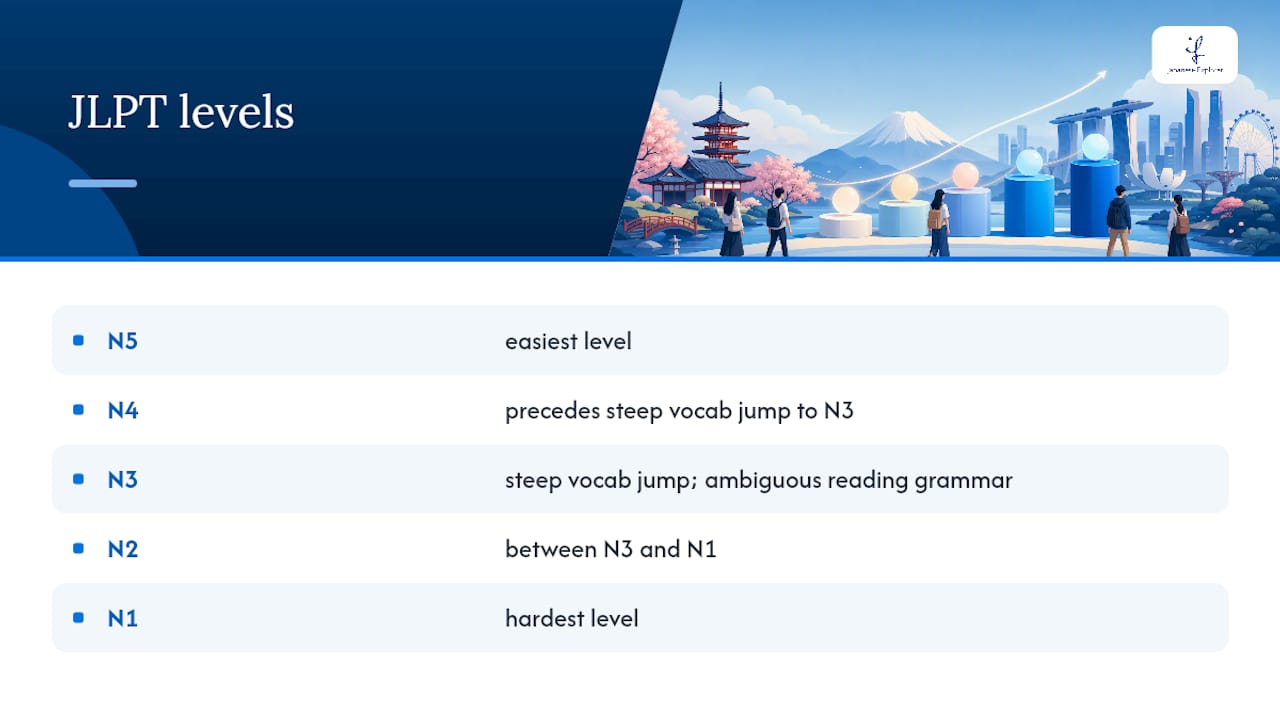
There are five levels, N5 (easiest) through N1 (hardest). Choosing the right one from the start saves you months of misaligned study.
Study-hour estimates reflect level-specific guidance for learners starting from zero at each level. If you already have some Japanese background, your actual prep time will be shorter. Not sure where you stand? A Japanese language placement test can pinpoint your current level before you register.
N3 is often the most underestimated level. The vocabulary jump from N4 to N3 is steep, and the reading passages introduce ambiguous grammar that trips up learners who relied on pattern memorization at lower levels.
How is the JLPT structured, and how does scoring work?
Every level has three scored sections, though the content and timing shift as difficulty increases.
- Language Knowledge (Vocabulary): Tests kanji reading, vocabulary meaning, and contextual word use.
- Language Knowledge (Grammar) + Reading: Covers grammar patterns, sentence completion, and reading comprehension passages.
- Listening: Audio-based questions testing comprehension of conversations and announcements.
Official test-section guidelines list the approximate listening times per level: N1 is 55 minutes, N2 is 50 minutes, N3 is 40 minutes, N4 is 35 minutes, and N5 is 30 minutes. Total test time (all sections combined) ranges from roughly 105 minutes at N5 to 170 minutes at N1.
Scoring uses a scaled system, not a raw percentage. Each section has its own minimum passing score, and passing requires meeting both the overall pass mark AND each sectional minimum. A strong vocabulary score cannot compensate for a failing listening section. This is the rule that surprises the most test-takers: you can score high overall and still fail if one section falls below its floor.
Know your weak section early. Many learners discover during mock exams that listening is their lowest score, not grammar. Identify that gap in month one, not the week before the test.
How do you register for the JLPT in Singapore?
Registration goes through JCSS, not directly through jlpt.jp. Here is the step-by-step process:
- Visit the JCSS website and locate the current registration announcement for the upcoming session.
- Create or log in to your JCSS account (new applicants will need to register a profile first).
- Select your level and session (July or December), then complete the online application form.
- Upload a passport-sized photo that meets the specified dimensions and background color requirements.
- Pay the registration fee via the accepted payment methods listed on the JCSS site (credit card or bank transfer are common options; confirm the current accepted methods on their page).
- Receive your test voucher or admit slip by email or post, which confirms your test center and seat number.
- Check your assigned test center and plan your travel route in advance.
Required documents at registration:
- Valid photo ID (NRIC, passport, or Employment Pass) — the name must match your registration exactly.
- Passport-sized photo per JCSS specifications.
- Payment confirmation.
Special testing accommodations (for learners with disabilities or medical conditions) must be requested during the registration window, not after. Contact JCSS directly with supporting documentation as early as possible, since approval requires time and may involve coordination with the Japan Foundation.
Where is the JLPT held in Singapore, and what are the test-day rules?
JCSS assigns test centers based on your registration details. The specific venue is confirmed on your admit slip, so do not assume a location until you receive that document. Historically, test centers have been at educational institutions across Singapore, but JCSS may change venues between sessions.
What to bring on test day:
- Your printed admit slip or test voucher.
- The same photo ID you used during registration.
- Pencils (2B recommended) and an eraser — pens are not permitted for answer sheets.
- A watch (non-smartwatch; analog or basic digital).
What is strictly prohibited:
- Mobile phones and any electronic devices that are not powered off and stored away.
- Dictionaries, notes, or any reference materials.
- Food or drinks inside the examination room.
- Smartwatches or any wearable with a display.
Test security procedures are strict at all overseas sites. Devices must be powered off before entering the exam room. Invigilators may ask you to place your phone in a bag at your feet or in a designated area. Ignoring this instruction can result in disqualification.
Pro Tip: Arrive at least 30 minutes before the stated start time. Late entry is typically not permitted once the test begins. Map your route the week before, including MRT and bus options, so a train delay does not cost you your seat.

What does the JLPT cost in Singapore, and how do certificates work?
JCSS sets the registration fee for Singapore test-takers. Fees are not published on jlpt.jp for overseas sites; you need to check the JCSS website directly for the current amount in Singapore dollars. Fees have typically been in the range of SGD 60–100 per session, but verify the exact figure before registering since this can change.
Key points on payment and certificates:
- Payment is non-refundable in most cases. Cancellations and rescheduling are generally not permitted once registration closes. Confirm the JCSS cancellation policy before you pay.
- Score reports for overseas test-takers are issued several months after the test date and are sent by post to the address on your registration.
- Certificates confirming your level are mailed separately after results are published.
- Duplicate certificates can be requested through the official JLPT site if your original is lost or damaged. A fee applies for duplicate issuance; details and the request process are listed on jlpt.jp.
- CEFR cross-reference: jlpt.jp publishes a reference table mapping JLPT levels to Common European Framework of Reference (CEFR) levels, which is useful if you need to present your Japanese language certification to employers or academic institutions that use the CEFR scale.
What are the best study materials for JLPT preparation?
Start with the official source. The JLPT publishes free sample questions by level at jlpt.jp. These are not just practice problems; they show you the exact item types, instructions, and answer-sheet format you will encounter on test day. Working through them first tells you whether your target level is realistic before you invest in textbooks.
Recommended resources by type:
- Official JLPT Sample Questions (jlpt.jp): Free, level-specific, and the most accurate representation of real test items. Use these before anything else.
- Anki (spaced repetition flashcard app): Best for building vocabulary and kanji recognition. Pre-built JLPT decks are available for every level.
- Nihongo So-Matome series: Compact, level-specific workbooks covering grammar, vocabulary, kanji, and reading. Popular among N3–N1 learners for their structured weekly format.
- Shin Kanzen Master series: More rigorous than So-Matome; preferred by N2 and N1 candidates who want deeper grammar and reading practice.
- Migaku: A browser extension and learning platform that integrates spaced repetition and immersion-based study into real Japanese content, useful for building listening comprehension alongside formal study.
- JLPT Sensei (jlptsensei.com): Free online grammar lists and practice questions organized by level.
Where to find materials in Singapore:
- Kinokuniya (Ngee Ann City): Stocks Nihongo So-Matome, Shin Kanzen Master, and other Japanese-language study books.
- Popular Bookstore: Carries a smaller selection of JLPT prep books.
- Amazon.co.jp (shipped to Singapore): Wider selection, often cheaper for Japanese-published titles.
- National Library Board (NLB): Some branches carry Japanese-language learning materials; check the NLB catalogue online.
How should you build an effective JLPT study plan?
The most common mistake is treating all four skills equally from day one. A smarter approach sequences your study by the test’s own structure and your personal weak points.
12-week plan (N4/N5 target):
- Weeks 1–3: Complete all official sample questions for your level; identify gaps in vocabulary and grammar.
- Weeks 4–6: Daily Anki reviews (20–30 new cards/day) + one grammar chapter per day from So-Matome.
- Weeks 7–9: Add timed reading passages (15 minutes per session) and daily listening practice using NHK Web Easy or level-appropriate audio.
- Weeks 10–11: Two full mock exams under timed conditions; review every wrong answer.
- Week 12: Light review only. No new material. Focus on sleep and logistics.
6-month plan (N2/N1 target):
- Months 1–2: Vocabulary foundation using Anki (target 30–50 new words/day) + Shin Kanzen Master grammar.
- Months 3–4: Intensive reading practice with graded readers, then native materials (news articles, essays). Add one listening session daily.
- Month 5: Weekly mock exams. Track section scores to spot the weakest area and double down there.
- Month 6: Final review, timed practice, and logistics prep.
Practice-test routines, spaced repetition, and timed mock exams consistently produce the best results across all levels. The key is consistency over intensity: 45 focused minutes daily beats a four-hour weekend cram session.
Pro Tip: In the final month, do at least two full mock exams at the same time of day as your actual test. Your brain performs differently at 9 AM than at 8 PM, and training your focus for the real test window makes a measurable difference.
For a more structured approach, Japanese Explorer’s guide on creating a Japanese study plan walks you through building a personalized schedule that fits your weekly hours and target level.
The JLPT is a milestone, not the whole map
Passing the JLPT is genuinely worth pursuing. It signals to employers, universities, and yourself that your Japanese has reached a measurable standard. N2 in particular opens doors in Japanese corporate environments and is increasingly listed as a hiring requirement for roles in Singapore’s Japan-linked business sector.
But here is what the certificate does not tell you: whether you can hold a real conversation, read a novel for pleasure, or navigate a meeting in Tokyo without freezing. The JLPT tests reading and listening comprehension under controlled conditions. Speaking and writing are not assessed at all. Learners who study exclusively for the test sometimes pass N2 while still struggling to introduce themselves naturally in Japanese.
The most effective approach combines structured test prep with real-world exposure. Read native materials. Watch Japanese content without subtitles. Find conversation practice. The JLPT itself acknowledges that the certification should be complemented with genuine language use to reach conversational fluency. Use the exam as a checkpoint, not a destination.
Japanese Explorer supports your JLPT preparation in Singapore
Studying for the JLPT on your own is possible, but having a structured class keeps you accountable and fills the grammar gaps that self-study tends to miss. Japanese Explorer offers JLPT preparation courses in Singapore designed for adult learners targeting N5 through N2, taught by certified bilingual instructors who know exactly where each level trips people up.

Classes run in small groups for focused feedback, and online Japanese courses via Zoom are available if you prefer to study from home. The school is located at 10 Anson Road, Level 22, International Plaza, Singapore 079903, right above Tanjong Pagar MRT. Not sure which level to target? Take a placement test to find your starting point, then enroll in the course that matches your July or December exam goal.
Sources
- JLPT Japanese-Language Proficiency Test
- JLPT Study Guide: How to Prepare for Japanese Language Proficiency Test
- Japanese Study Plan for JLPT: N5 to N1 Level-by-Level Guide | JP YoKoSo
FAQ
What is the JLPT, and what are the N1 through N5 levels?
The Japanese-Language Proficiency Test (JLPT) is an internationally recognized Japanese language certification with five levels: N5 (basic) through N1 (near-native). Each level tests vocabulary, grammar, reading, and listening comprehension, with no speaking or writing component.
Is the JLPT exam difficult?
Difficulty depends entirely on your target level. N5 and N4 are manageable with consistent study over a few months, while N2 and N1 require hundreds of hours of preparation and exposure to complex, native-level Japanese.
Can you skip N5 and go straight to N4?
Yes. There is no requirement to pass lower levels before registering for a higher one. Take a placement test to assess your current level, then register for whichever level matches your ability.
How much does the JLPT exam cost in Singapore?
Fees are set by JCSS and are not listed on jlpt.jp. Check the JCSS registration page directly for the current Singapore fee in SGD before applying, as amounts can change between sessions.
How do you pass the JLPT?
You must meet the overall pass mark and the minimum score for each individual section. A high total score does not compensate for a failing section, so balanced preparation across vocabulary, grammar, reading, and listening is the only reliable strategy.