
If you want conversational fluency, a live small group or private class gets you speaking fastest. If you’re chasing JLPT certification, a structured term-based course with a clear syllabus keeps you on track. If you’re a busy professional, a blended format combining live online sessions with self-study fits around your calendar without sacrificing progress.
TL;DR:
- Most learners can reach basic JLPT N5 level with around three months of consistent weekly study, but higher levels require longer-term commitment.
- Aligning class type with your goals is crucial, as in-person group classes maximize speaking, while private lessons offer flexibility for tight schedules.
- Choosing a program with a clear syllabus mapped to recognized standards like JLPT levels ensures realistic outcomes and progress tracking.
- Proper placement tests and experienced instructors with relevant background are essential for avoiding mismatched levels and ensuring effective learning.
- Flexibility in scheduling, make-up policies, and support outside class hours significantly impact your ability to stay consistent and see measurable results.
Table of Contents
- What Types of Japanese Class Are Available?
- How Do Class Levels Map to JLPT?
- How Do You Choose the Right Class?
- What Do Japanese Classes Cost and How Are They Scheduled?
- How Do You Start Taking Japanese Lessons?
- Why Japanese Explorer Works for Adult Learners
- Do Classes Include Cultural Immersion or Extra Activities?
- What Should You Look for in an Online Learning Platform?
- Does the Institution’s Curriculum Quality Matter?
- What Support Do You Get Outside of Class Time?
- What Happens if You Miss a Class?
- The Real Bottleneck Isn’t the Class Format
- Ready to Book Your Japanese Class?
- Where to Learn More
- Sources
- FAQ
What Types of Japanese Class Are Available?
Five formats dominate the market, and each solves a different problem.
- In-person group classes typically have a moderate number of students with a live instructor, maximizing speaking practice and peer motivation.
- Private lessons offer one-on-one attention, ideal for learners with a specific deadline (an upcoming business trip, a JLPT exam) or an unusual schedule.
- Live online group classes replicate the classroom experience over Zoom, keeping interaction high while cutting commute time to zero.
- Online self-study courses, like JF Japanese e-Learning Minato, let you work through grammar and vocabulary at your own pace with occasional instructor support.
- Corporate training brings a Japanese class directly to a company’s staff, usually customized around workplace vocabulary and meeting etiquette.
Group formats win on speaking time and cost efficiency. Private and corporate options win on flexibility and pacing. The right pick often depends on whether you need accountability or independence more.
How Do Class Levels Map to JLPT?
Beginner courses build reading of hiragana and katakana, basic greetings, and simple present tense sentences. Intermediate levels introduce kanji, past and conditional forms, and more natural conversation flow. Advanced classes tackle formal register, nuanced grammar, and business or academic reading.
Most schools align their internal levels loosely with the JLPT scale, which runs from N5 (basic) to N1 (near native). A typical mapping looks like this:
| Course Stage | Approximate JLPT Level | Common Textbook |
|---|---|---|
| Beginner 1 to 2 | N5 | Genki I |
| Beginner 3 to Intermediate 1 | N4 | Genki II |
| Intermediate 2 to 3 | N3 | Marugoto (Intermediate) |
| Advanced | N2 to N1 | Marugoto, JF Standard materials |
The Japan Foundation frames adult learning around two tracks: “Katsudoo,” a practical communication path, and “Rikai,” a systematic study path. Choosing between them early saves months of mismatched effort.
Pro Tip: If your main goal is passing the JLPT, prioritize a Rikai-style course with grammar drilling. If you just want to survive a trip to Osaka, a Katsudoo-style conversational class gets you there faster.
With one term of weekly attendance, most learners move from absolute beginner to a solid N5 foundation. Reaching N3 typically takes multiple consecutive terms of consistent study, since kanji recognition and grammar complexity both jump significantly at that stage.
How Do You Choose the Right Class?
Not every course that calls itself a “Japanese class” delivers the same outcome. Run through this before enrolling:
- Confirm there’s a placement test or level guide, since placement testing is standard practice among schools serious about correct level placement.
- Ask about the teacher’s background: native or bilingual fluency, plus real classroom experience, matters more than a flashy brochure.
- Check class size. Anything over 15 students in a “conversational” class usually means limited speaking time per person.
- Compare the syllabus against JLPT levels or a recognized course structure so you know exactly what you’ll be able to do by the end of term.
- Ask whether a trial lesson is available before you commit to a full term.
Sample questions worth asking directly: “How many students per class?” and “Which textbook do you use, and what will I be able to do by the end?”
Red flags include no placement test, vague promises like “become fluent fast,” and pricing that only reveals extra fees after you’ve signed up.
What Do Japanese Classes Cost and How Are They Scheduled?
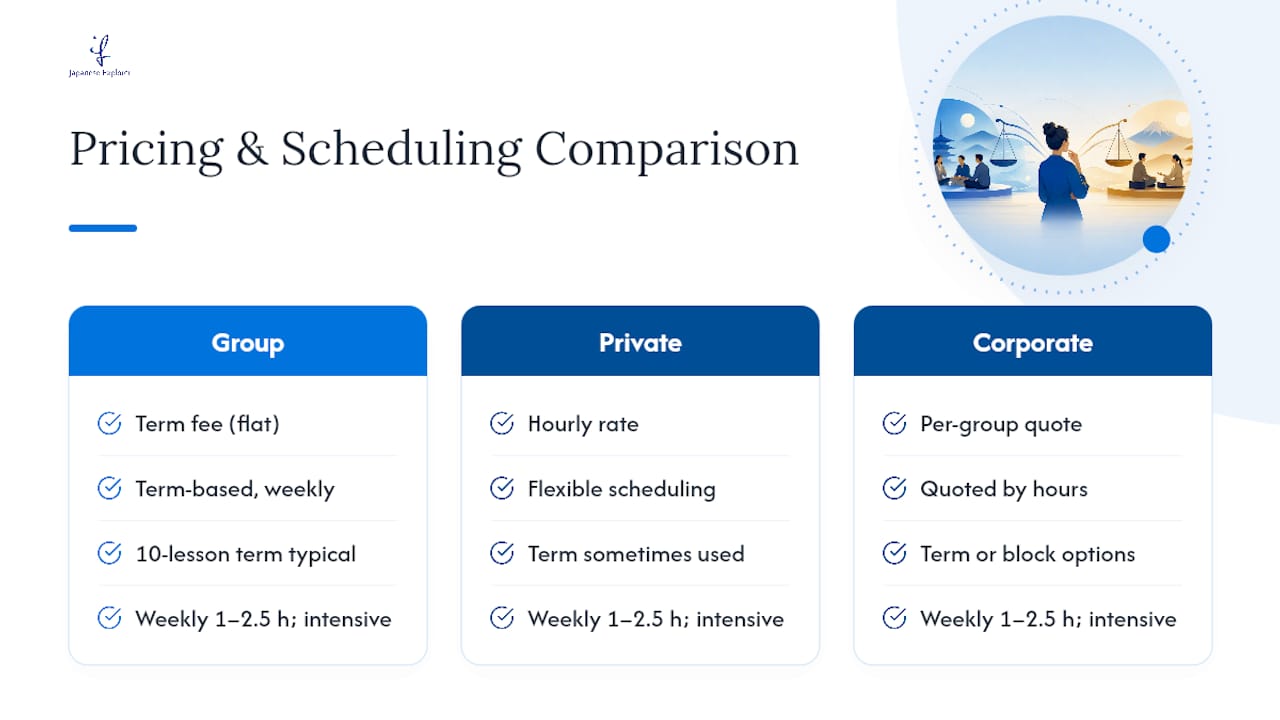
Most schools run on a term system, commonly 10 lessons per term, with weekly sessions lasting one to two and a half hours. Intensive options exist for learners who want to compress a term into a few weeks.
Pricing generally follows three patterns: group classes charge a flat term fee, private lessons charge hourly, and corporate training is quoted per group based on hours and customization. Course listings across Singapore confirm that term-based in-person and online adult courses are the dominant model in this market, which makes budgeting around a per-term fee more realistic than trying to price a single lesson.
Before paying, check three things: whether the term price is pro-rated if you join late, whether textbooks and JLPT exam registration are billed separately, and what the policy is if you need to transfer terms or request a refund.
How Do You Start Taking Japanese Lessons?
Getting from “interested” to “enrolled” takes three steps.
- Take a placement test or level guide. This is a short assessment, often 15 to 30 minutes, that places you accurately instead of guessing based on how many anime episodes you’ve watched.
- Pick your format and term. Decide between group, private, online, or corporate based on your schedule and speaking goals, then confirm the next term’s start date.
- Confirm cost, schedule, and materials. Get the textbook list and check if you need to buy it separately or if it’s bundled into the term fee.
For live online classes, a quick tech check saves your first lesson from turning into a troubleshooting session: stable internet, a working webcam and headset, and Zoom installed and tested beforehand.
Why Japanese Explorer Works for Adult Learners
The curriculum can be structured around an approach that blends grammar, listening, and speaking into every lesson rather than treating them as separate skills.
- Instructors may be bilingual and experienced, focusing on real-world communication rather than rote memorization.
- Formats can include group, private, and online classes, so the schedule may dictate the format.
- A placement test at the start can help ensure you are placed at an appropriate level to avoid already mastered or overly advanced content.
- The training center is located at 10 Anson Road, Level 22, International Plaza, Singapore 079903, directly above Tanjong Pagar MRT, making in-person attendance straightforward for anyone working in the city center.
The combination of a clear curriculum framework and flexible delivery is what separates a class that produces real conversational ability from one that just fills a time slot.
Do Classes Include Cultural Immersion or Extra Activities?
A grammar textbook teaches you to conjugate verbs. It doesn’t teach you when to bow, how to read the mood at a business dinner, or why silence in a conversation isn’t always awkward. That’s where supplementary activities earn their place alongside the core curriculum.
Many adult programs pair standard lessons with language exchange sessions, where learners practice with native speakers in a low-pressure, conversational setting rather than a graded classroom exercise. Cultural workshops covering topics like tea ceremony etiquette, seasonal festivals, or business card exchange norms give context that textbooks tend to skip entirely.

These extras matter more than they sound. A learner who can conjugate perfectly but freezes during an actual introduction at a Tokyo trade show hasn’t fully succeeded. Cultural fluency and language fluency develop together, not separately, and the strongest adult courses treat them that way.
When evaluating a school, ask whether cultural events or exchange meetups happen regularly or only around major holidays. A once-a-year cultural festival is a nice bonus. Monthly or term-based exchange opportunities are a genuine learning tool that reinforces classroom material in a setting where mistakes carry lower stakes than a formal test.
What Should You Look for in an Online Learning Platform?
The platform behind a live online Japanese class matters almost as much as the teacher standing in front of the camera. A clunky interface turns a 90-minute lesson into 20 minutes of technical troubleshooting.
Look for a few basics before enrolling. The video platform should support breakout rooms, since pair or small-group speaking practice is where most real progress happens in a live class. Screen sharing needs to be smooth enough for an instructor to display kanji stroke order or grammar charts without lag. Chat function matters too, since many learners type unfamiliar words during class to look up later.
Required devices are minimal. A laptop or tablet with a working camera and microphone covers most needs, though a dedicated headset improves audio clarity considerably, especially for picking up subtle pronunciation differences. A self-paced learning component, where you review recorded material between live sessions, works best when the recordings are actually accessible afterward, not just streamed once and gone.
Interactive features like digital whiteboards, polling for quick vocabulary checks, and shared documents for collaborative exercises separate a genuinely engaging online course from a webinar where you mostly watch and take notes.
Does the Institution’s Curriculum Quality Matter?
Curriculum quality is harder to judge from a website than teacher credentials, but it’s arguably more important, since even a great teacher struggles to compensate for a disorganized syllabus.
Look for programs that align with recognized frameworks rather than an ad-hoc mix of worksheets. The Marugoto Japanese Online Course, developed by the Japan Foundation, follows the JF Standard and structures content around the same Katsudoo and Rikai pathways mentioned earlier, giving learners a transparent sense of what each level actually covers. Schools that reference familiar textbooks, Genki, Minna no Nihongo, or Marugoto, give you an external benchmark to check progress against, rather than relying on the school’s own internal claims.
Ask directly what standard the syllabus maps to, and whether it corresponds to JLPT levels. A course that can’t answer this clearly, or that dodges the question with vague language about “our proprietary method,” deserves more scrutiny before you commit a full term’s fee.
What Support Do You Get Outside of Class Time?
Progress in a language rarely happens only inside the scheduled lesson. What happens between classes often determines whether material sticks or evaporates by the following week.
Reasonable support to expect includes access to a tutor or instructor for quick questions outside class hours, even if it’s limited to email or a messaging channel rather than unlimited calls. Some programs offer optional conversation clubs or study groups where learners from different class sections practice together, which reinforces material without adding formal lesson time.
Feedback mechanisms matter more than they get credit for. A class that gives you a quiz grade with no explanation teaches you less than one that flags specific pronunciation or grammar patterns to work on. Ask whether instructors provide individual feedback during or after group lessons, since larger classes sometimes default to generic corrections that don’t address your specific gaps.
Forums or online communities, even informal ones, help too. Being able to ask “why does this particle change here?” and get an answer within a day beats waiting until the next scheduled class to clarify confusion that’s been nagging at you all week.
What Happens if You Miss a Class?
Adult learners have jobs, family obligations, and travel schedules that occasionally collide with a fixed class time. How a school handles a missed session says a lot about whether it’s built for real adult life or just theoretical convenience.
Ask specifically about make-up lesson policies before enrolling, not after you’ve already missed something. Reasonable policies include the ability to join a different section at the same level during the same week, access to a recorded version of the missed lesson, or a documented catch-up session with the instructor.
Rigid attendance policies with no flexibility tend to punish exactly the working professionals who most need a Japanese class that respects their schedule. On the other hand, unlimited free rescheduling with no structure at all can water down the group dynamic that makes live classes valuable in the first place. The better programs strike a middle ground: reasonable flexibility paired with a clear process, rather than either extreme.
The Real Bottleneck Isn’t the Class Format
Most guides treat format selection as the hardest decision in learning Japanese. It isn’t. The harder problem is consistency, and no class format fixes that on its own.
A live group class forces a weekly commitment, which works well for learners who need external structure. Self-study platforms hand you total flexibility, which quietly becomes a trap for anyone who hasn’t built a study habit yet. The conventional advice, “just pick whichever fits your schedule,” skips the more useful question: which format will you actually show up for, week after week, for six months straight?
JLPT prep gets oversold as a pure grammar exercise, too. Grammar matters, but listening comprehension is where most N3 and N2 candidates lose points, and that skill only improves through actual spoken practice, not textbook drilling alone.
If there’s one thing to prioritize first, it’s this: pick the format that matches your actual behavior, not your aspirational schedule. A packed calendar that skips self-study every week does less for you than a slower, live-taught class you never miss.
— Paul
Ready to Book Your Japanese Class?
The school provides a direct path from decision to enrollment, aiming to reduce the guesswork in choosing courses. Every course, whether it’s a small group class, a live online course, or a private lesson, starts with a placement test so you’re never sitting through material below or above your actual level.
If your goal is business fluency for client meetings, the Business Japanese Course maps directly to workplace scenarios rather than generic textbook dialogue. Prefer face-to-face instruction in the city center? The training center at 10 Anson Road, Level 22, International Plaza, is located right above Tanjong Pagar MRT, making it an easy stop before or after work. Book a placement test today, pick the format that fits how you actually study, and start your next term with a class built around your goals instead of a one-size-fits-all syllabus.
Where to Learn More
- JF Japanese e-Learning Minato: free, flexible online modules for practical daily grammar and vocabulary.
- Japan Foundation learner resources: explains the JF Standard and the Katsudoo/Rikai learning tracks.
- Marugoto Japanese Online Course: official Japan Foundation curriculum for starter-level online study.
- Japan Society language center: example of term-based course scheduling at an established institution.
Sources
- JF Japanese e-Learning Minato
- Japan Foundation learner resources (JF Standard)
- Marugoto Japanese Online Course (Marugoto-online)
- MySkillsFuture course search — Japanese language
FAQ
How Much Do Japanese Lessons Cost?
Pricing varies by format: group classes are typically billed per term (around 10 lessons), private lessons are billed hourly, and corporate training is quoted based on group size and hours. Course listings on MySkillsFuture show term-based pricing is the standard model for adult courses.
Can You Learn Japanese in Three Months?
You can build a solid beginner foundation, roughly N5 level basics like hiragana, katakana, and simple sentence patterns, in three months of consistent weekly study. Reaching conversational fluency or higher JLPT levels takes considerably longer and depends heavily on regular practice outside of class.
What Do N1 Through N5 Mean in Japanese?
N5 through N1 are the five levels of the Japanese Language Proficiency Test, with N5 covering basic phrases and N1 representing near native comprehension of complex, nuanced Japanese. Most adult courses map their internal levels to this scale so learners can track progress against a recognized benchmark.
Are Japanese Classes Worth the Investment?
For most adult learners, structured classes are worth it because they provide accountability, corrected feedback, and speaking practice that self-study alone rarely delivers. A class with a proper placement test and clear level outcomes tends to produce faster, more measurable progress than an unstructured app-only approach.