
The fastest way to learn a new language combines three things: comprehensible input (listening and reading just above your current level), spaced repetition vocabulary review, and early low-stakes speaking practice. Start all three on day one, and you will see measurable progress within a week. According to a 2024 evidence-based guide, combining these three pillars produces the fastest and most durable gains of any approach tested.
Your 7-day starter routine: spend 15 minutes on graded listening, 10 minutes on flashcard review with an SRS app like Anki, and 5 minutes speaking aloud, either to yourself or a language partner.
Start today with these three actions:
- Download Anki or a similar SRS app and load a high-frequency word deck for your target language.
- Find one piece of graded audio or video content pitched just above your current level (a beginner podcast, a graded reader, or a subtitled short clip).
- Say five sentences out loud in your target language before you go to bed tonight, even if they are imperfect.
Key Takeaways
The fastest path to conversational ability combines daily comprehensible input, spaced repetition vocabulary review, and early speaking practice, all sustained for at least 90 days at 5–7 hours per week.
| Point | Details |
|---|---|
| Start all three pillars on day one | Combine graded input, SRS review, and speaking practice from the very first session. |
| Aim for 5–7 hours per week | Distribute study across short daily blocks rather than long weekend sessions for better retention. |
| Prioritize the top 1,000–2,000 words | High-frequency vocabulary covers roughly 85% of everyday conversation and delivers the fastest communicative payoff. |
| Speak before you feel ready | Early output forces retrieval under pressure, which is one of the strongest memory-consolidation mechanisms available. |
| Use milestones, not just hours | Track observable outcomes (500 active words, a 10-minute free conversation) to measure real progress weekly. |
Table of Contents
- How do you build a 30- and 90-day plan to learn fast?
- Why do the highest-impact techniques actually work?
- How do you build vocabulary fast with a frequency-first approach?
- How do you start speaking fast and improve your listening?
- What are realistic timelines for fast language learning?
- What mindset mistakes slow down language learners?
- Which apps and resources actually speed up language learning?
- Why do structured classes speed up rapid progress?
- The one approach I’d recommend for motivated beginners
- Sources
- FAQ
How do you build a 30- and 90-day plan to learn fast?
A structured schedule is what separates learners who plateau after two weeks from those who hold a real conversation at the 90-day mark. The key is short, repeatable blocks rather than marathon study sessions.
Your daily time blocks
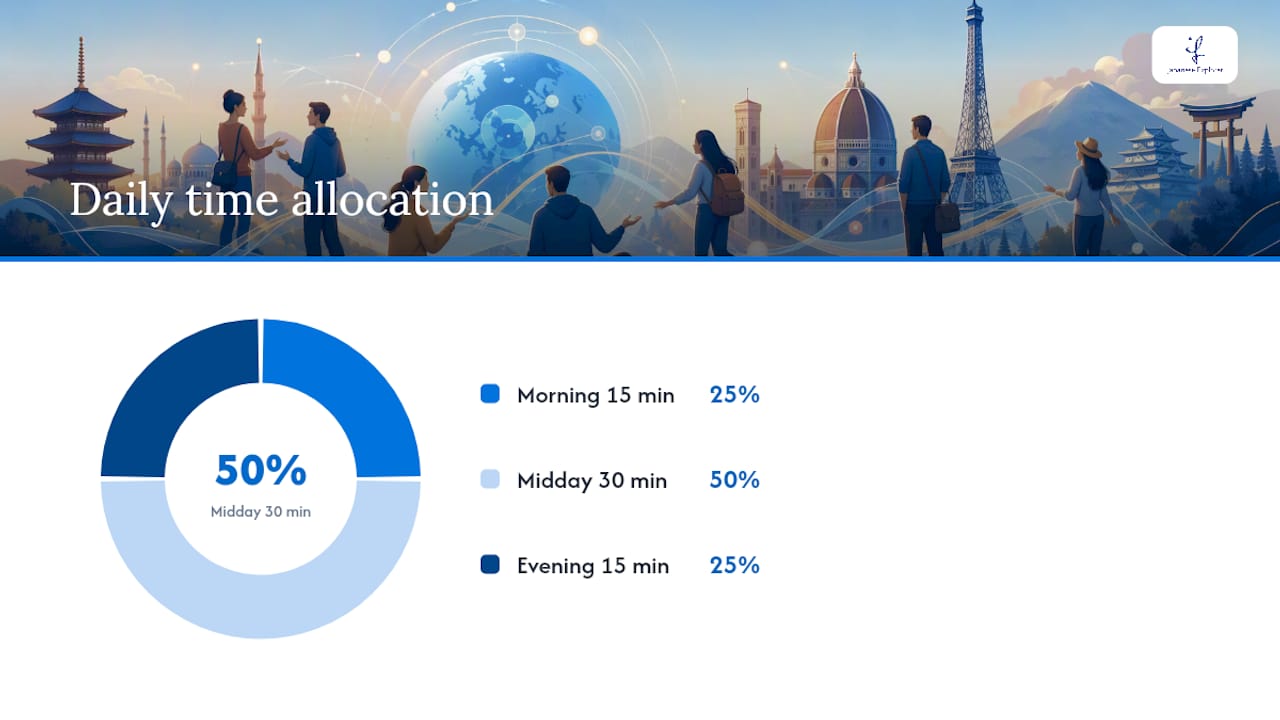
A practical daily routine that mixes comprehensible input, active output, and short SRS review creates visible progress fast and sustains motivation. The evidence-backed 15/30/15 structure works like this:
- 15 minutes: Comprehensible input (graded podcast, short video, or graded reader at your level).
- 30 minutes: Active study (new vocabulary in context, grammar patterns through example sentences, sentence mining).
- 15 minutes: SRS review (Anki or similar) plus 5 minutes of speaking practice (read sentences aloud, record yourself, or chat with a partner).
That totals roughly one hour per day, which puts you at 5–7 hours per week, the minimum effective dose for visible progress.
Sample week schedule
| Day | Morning (15 min) | Midday (30 min) | Evening (15 min) |
|---|---|---|---|
| Monday | Graded podcast | New vocabulary + sentence mining | SRS review + speak 5 sentences |
| Tuesday | Short native clip (subtitled) | Grammar pattern practice | SRS review + shadowing drill |
| Wednesday | Graded reader | New vocabulary + sentence mining | SRS review + speak 5 sentences |
| Thursday | Graded podcast | Conversation template practice | SRS review + record yourself |
| Friday | Short native clip | Grammar + sentence mining | SRS review + speak 5 sentences |
| Saturday | Native audio (no subtitles) | Language exchange or tutor session | Light SRS review |
| Sunday | Rest or light review | Review week’s vocabulary | Self-test: 5-minute free talk |
30-day and 90-day goals
30-day targets:
- Learn 300–500 high-frequency words using SRS.
- Master 20–30 survival phrases (greetings, directions, ordering food, asking for help).
- Hold a 2-minute scripted conversation with a partner or tutor.
- Understand the basic sentence structure of your target language.
90-day targets:
- Reach 1,000–1,500 active vocabulary words.
- Sustain a 10-minute unscripted conversation on familiar topics.
- Follow a native-speed audio clip on a familiar subject with roughly 60–70% comprehension.
- Pass a self-test on core grammar patterns (present, past, question forms, negation).
The Coursera language learning guide recommends combining tools, tutors, and graded input in exactly this kind of layered daily routine for steady retention.
Why do the highest-impact techniques actually work?
Most people try to learn a language the way they learned it in school: grammar rules first, then vocabulary lists, then maybe some conversation. That order is backwards for speed. Here is what the research says works, and why.
Comprehensible input and the “i+1” principle
Comprehensible input means content you can mostly understand, with a small portion that stretches you. Linguist Stephen Krashen’s “i+1” framing captures this: your input should be at your current level (i) plus one step beyond. Too easy and you stop acquiring; too hard and you stop comprehending.
BBC Future’s review of language research shows that immersion-style, cross-situational learning produces rapid initial gains by letting the brain extract statistical regularities from repeated exposure. You do not need to be in the country. Graded podcasts, subtitled series, and leveled readers all deliver this effect. Academic research into cross-situational learning confirms that learners can infer word meanings from repeated exposure in variable contexts, which is exactly what graded media provides.
Spaced repetition systems (SRS)
SRS apps like Anki schedule each flashcard review at the moment you are about to forget it, which means you spend review time on the words that need it most. Massed review (cramming a list once) produces short-term recall. SRS produces long-term retention with a fraction of the time investment.
The key to making SRS work long-term is pairing it with content you actually care about. Pair SRS with stories, dialog sentences, or media you enjoy so review persists rather than becoming a chore you skip.
Pro Tip: Build your Anki cards from sentences you encounter in your graded input, not from abstract word lists. A card showing “I missed the train” in context beats a card showing the bare word “miss” every time.
Early output: speak before you feel ready
Waiting until you feel “ready” to speak is the single most common reason learners plateau. Chris Lonsdale’s 7 Actions method recommends mixing production early, focusing on meaning before perfect grammar, and using a “language parent” (a patient native speaker who corrects gently) to build low-anxiety output habits from week one.
Early speaking does two things grammar study cannot: it forces you to retrieve vocabulary under pressure, which strengthens memory, and it reveals exactly which gaps matter for real communication.
Pronunciation and shadowing
Shadowing means listening to a native speaker and repeating their speech simultaneously, matching rhythm, stress, and intonation. A short 5-minute shadowing drill each day builds production accuracy faster than pronunciation drills in isolation. Research into phonological acquisition supports the idea that early attention to prosody and sound patterns accelerates listening comprehension as well as speaking accuracy.

How to combine techniques in one session
A clean study-flow for a 60-minute session:
- Minutes 1–15: Listen to graded content. Note 5–10 new words or phrases.
- Minutes 16–40: Study those words in sentence context. Mine 3–5 sentences for your SRS deck.
- Minutes 41–50: SRS review of existing cards.
- Minutes 51–60: Speak aloud. Shadow one short clip or run a 5-minute conversation drill.
How do you build vocabulary fast with a frequency-first approach?
The single fastest vocabulary gain comes from targeting the words you will actually use, not the words that appear in a textbook’s thematic unit on “farm animals” or “office furniture.”
Why the top 1,000–2,000 words matter most
High-frequency word lists give you the most communicative coverage per hour of study. The top 1,000 words in most languages cover roughly 85% of everyday spoken conversation. Everything beyond that is diminishing returns until you have the core locked in.
Chris Lonsdale’s method makes this point directly: high-frequency lists are efficient, but the fastest gains come from words and phrases you will actually use in your daily life. A business professional needs “meeting,” “deadline,” and “proposal” before they need “butterfly” or “medieval.”
Practical steps to build your personal word list
- Start with a pre-built high-frequency deck (Anki has free community decks for most major languages).
- Add words you encounter in your graded input, not random words from a dictionary.
- Write each new word in a full sentence that reflects how you would actually use it.
- Review with SRS daily, targeting 10–20 new words per session.
For Japanese specifically, building vocabulary fast and effectively means prioritizing kanji compounds and common verb patterns early, since these unlock large clusters of related vocabulary at once.
A short phrase bank for immediate use
These phrase types give you the highest communicative return in the first 30 days:
- Greetings and small talk: hello, how are you, nice to meet you, see you later.
- Survival phrases: where is the bathroom, how much does this cost, I don’t understand, can you repeat that?
- Work and professional contexts: I have a meeting, can we reschedule, please send me the document.
- Connectors: because, but, so, and, also, however, I think that, I want to.
Pro Tip: Learn connectors early. “I want coffee because I’m tired” is a complete, natural sentence you can build from two vocabulary words and one connector. Connectors multiply the sentences you can produce without multiplying the words you need to know.
What to avoid
Thematic vocabulary lists (colors, days of the week, body parts) feel productive but deliver low communicative payoff unless you are a complete beginner. Once you know “red,” “blue,” and “green,” you rarely need “chartreuse” or “magenta” in week two. Spend that time on verbs, connectors, and question words instead.
How do you start speaking fast and improve your listening?
Speaking practice feels uncomfortable at first. That discomfort is the signal that your brain is working. Here is how to structure it so you get maximum correction with minimum wasted time.
Low-stakes speaking templates
The goal in the first 30 days is not fluency. It is production. Use these templates to get started:
- Sentence-replacement drills: Take a model sentence (“I go to work by train”) and swap one element at a time (“I go to school by bus,” “She goes to work by car”). This builds grammatical intuition without requiring you to generate sentences from scratch.
- Scripted dialogues: Write or download a short 10-line dialogue on a topic you need (ordering food, introducing yourself, asking for directions). Memorize it, then vary it.
- Role plays: Ask a language partner or tutor to play a specific scenario (a café, a job interview, a phone call). Constrained scenarios reduce anxiety and focus correction on useful vocabulary.
The role of speaking practice in language learning is well-documented: output forces retrieval, and retrieval under mild pressure is one of the most powerful memory-consolidation mechanisms available.
How to structure a 10–20 minute speaking session
- Warm up (2 minutes): Say 5 sentences you already know well. This activates the language in your brain before you push into new territory.
- Targeted practice (8–12 minutes): Work through your scripted dialogue or role play. Ask your partner to correct errors in real time or note them for review at the end.
- Free production (3–5 minutes): Drop the script. Talk about your day, describe a picture, or answer a question spontaneously.
- Error review (2 minutes): Go over the corrections from the session. Repeat each corrected sentence three times aloud.
Pro Tip: Record yourself during free production. Listening back reveals pronunciation and grammar errors you never notice in the moment, and it gives you a concrete record of progress to compare week over week.
Listening progression: from graded to native
Listening comprehension builds in stages. Jumping straight to native-speed content is the most common mistake beginners make.
- Stage 1: Graded podcasts and leveled readers (weeks 1–4). You should understand 70–80% without pausing.
- Stage 2: Native content with subtitles in your target language (weeks 4–8). Pause, rewind, and look up key phrases.
- Stage 3: Native content without subtitles, with active listening focus on rhythm, stress, and word boundaries (weeks 8 onward).
Understanding the role of listening in language mastery is what separates learners who plateau at “tourist level” from those who reach real conversational control. Active listening, where you focus on how words connect and where sentences begin and end, builds the comprehension circuits that later enable production.
Sources for corrective feedback
- Language parents: — a patient native speaker who corrects gently without interrupting flow, as recommended by Chris Lonsdale’s method.
What are realistic timelines for fast language learning?
“Fast” is relative, and it depends heavily on which language you are learning and how many hours you put in each week. Setting honest expectations prevents the discouragement that kills most learning attempts.
The U.S. Department of State’s Foreign Language Training programs provide the most widely cited institutional benchmarks. Their intensive programs classify languages into categories based on difficulty for English speakers:
- Category I languages (Spanish, French, Italian, Portuguese): roughly 600–750 classroom hours to reach professional working proficiency.
- Category II languages (German, Indonesian): roughly 900 hours.
- Category III languages (Russian, Hindi, Thai): roughly 1,100 hours.
- Category IV languages (Arabic, Chinese, Japanese, Korean): roughly 2,200 hours.
These are intensive, full-time program hours. For a self-learner doing 5–7 hours per week, the timeline stretches considerably, but the ratios hold: a Category I language will take roughly one-third the time of a Category IV language to reach the same level.
What “fast” actually looks like at 5–7 hours per week:
- 30 days: Survival conversation, 300–500 words, basic sentence construction.
- 90 days: Comfortable 10-minute conversation on familiar topics, 1,000+ active words.
- 6 months: Intermediate conversational control, ability to follow native media on familiar subjects.
Milestone checklist
Use these observable outcomes to measure real progress, not just hours logged:
- Can you introduce yourself and ask basic questions without pausing to translate in your head?
- Can you understand a graded podcast at your level without replaying more than twice?
- Can you write a 5-sentence message in your target language from memory?
- Can you hold a 10-minute conversation on a familiar topic without switching back to English?
- Have you reached 500 active vocabulary words (words you can produce, not just recognize)?
How to self-test weekly
Every Sunday, spend 5 minutes on a free-talk self-test: describe your week in your target language, record it, and note where you paused or switched to English. Compare recordings week over week. That gap between what you want to say and what you can say is your study priority for the coming week.
What mindset mistakes slow down language learners?
Progress stalls for predictable reasons. Knowing the traps in advance saves weeks of wasted effort.
The three most common traps
- Passive listening without active attention. Listening to a podcast while commuting and calling it “study” is one of the most widespread time-wasters in language learning. Listening must be active: focus on rhythm, stress, and word boundaries to build the comprehension circuits that later enable production. Background listening has almost no acquisition value on its own.
- Memorizing rare or thematic vocabulary too early. Spending week two on a list of 30 kitchen utensils when you cannot yet say “I need help” is a classic beginner mistake. Frequency first, always.
- Postponing speaking until you feel “ready.” There is no ready. The discomfort of early speaking is the mechanism, not an obstacle to it.
Motivation tactics that actually work
Staying consistent over 90 days is harder than any grammar rule. A few tactics that hold up in practice:
- Habit stacking: attach your SRS review to something you already do daily (morning coffee, commute, lunch break). The habit piggybacks on an existing routine and requires no willpower to initiate.
- Visible progress indicators: keep a simple log of your active vocabulary count and your weekly speaking minutes. Watching a number grow is more motivating than a vague sense of “getting better.”
- Micro-goals: instead of “I will be fluent in 3 months,” set “I will learn 10 new words today” and “I will speak for 5 minutes tonight.” Small wins compound.
For more on building and sustaining study habits, the motivation guide from Japanese Explorer covers practical tactics for keeping momentum through the inevitable slow weeks.
Pro Tip: When progress feels invisible, change the metric, not the method. If vocabulary count feels stuck, measure speaking minutes instead. A different lens often reveals progress you were not tracking.
When you hit a plateau
Plateaus usually mean one of three things: your input is too easy, your output is too scripted, or you are not getting enough corrective feedback. Try one of these fixes before abandoning your routine:
- Increase input difficulty by one level (move from graded podcasts to native content with subtitles).
- Add a weekly tutor session for targeted correction.
- Set a new micro-goal that forces production in an unfamiliar context (a new topic, a new scenario).
Which apps and resources actually speed up language learning?
Apps are powerful habit anchors and SRS delivery systems. They are not, on their own, a path to conversational fluency. Research and practical guides consistently show that apps build habit and basic vocabulary reliably through microlessons, but rarely produce conversational fluency without paired speaking practice.
The right question is not “which app is best?” but “which combination of tools covers input, output, and retention?”
Categories to prioritize
- SRS apps (retention): Anki (free, fully customizable), Kitsun (web-based, good for Japanese), or the built-in SRS in apps like WaniKani for Japanese kanji. These are your vocabulary backbone.
- Graded input (comprehension): Podcasts like JapanesePod101 or SpanishPod101, graded reader series (Extensive Reading Foundation), and YouTube channels with subtitles at your level.
- Speaking practice platforms (output): iTalki for tutor sessions, Tandem or HelloTalk for language exchange, or a structured class with a qualified teacher.
- Native media exposure: Netflix with target-language subtitles, YouTube in your target language, or podcasts for native speakers once you reach intermediate level.
How to evaluate any resource quickly
Ask three questions before committing time to a new app or course:
- Does it support spaced repetition or active recall?
- Does it give you corrective feedback on your output?
- Does it expose you to natural, contextual language rather than isolated words?
If the answer to all three is no, the resource is a supplement at best.
Prioritized resource list by learning goal
| Goal | Recommended resource type | Example tools |
|---|---|---|
| Vocabulary retention | SRS app with sentence cards | Anki, WaniKani (Japanese) |
| Listening comprehension | Graded podcasts, leveled video | JapanesePod101, graded YouTube |
| Speaking output | Tutor sessions, language exchange | iTalki, Tandem, HelloTalk |
| Grammar in context | Structured course or graded reader | Textbook + class, Extensive Reading Foundation |
| Native media exposure | Subtitled streaming, native podcasts | Netflix (target-language subs), Spotify |
For a broader look at tools and supplementary resources that work well alongside structured study, this guide on boosting your language learning covers practical combinations worth trying.
Why do structured classes speed up rapid progress?
Self-study works, but it has a ceiling. The three-element method (input, SRS, output) is most powerful when someone qualified is curating the input, monitoring your SRS gaps, and correcting your output in real time.
A structured class delivers something unguided self-study cannot: a corrective feedback loop that catches fossilized errors before they become habits. When you study alone, you tend to practice what you already know. A teacher pushes you into the territory just beyond your comfort zone, which is exactly where acquisition happens.
Structured lessons at Japanese Explorer integrate grammar, speaking, and listening in every session, taught by experienced bilingual and certified instructors who focus on interactive, real-world communication. The curriculum follows the Association for Japanese-Language Teaching framework, giving learners a sequenced, measurable path from beginner to advanced or business-level Japanese.
The practical advantages of a guided class over solo study come down to three things. First, the material is curated: you get comprehensible input at exactly the right level without spending time searching for it yourself. Second, accountability: a weekly class creates a deadline that solo learners rarely impose on themselves. Third, customization: a qualified teacher can identify your specific gaps (pronunciation, particle use, pitch accent) and address them directly, rather than leaving you to guess what to fix.
Pro Tip: Use your class sessions for output and correction, and your self-study time for SRS review and graded input. The two modes are complementary, not redundant. Class time is most valuable when you arrive having already reviewed the vocabulary.
For learners who want the structure of a class with the flexibility of remote study, online Japanese courses via Zoom offer the same instructor-led correction and curriculum without requiring you to be in a specific location. If you prefer in-person interaction and live in Singapore, small group Japanese classes at Japanese Explorer’s centre at 10 Anson Road, Level 22, International Plaza (right above Tanjong Pagar MRT) give you a live classroom environment with peers at the same level.
When to choose self-study over a class: if you are highly self-disciplined, have a clear learning goal, and can source quality corrective feedback through language exchanges or tutors, self-study can carry you to intermediate level. A class becomes especially valuable when you plateau, when you need professional-level language skills on a deadline, or when you want accountability built into your schedule.
The one approach I’d recommend for motivated beginners
If you are starting from zero and want the fastest reliable path to real conversation, the answer is not the most popular app or the thickest textbook. It is a structured class paired with daily SRS review and weekly speaking practice outside class.
Here is why. Most beginners underestimate how much time they waste making decisions: what to study today, which words to learn next, whether their pronunciation is close enough. A structured course with a qualified teacher eliminates those decisions. You show up, you get curated input at the right level, you get corrected, and you leave with a clear assignment. Your self-study time then becomes focused and efficient rather than scattered.
The one caveat: this approach requires consistency. A class you attend twice and then skip is worse than a self-study routine you maintain daily. If your schedule is genuinely unpredictable, a daily SRS habit plus a language exchange partner is a stronger foundation than an irregular class.
For learners who are highly independent and motivated, immersion-style self-study (graded input, Anki, and a weekly tutor session on iTalki) can produce strong results. But most beginners benefit from the guardrails a structured program provides, at least for the first 90 days.
Sources
- How to Learn a New Language Fast (Evidence-Based Guide 2026)
- Foreign language training | U.S. Department of State
- How to learn a new language
- Doi
FAQ
What is the fastest way to learn a new language?
The fastest approach combines comprehensible input at your level, spaced repetition vocabulary review, and early speaking practice, all practiced daily. A structured class with a qualified teacher accelerates this further by providing curated input and real-time corrective feedback.
How many hours does it take to learn a language?
It depends on the language. The U.S. Department of State’s training benchmarks estimate roughly 600–750 hours for Category I languages like Spanish or French, and around 2,200 hours for Category IV languages like Japanese, Arabic, or Mandarin. At 5–7 hours per week, reaching basic conversational ability in a Category I language typically takes 6–12 months.
What is the 15/30/15 method for language learning?
The 15/30/15 method structures a daily study session into three blocks: 15 minutes of comprehensible input (listening or reading), 30 minutes of active study (vocabulary in context, sentence mining, grammar patterns), and 15 minutes of SRS review plus speaking practice. This one-hour routine, done consistently, produces visible progress within the first 30 days.
How can I learn a new language easily?
Focus on high-frequency words first, get graded input at your level rather than native-speed content, and start speaking from day one even if imperfectly. Pairing a daily SRS habit with a weekly tutor or class session removes most of the guesswork and keeps progress steady.
What are the hardest languages to learn for English speakers?
The U.S. Department of State classifies Arabic, Chinese (Mandarin and Cantonese), Japanese, and Korean as Category IV languages, requiring roughly three times the study hours of Spanish or French to reach the same proficiency level. Japanese adds the challenge of three writing systems (hiragana, katakana, and kanji), making structured, guided study especially valuable for reaching fluency efficiently.