
In this guide, “free online Japanese classes” refers to the trial or introductory lessons that paid, instructor-led programs offer, not free self-study materials. If you are an adult or corporate learner weighing your options, the smart first move is booking a trial lesson with a live Zoom class to test the instructor, format, and fit before you commit to a full course.
TL;DR:
- A trial lesson allows learners to assess instructor bilingualism, class size, and lesson focus before committing to a full course, especially for adult or corporate learners.
- Structured courses that include live speaking practice, homework, and progress tracking result in faster speaking improvements than self-study with free materials.
- Private lessons offer intensive, personalized speaking time for specific professional or negotiation goals, typically costing more than group classes but providing targeted results.
- Pricing varies with format and provider, with group classes costing less per hour and bundled lessons providing better value; check whether materials and recordings are included.
- Preparing a clear goal statement and testing your technical setup enhances the effectiveness of trial lessons, which are key to ensuring the course fits your learning needs.
Table of Contents
- How Do You Choose the Right Online Japanese Class?
- Group, Private, or Corporate: Which Format Fits You?
- What Should You Expect to Pay?
- How Should You Prepare for a Trial Lesson?
- Why Structure Beats a Loose Collection of Free Materials
- What Adult Learners Get Wrong About “Free” Language Learning
- Ready to Book Your Trial Lesson?
- Sources
- FAQ
How Do You Choose the Right Online Japanese Class?
Picking a course starts with knowing what you actually want from it. A trial lesson is your chance to check that against reality, but only if you walk in with the right questions.
Start by mapping your goal to the course outcome. If you want to hold a conversation with your in-laws, a general conversational track works. If you need to run a meeting in Osaka next quarter, you need a curriculum built around business scenarios, not tourist phrases. Ask to see a syllabus or learning roadmap before you enroll. Guided programs with a structured curriculum and consistent teacher produce faster speaking gains than piecing lessons together on your own, according to a comparison of self-study and guided online lessons.
Here is what to ask during a consultation or trial:
- Is the instructor bilingual, and have they taught adult or corporate learners before?
- How much of each session is actual student speaking time, versus lecture?
- What is the class size, and how are makeup sessions handled if you miss one?
- Are lesson recordings and materials included, and is there a progress report for corporate accounts?
- What happens after the trial? Is there a refund or credit policy if the fit is wrong?
Run through this checklist in order:
- Confirm your goal (conversational, business, or exam-focused) matches the course description.
- Request a sample lesson plan or unit outline.
- Ask about instructor credentials and average class size.
- Clarify the trial terms and what follow-up looks like.
- Compare at least two providers before deciding.
Pro Tip: Bring a one-sentence goal statement to your trial, like “I need to handle vendor calls in Japanese by Q3.” It forces the instructor to show you exactly how their curriculum gets you there, instead of a generic pitch.
Group, Private, or Corporate: Which Format Fits You?
The format matters more than most learners assume, because it determines how much you actually speak.
Group classes give you a steady schedule, peer accountability, and lower cost per session. Social accountability from a fixed class time is one of the biggest reasons group learners stick with a course longer than solo app users, according to ATJ LRC’s breakdown of live Zoom formats. Group works best for general conversational improvement, where hearing classmates struggle with the same particles is genuinely useful.
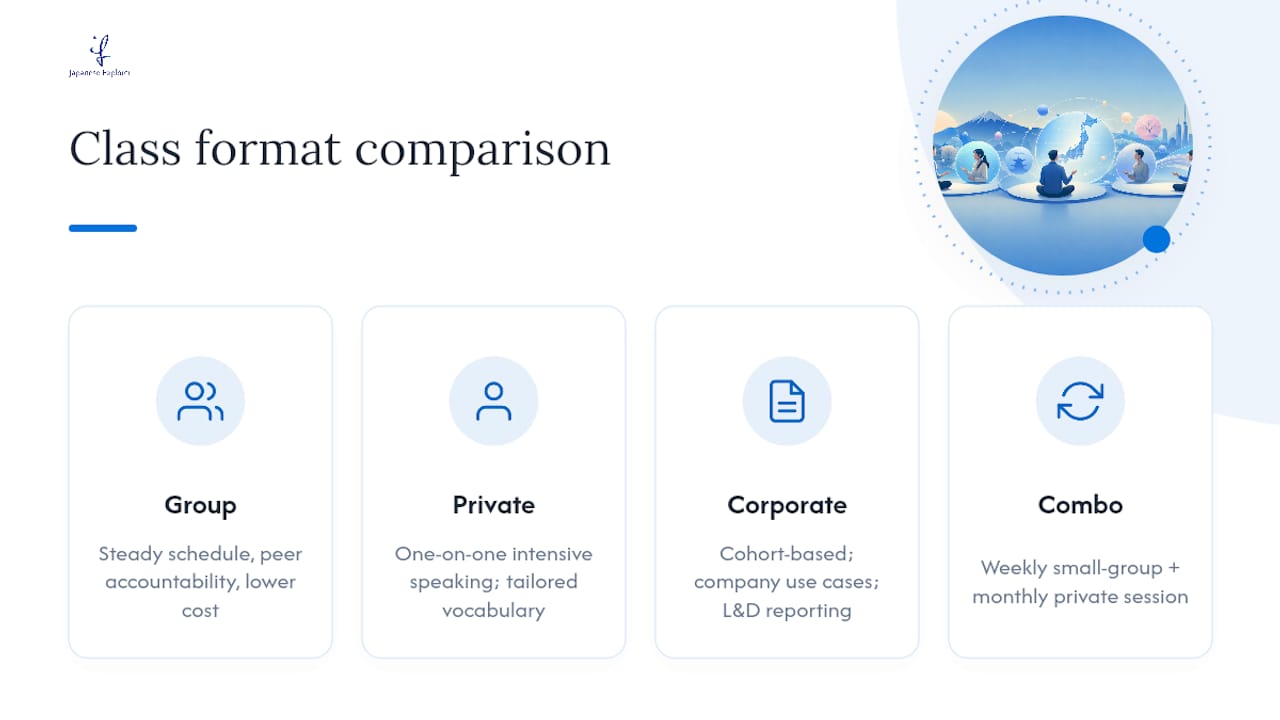
Private lessons trade the lower cost for intensive, one-on-one speaking time. If you are an executive prepping for a specific negotiation or a job transfer to Tokyo, private coaching lets the instructor build sessions entirely around your vocabulary gaps and schedule.
Corporate training sits apart from both. It is cohort-based, built around your company’s actual use cases, client-facing etiquette, internal terminology, and usually comes with reporting back to an L&D contact.
A common combination that works well: a weekly small-group class for steady progress, paired with a monthly private session to drill whatever came up at work that month. Small groups of six to eight students tend to give each learner more speaking time and better retention than larger lecture-style classes, per one 2026 adult learner guide.
What Should You Expect to Pay?
Pricing varies by format, but the pattern is consistent across providers: group classes cost less per hour, private lessons cost more per hour but deliver more individual attention, and corporate contracts are usually priced per head or per project.
Certified tutors with specialized business training typically charge more than general conversation tutors, and learners who commit to regular private sessions tend to progress faster in speaking ability than those relying on apps alone, according to Preply’s analysis of tutor value.
Package shapes generally fall into a few buckets:
- Single trial or drop-in lessons, priced highest per hour, meant for testing fit.
- Lesson bundles (commonly 10 or 20 sessions), which lower the effective hourly rate.
- Monthly subscriptions for ongoing group classes with a fixed weekly slot.
- Corporate contracts, quoted per employee or as a flat project fee covering a cohort.
When you compare quotes, check what is bundled in. A group class priced around $12 to $20 per hour looks different once you factor in whether materials, recordings, and progress assessments are included or billed separately. High-quality programs often include recorded lessons and catch-up notes so a missed session does not set you back, a feature worth asking about directly when you compare providers.
How Should You Prepare for a Trial Lesson?
A trial lesson is only useful if you treat it like an evaluation, not just a free class.
Before the trial, state your actual level honestly, as guidance on honesty about language level and framing proficiency on CVs can be found in the English proficiency guide. Instructors can only tailor a lesson if they know whether you are starting from zero or you already survived two years of college Japanese. Pedagogical guidance for adult learners consistently points to candor about starting level as the single easiest way to avoid a mismatched, frustrating first lesson. Share your goals ahead of time too. Naming specific conversational topics or business scenarios you want covered gives the instructor something concrete to build around, rather than defaulting to a generic intro lesson.
During the trial, pay attention to three things: how much you actually spoke versus listened, how the instructor corrected your mistakes, and whether they adjusted when something clearly was not landing.
- Check your internet connection and use headphones with a mic to cut background noise.
- Test your camera placement so the instructor can see your mouth movements for pronunciation feedback.
- Do a test call five minutes early to catch any tech issues before the lesson starts.
- Find a quiet, distraction-free room, even if that means a closed door and a “do not disturb” sign.
- After the lesson, score it against a short rubric: goal alignment, instructor clarity, interaction level, and logistics.
Pro Tip: Keep a small “lesson kit” by your desk. A notebook, headphones, and a glass of water sound minor, but scrambling for a pen mid-sentence breaks your focus exactly when you should be listening.
Preparing your setup this way follows the same advice given for italki trial lessons: treat the trial as a low-commitment test, and do not hesitate to try a second one if the first instructor is not the right match.
Why Structure Beats a Loose Collection of Free Materials
A structured program earns its cost by doing something free materials cannot: integrating grammar, speaking, and listening into every single lesson instead of leaving you to stitch it together yourself.
Curriculum matters more than most learners expect. Programs that combine live speaking practice with homework and consistent progress tracking produce faster gains than ad-hoc self-study, according to the Nihongo Online School comparison cited earlier. That is the practical argument for paying an instructor instead of relying purely on free videos and apps: someone is actively correcting you in real time, every session.
What to look for in a structured school:
- Bilingual, experienced instructors who focus on real-world, interactive communication rather than pure textbook drilling.
- Small class sizes with genuine speaking time for each student, not a lecture with 30 muted mics.
- Flexible delivery across group, private, and corporate formats so the program fits your actual schedule.
- Support features like catch-up materials or progress updates, particularly valuable if you are enrolled through a corporate account.
Active participation techniques, such as echoing the instructor’s phrases and repeating corrections immediately, help build speaking muscle memory in a way that passive video-watching simply does not.
What Adult Learners Get Wrong About “Free” Language Learning
The instinct to search for free resources first is not wrong. It is just aimed at the wrong problem. Free apps and videos are genuinely good at vocabulary drilling and grammar exposure. What they cannot do is correct your pronunciation in real time or push you to actually speak when you would rather stay quiet and re-watch a lesson instead.
That is the gap conventional advice tends to skip over. Most “how to learn Japanese for free” content treats speaking as something that happens eventually, almost as an afterthought to grammar study. In practice, speaking is the skill adult learners struggle with most, precisely because it is the one free materials are worst at teaching. If you are a working professional with three or four hours a week to spend, spend them where correction actually happens: a live class with a real instructor watching your mouth and your mistakes.
Prioritize the trial lesson over the syllabus PDF. A syllabus tells you what a course covers. A trial tells you whether you will actually talk during it, and whether that matters more than any curriculum on paper.
— Paul
Ready to Book Your Trial Lesson?
If everything above sounds right but you are not sure where to start, you get a bilingual, experienced instructor running an actual conversation with you from lesson one, whether your goal is casual fluency or handling a client call in Osaka next quarter.

Our courses cover instructor-led online group classes, private one-on-one lessons, and business Japanese modules built for professionals, plus corporate training programs for teams that need role-specific language and etiquette. Booking a trial is simple: reach out through our course pages, tell us your current level and your goal honestly, and we will match you with an instructor and format that fits. Bring the evaluation checklist from this guide to your consultation. It will help you judge fit fast, whether you meet us online or visit our training centre at 10 Anson Road, Level 22, International Plaza, Singapore 079903, right above Tanjong Pagar MRT.
Sources
- Your First iTalki Trial Lesson in Japanese: What to Prepare and What to Expect – Japan Handbook
- How to learn Japanese online via Zoom – ATJ LRC
- Is it worth getting a Japanese tutor? Costs, benefits, and when to hire – Preply
FAQ
What Does “Free Online Japanese Classes” Mean in This Guide?
It refers to the trial or introductory lessons offered by paid, instructor-led programs, letting you test a live Zoom class before enrolling in a full course.
Will a Trial Lesson Actually Improve My Speaking?
A single trial is mainly a fit-check, but structured programs that follow it up with regular live speaking practice and homework tend to produce faster gains than self-study alone.
Should I Choose Group or Private Classes First?
Start with group classes if you want structure and lower cost, and add private sessions if you need intensive, role-specific practice for work.
How Long Does Enrollment Usually Take After a Trial?
Most learners can move from trial lesson to enrolled student within a few days once they confirm their goal, schedule, and preferred format, such as small-group classes or private coaching.
Can Corporate Training Be Customized to Our Industry?
Yes. Corporate programs like Japanese Explorer’s corporate training are typically built around your team’s actual client interactions, meeting etiquette, and industry terminology rather than a generic curriculum.