Sentence mining means pulling real example sentences from things you read or watch and saving them for spaced repetition review, rather than memorizing isolated words. Start once you have a basic vocabulary and grammar foundation, and lean on the “1T rule”: each sentence you save should contain exactly one unknown element. Keep your first sessions small, somewhere around five to ten sentences, so the habit survives past week one.
TL;DR:
- Starting sentence mining requires understanding most sentences contain only one unknown word or grammar point, typically after building a core vocabulary of a few hundred words.
- Effectively capturing sentences involves quickly noticing, confirming meaning, and recording context, with a focus on quality over quantity for long-term sustainability.
- Tools like Anki, automated apps, and media-based workflows support different levels of automation and source material for efficient sentence collection and review.
- Building targeted cards that test understanding in Japanese, with furigana and audio, improves retention more than translation-focused cards.
- Combining sentence mining with structured grammar lessons and native listening practice creates a reinforcing loop essential for progressing toward fluency.
Table of Contents
- What Is Japanese Sentence Mining, and Why Does It Work?
- When Should You Start Sentence Mining?
- How Do You Sentence Mine, Step by Step?
- Which Tools Fit Your Mining Workflow?
- What Should a Japanese Mining Card Look Like?
- How Do You Keep Sentence Mining Sustainable?
- What Mistakes Should You Avoid, and What Advanced Tactics Help?
- How Do Classes or Tutors Complement Sentence Mining?
- How Does Sentence Mining Fit With Grammar Study and Listening Practice?
- Should Your Mining Strategy Change Based on Your Goal?
- A Realistic 4-Week Starting Plan
- How Japanese Explorer Fits Into Your Mining Routine
- Sources
- FAQ
What Is Japanese Sentence Mining, and Why Does It Work?
Word lists teach you definitions. Pure immersion teaches you almost nothing measurable for months. Sentence mining sits between the two: you learn vocabulary embedded in the grammar, tone, and collocations it actually appears in, which is closer to how you will meet that word again in a novel, a drama, or a conversation.
The learning science behind it is straightforward. Context forces deeper processing than a flashcard with an English gloss, and pairing that context with spaced repetition locks it into long-term memory through review intervals that stretch out as you prove you remember. Refold’s methodology treats this combination as the backbone of intermediate study, defining sentence mining as saving one-unknown sentences from content you already enjoy and reviewing them on a schedule.
What you actually gain:
- Grammar patterns absorbed in their natural position, not as abstract rules
- Collocations and set phrases you would never generate from a dictionary alone
- Stronger passive recognition that eventually feeds active recall, though not overnight
Pro Tip: Expect recognition first and production later. You will understand a mined phrase in a drama weeks before you can produce it unprompted in conversation.
When Should You Start Sentence Mining?
Mining sentences before you have any vocabulary base is the single most common way learners burn out on this method. Tofugu and similar language resources recommend building a few hundred words of core vocabulary first, so most sentences you encounter contain only one unfamiliar piece rather than five.
Run this quick self-test before you commit to a mining routine:
- Pick five random sentences from something you are currently reading or watching.
- Count how many contain exactly one unknown word or grammar point.
- If three or more qualify, you are ready to start mining today.
- If fewer than two qualify, spend two to three more weeks on core vocabulary and grammar first.
- Retest weekly until your hit rate improves.
If you are not there yet, that is not a setback, it just means your energy is better spent elsewhere for now. A structured approach to vocabulary expansion or targeted grammar drilling will get you to that 1T threshold faster than forcing sentences that are three levels above you.
How Do You Sentence Mine, Step by Step?
Once you clear the readiness bar, the workflow itself is simple enough to run daily without a spreadsheet.
- Notice. While reading, watching, or listening, flag any sentence where exactly one word or grammar point trips you up. This is the 1T heuristic Refold’s method is built around, and it is the single filter that keeps your deck comprehensible.
- Understand. Before saving anything, confirm the reading, the meaning, and the nuance. A dictionary lookup that takes fifteen seconds now saves you from reviewing a wrong definition fifty times later.
- Capture. Save the sentence with its context intact. The fastest methods are a phone note, a browser popup dictionary, or a dedicated capture tool. Kikugo’s guidance favors five to ten strong lines per session over dozens of weak ones, and that ratio matters more than raw volume.
- Review. Feed captured sentences into your spaced repetition system and set a realistic daily target. SubSmith’s process notes recommend tuning batch size to Japanese-specific factors like subtitle density and your JLPT level, rather than copying a generic flashcard pace built for a simpler writing system.
Pro Tip: Capture speed beats card perfection. Learners who accept a slightly messy card and move on tend to sustain the habit for months longer than those who chase a flawless template every single time, a pattern echoed in Lexirise’s mining guide.
Which Tools Fit Your Mining Workflow?
Your tool choice should match your source material and your patience for setup, not the other way around.
- Manual, low-setup capture works for anyone starting out: a phone notes app, a clipboard manager, or a browser popup dictionary lets you save sentences from anything without installing software.
- Anki with add-ons remains the standard destination for review, since its scheduling algorithm and cross-device sync are hard to beat once your deck grows past a hundred cards.
- Automated desktop apps like Sentence Miner pull sentences directly from videos, YouTube, and EPUBs, then export ready-made Anki cards with frequency filters and automatic audio clipping built in.
- Video and subtitle workflows suit learners immersing through dramas or anime, where subtitle files double as a sentence source.
- Mobile-only setups are the most limited option; heavier automation tools generally need a desktop, so mobile-first learners should expect more manual copying.
Automated tools cut friction for media-heavy mining, but they add setup and maintenance overhead that a pure mobile workflow avoids entirely.
What Should a Japanese Mining Card Look Like?
A card that tests translation instead of comprehension teaches you to translate, not to understand. Build cards that force you to process the sentence in Japanese first.
- Target word or grammar point, isolated so you know exactly what you are being tested on
- Full sentence with furigana, so unfamiliar kanji readings do not block recall of the point you are actually reviewing
- Reading and definition, kept brief, on the back only
- Audio clip, when available, since it trains listening recognition alongside reading
- Source note, so you can find the original context if the card ever confuses you months later
Use cloze deletion for grammar points and particles, targeted-sentence cards for most new vocabulary, and reserve plain single-word cards for concrete nouns you can picture directly, a distinction AJATT’s method has long emphasized for keeping card types matched to what they are meant to test.
How Do You Keep Sentence Mining Sustainable?
A deck that grows faster than you can review it is the fastest way to quit. Treat your daily new-card count as a budget, not a goal.
- Cap new cards at a number your review time can actually absorb. Ten to twenty new cards a day is a common sustainable range for most working adults.
- Track total review minutes, not just card count. Fifteen unknown-heavy cards can eat more time than forty easy ones.
- Suspend or delete cards that keep failing after several reviews. Low-value cards clog your queue without teaching you much.
- Merge near-duplicate sentences testing the same word, since reviewing the same point three different ways rarely adds new information.
- Take a deliberate mining pause every few weeks to let your backlog shrink and your retention catch up.
What Mistakes Should You Avoid, and What Advanced Tactics Help?
The biggest failure mode is mining sentences you do not actually understand yet, hoping repetition alone will explain them. It will not, and you will end up reviewing confusion rather than knowledge. A close second is overloading your daily new-card count in week one out of enthusiasm, then abandoning the whole system in week three from review fatigue. A third is spending hours perfecting a card template instead of capturing sentences.
Once your habit is steady, a few higher-leverage moves pay off. Prioritize sentences using frequency data so you learn common words before rare ones. Batch-mine an entire episode or chapter in one sitting rather than pausing constantly. Clip short audio segments alongside your sentences to train listening recognition, not just reading.
Pro Tip: Reuse a genuinely good example sentence across similar grammar points instead of hunting for a fresh one every time. A clean, natural sentence you already trust is worth more than a new one you are unsure about.
How Do Classes or Tutors Complement Sentence Mining?
Sentence mining assumes you already have enough grammar and vocabulary to recognize what “one unknown” even looks like, and that foundation is exactly where structured lessons earn their keep. A course builds the base grammar faster than trial and error, which means more of your mined sentences clear the 1T bar sooner.
An instructor also catches the errors self-study misses: a nuance you mistranslated, a reading you guessed wrong, or a card that quietly reinforced a mistake for weeks. Different formats suit different goals:
- Private lessons for closing specific grammar gaps fast
- Online courses for learners who need flexibility around a mining routine
How Does Sentence Mining Fit With Grammar Study and Listening Practice?
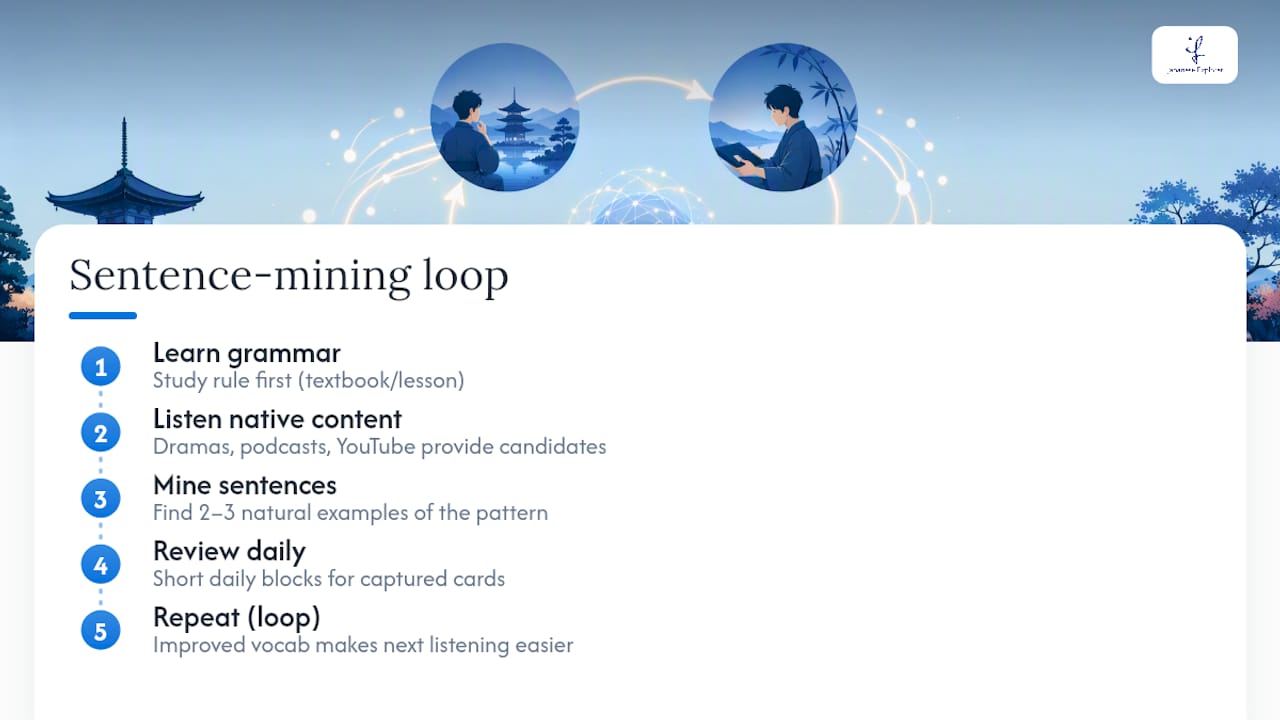
Sentence mining is not a replacement for structured grammar study, it is what makes grammar study stick. When you learn a grammar point in a lesson or textbook, hunting for two or three natural mined examples of that exact pattern cements it far better than the textbook’s single sample sentence ever could. The order matters here: learn the rule first, then go looking for it in the wild.
Native listening practice feeds the front end of your mining pipeline. Dramas, podcasts, and YouTube videos are where your 1T sentences actually come from, so the more time you spend immersing, the more raw material you have to notice and capture. This creates a loop: listening surfaces’ candidate sentences, mining locks in the words and patterns you flagged, and your improved vocabulary makes the next listening session easier to follow. Skipping either half breaks the cycle. Mining without listening starves your deck of fresh material. Listening without mining lets comprehensible input slip past without ever becoming a memory.
A weekly rhythm works well for most learners: a couple of sessions dedicated to grammar study or structured sentence-level practice, a few sessions of native content for mining and listening combined, and daily short review blocks for the cards you have already captured. None of these three pillars, grammar, immersion, and review, functions well in isolation.
Should Your Mining Strategy Change Based on Your Goal?
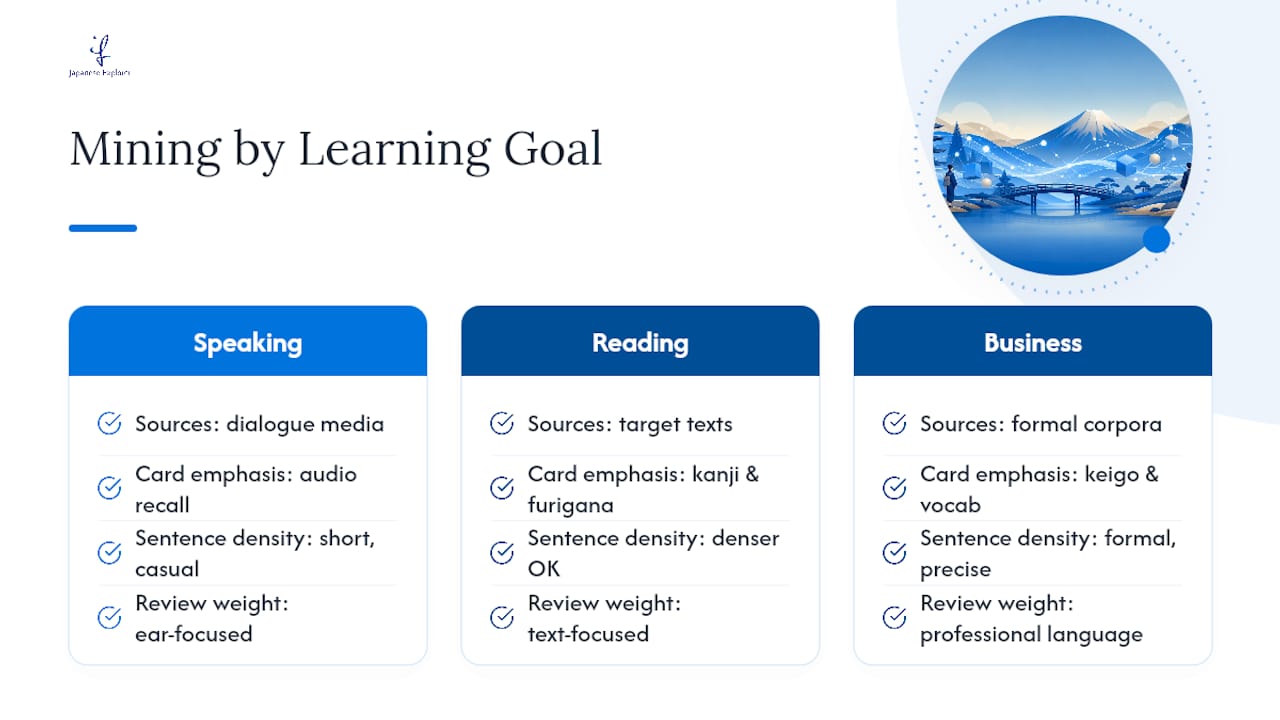
A learner chasing conversational fluency and a learner chasing reading comprehension should not be mining the same way. If speaking is your target, prioritize sentences from dialogue-heavy sources like dramas, podcasts, and conversational YouTube channels, and weight your card reviews toward audio recall over kanji recognition. You want your ear trained on natural speech rhythm and casual grammar contractions that textbooks rarely cover.
If reading comprehension is the goal, mine from the actual text types you want to read, whether that is news articles, novels, or manga, and put more emphasis on kanji and furigana fields on your cards. Reading-focused learners can also tolerate a slightly denser sentence than speaking-focused learners, since you have time to parse a written sentence that would fly past too fast in spoken audio.
Business Japanese learners need a third variation entirely: sentences mined from formal correspondence, keigo-heavy dialogue, and industry-specific vocabulary, since casual drama dialogue will not prepare you for a client meeting. Whichever goal you are optimizing for, the underlying workflow stays identical, notice, understand, capture, review, only the source material and card emphasis shift to match what you are actually trying to do with the language.
A Realistic 4-Week Starting Plan
Week one: hit your 1T readiness threshold and capture five sentences daily. Week two: raise to eight to ten sentences daily and start daily reviews. Week three: add audio clips to half your cards. Week four: check your passive recall rate before adding volume. Passive recognition arrives in weeks; comfortable production takes months, so pace yourself rather than chasing speed. For a longer view of how mining fits into overall fluency, see this practical guide to real fluency.
— Paul
How Japanese Explorer Fits Into Your Mining Routine
Sentence mining works best when you already have enough grammar and vocabulary to recognize a 1T sentence the moment you see one, and that foundation is exactly what a structured course builds faster than self-study alone. Japanese Explorer’s courses give you the base grammar, corrected pronunciation, and nuance checks that make your mined sentences actually reliable instead of half-guessed.

If you are closing specific grammar gaps fast so your mining sessions stop stalling on the same patterns, the Private Physical or Online Conversational Japanese Course runs $1,280 to $1,580 one time, with a one-time registration fee from $50 per student. If your goal is turning recognition into real conversation, the Group Japanese Classes cost $350 one time and put you in a room practicing the exact patterns you have been mining. Learners who need flexibility around work or a mining schedule can take either format over online Zoom sessions. Classes run out of 10 Anson Road, Level 22, International Plaza, Singapore 079903, right above Tanjong Pagar MRT. Check current class schedules and enroll on the site to get your next cohort date.
Sources
- Spaced repetition — Wikipedia
- Sentence Mining — Refold Roadmap Library
- Japanese sentence mining guide — Kikugo
- Sentence Miner releases — GitHub
- Tofugu: learn Japanese
FAQ
When Should You Start Sentence Mining in Japanese?
Start once you can read five random sentences and find that most contain only one unknown word or grammar point, the 1T threshold most mining methods use. Tofugu recommends building a few hundred words of core vocabulary first so your mining sessions produce comprehensible sentences instead of frustration.
How Do You Use Sentence Mining Day to Day?
You notice a 1T sentence while reading or watching something, confirm its meaning and reading, capture it with context intact, then review it through spaced repetition on a regular schedule. Refold’s workflow treats this notice, understand, capture, review cycle as the core method, and keeping each step quick is what makes the habit last.
What Is the 10,000 Sentences Method?
An older approach argues memorizing a very large number of native sentences eventually builds fluency through sheer volume and pattern exposure. Modern sentence mining borrows the same logic but scales it down to a sustainable daily habit built on comprehensible 1T sentences reviewed with spaced repetition, rather than one enormous fixed target.
How Does Japanese Sentence Structure Affect Mining?
Japanese follows a subject, object, verb order with particles marking grammatical roles, which means a mined sentence often needs its full structure intact to make sense, unlike English words that can stand alone. This is why sentence mining suits Japanese particularly well: isolating a single word strips out the particle and word order information you actually need to use it correctly.
Can a Japanese Course Speed Up My Mining Results?
Yes. A structured course builds the grammar and vocabulary foundation that determines how many sentences you encounter actually clear the 1T bar, and an instructor can correct card errors self-study would miss. Japanese Explorer offers group, private, and online formats built around exactly this kind of foundation work.