
The fastest path to real progress is a vetted private tutor or a structured language school, not a random online listing. Book a trial lesson or a placement test within your first week of searching, before you second guess yourself. Whether your goal is casual conversation, the JLPT, or business Japanese, a good teacher will ask about that goal before they ask for payment.
TL;DR:
- Structured programs with a placement test and trial lesson significantly reduce mismatched expectations and speed up progress.
- Teachers with extensive teaching experience and tailored lesson plans matter more than native fluency or general credentials.
- Prices vary: group classes start around $350, private lessons range from $1,280 to $1,580, with discounts for bundles and structured curricula.
- One-on-one lessons or courses built on recognized textbooks and clear progression outperform loosely organized private tutoring.
- Prioritizing trial lessons and explicitly defining goals ensures the teaching approach aligns with your specific language learning needs.
Table of Contents
- Where Do You Find a Qualified Japanese Language Teacher?
- What Should You Check in a Japanese Language Instructor?
- How Are Lessons Structured, and What Should You Expect to Pay?
- How Do You Actually Hire a Teacher, Step by Step?
- How Do You Prepare for Your First Lesson and Track Progress?
- Why Japanese Explorer Fits This Checklist
- What the Research Actually Supports
- Start With a Placement Test, Not a Guess
- Sources
- FAQ
Where Do You Find a Qualified Japanese Language Teacher?
You have four realistic channels, and each one serves a different kind of learner. Knowing which one matches your goal saves weeks of trial and error.
Language schools and local centers give you the most structure. A good school runs a placement test before your first class, follows a consistent curriculum across levels, and replaces a teacher without disrupting your progress if someone leaves. This matters more than most learners expect. Freelance tutors who fall ill or change cities can leave you stranded mid-course; an institution absorbs that risk for you.
Private tutors offer the opposite trade-off: flexibility over structure. A tutor found through a marketplace listing can be excellent, but marketplaces vary wildly in how they vet credentials. An independent tutor you find through a personal referral often comes pre-vetted by someone you trust, while a marketplace profile requires you to do that verification yourself, checking reviews, asking for a demo, and confirming actual teaching experience rather than just native fluency.
National and institutional platforms deserve more attention than they get. The JF Japanese e-Learning Minato platform, run by the Japan Foundation, offers both self-study courses and Tutor Support Courses that pair interactive lessons with live correction. If you want a structured curriculum built by a national body but still want a human checking your work, this hybrid model is worth exploring before you commit to a private arrangement. Related to it is Marugoto, a communicative course sequence that leans heavily on cultural context alongside grammar, with tutor-supported group options available through Minato.
Community and job-board options round out the list. University language departments sometimes run open community classes, and job boards occasionally list independent teachers looking for private students directly, cutting out marketplace fees. This channel takes longer to search but can turn up teachers with strong academic backgrounds who haven’t yet built a marketplace presence.
Once you know your channel, filter fast using these criteria:
- Goal first. Conversation, JLPT prep, and business Japanese require different lesson plans, so state your goal before you even ask about pricing.
- Lesson mode. Decide online versus in-person before you start browsing. It narrows your options by half immediately.
- Teacher background. Native speaker status matters less than teaching experience with your specific goal.
- Availability match. A teacher with a packed schedule that barely overlaps yours will frustrate you within a month.
- Trial policy. If a channel or teacher won’t offer any kind of trial lesson, move on. It’s a preview of how they’ll treat your first misstep.
For a broader sense of what a structured program actually covers session by session, the range of Japanese language courses offered by established schools gives you a useful benchmark to compare against any private tutor’s proposal.
What Should You Check in a Japanese Language Instructor?
Credentials matter, but not in the way most learners assume. Native fluency is not the same as teaching skill, and a teaching certificate from a recognized program tells you more about someone’s classroom ability than their passport does.
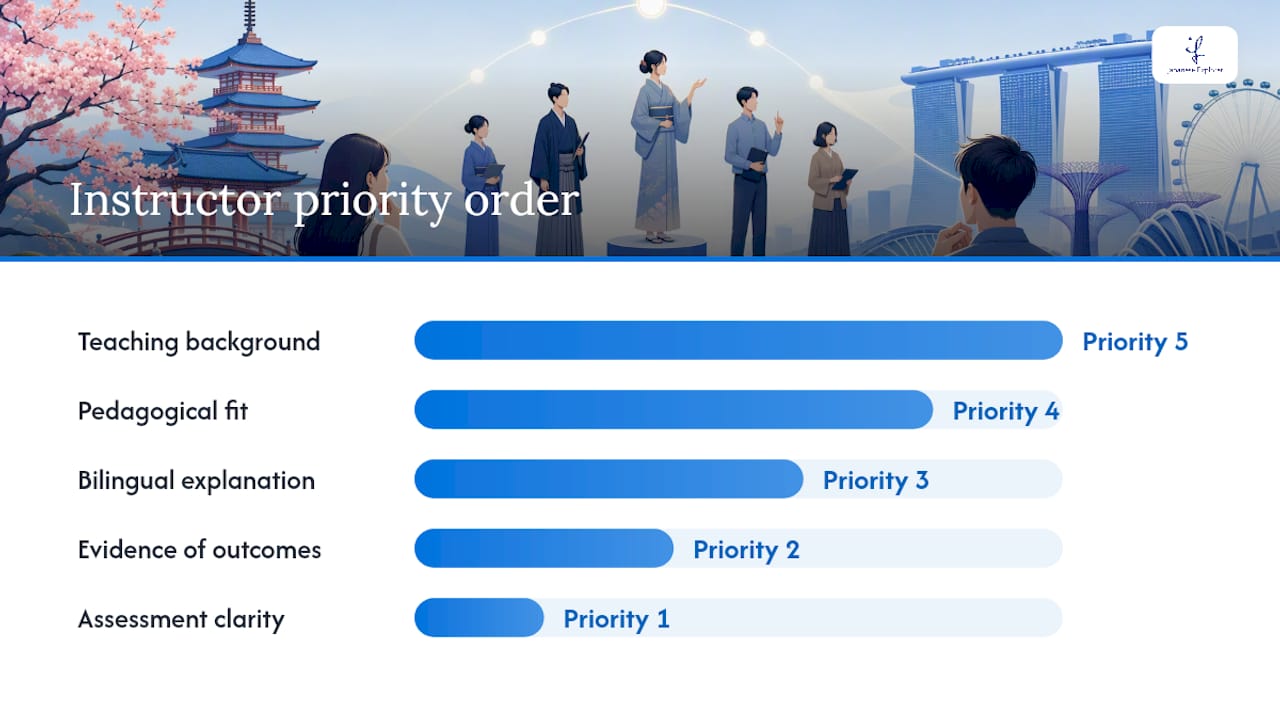
Here’s what to verify, in order of priority:
- Teaching background over native status. Ask directly how long they’ve taught, and whether they’ve taught your specific goal (conversation, JLPT, business) before. A teacher who has spent years running structured 5-week or 10-week courses, following textbooks like Genki or Minna no Nihongo, will typically build you a more coherent path than someone who has only tutored casually.
- Pedagogical fit. Ask whether lessons are tailored to your goal or drawn from a fixed syllabus regardless of student. Industry guidance consistently points toward prioritizing teachers who adjust their material to what you actually need, rather than running the same generic curriculum for every student.
- Bilingual explanation ability. If you’re a true beginner, a teacher who can explain grammar in English when needed will get you unstuck faster than a pure immersion approach. Immersion has its place later, but not in week one.
- Evidence of outcomes. Ask for a sample lesson plan or a short demo. Reviews and testimonials help, but a five-minute look at how they actually structure a lesson tells you more than a star rating ever will.
- Assessment clarity. A serious teacher can describe, specifically, how they’ll measure your progress. If they can’t answer this in one sentence, that’s a signal.
Watch for red flags that show up before you’ve paid anything: refusal to offer any kind of trial, vague or evasive answers about lesson structure, scheduling that changes constantly without explanation, or pressure to buy a large package before you’ve had a single real lesson.
Pro Tip: Ask every candidate teacher the exact same question in your first message: “How would you structure my first four lessons if my goal is [your specific goal]?” The answers you get back, side by side, will tell you more about teaching quality than any bio or review ever could.
How Are Lessons Structured, and What Should You Expect to Pay?
Format depends entirely on your goal, and pricing follows format more than it follows the teacher’s résumé.
The most common structures are one-to-one private lessons, small-group classes, intensive multi-week sessions, corporate training blocks, and online tutor-supported courses. Many established adult programs run in 5-week or 10-week sessions, combining grammar, listening, reading, and writing in each session rather than isolating them, which keeps your skills developing in parallel instead of in silos.
Session length typically runs 30 to 90 minutes. Shorter sessions work well for busy professionals fitting in Japanese around a full workday; longer sessions suit learners preparing intensively for something like the JLPT on a deadline. Weekly cadence works for steady, long-term learners; intensive blocks work better if you have a trip or exam coming up fast.
Pricing varies by a few consistent factors:
- Format: private lessons cost more per hour than group classes, but move faster since every minute is tailored to you.
- Delivery mode: online lessons sometimes run slightly cheaper than in-person, since neither party pays for travel time.
- Teacher credentials: a teacher with specific business Japanese experience or JLPT coaching history typically charges more than a general conversation tutor.
- Package size: most schools and tutors discount per-lesson cost when you book a bundle rather than single sessions.
One practical note that’s easy to miss: tutor-supported courses and marketplaces typically build in a trial lesson or discounted first session precisely because fit matters so much before a longer commitment. Treat the absence of any trial option as a real cost, not just an inconvenience, since you’re effectively being asked to commit blind.
Before signing anything, get clear answers on cancellation windows, rescheduling flexibility, and refund terms. A teacher or school that hedges on these questions is telling you something about how they’ll handle the inevitable schedule conflict three weeks in.
How Do You Actually Hire a Teacher, Step by Step?
The process is the same whether you’re hiring a private tutor or enrolling in a language school. Skipping steps is what leads to mismatched expectations later.
- Define your goal precisely. “Conversational Japanese” is too vague. “Order food, handle small talk, and get through a business dinner in Japanese within six months” gives any teacher something to actually plan around.
- Review two or three options in parallel. Don’t commit to the first teacher or school you find; compare responses to the same questions across candidates.
- Request a trial lesson. Use it to test communication style, not just language ability. Can they explain a concept three different ways if the first one doesn’t land?
- Agree on a lesson plan and price in writing. Even an informal written confirmation avoids disputes later about what was promised.
- Confirm payment and scheduling terms before the second lesson. This is when cancellation policy actually gets tested, so know it going in.
During first contact, ask directly: “Have you taught someone with my exact goal before?” and “What does a typical homework load look like?” Reasonable proof to request includes a sample lesson plan, a short reference from a past student, or a five to ten minute demo. After the trial, judge fit on three things: did the lesson match what you asked for, how quickly did they respond to your messages, and did they propose a concrete way to check your progress at a set point.
How Do You Prepare for Your First Lesson and Track Progress?
Walk into lesson one with your goal written down, any placement test results in hand, your real schedule constraints stated upfront, and a short list of must-learn topics. This single step separates learners who make fast progress from learners who drift.
Set milestones across your first four to eight lessons rather than a single distant goal. Between lessons, build a short daily practice habit: a few minutes of spaced repetition, some listening exposure, and light review of what you covered. Free resources like NHK World-Japan’s leveled Japanese lessons work well here, letting you keep daily contact with the language without adding paid hours.
At the one-month mark, check three things: are you speaking with more confidence, is your teacher correcting fewer repeat mistakes, and can you point to measurable vocabulary or grammar gains.
Pro Tip: Keep a simple lesson log, just a few bullet points per session on what you covered and what tripped you up, and share it with your teacher every few weeks. It turns vague “am I improving?” anxiety into a concrete conversation.
Why Japanese Explorer Fits This Checklist
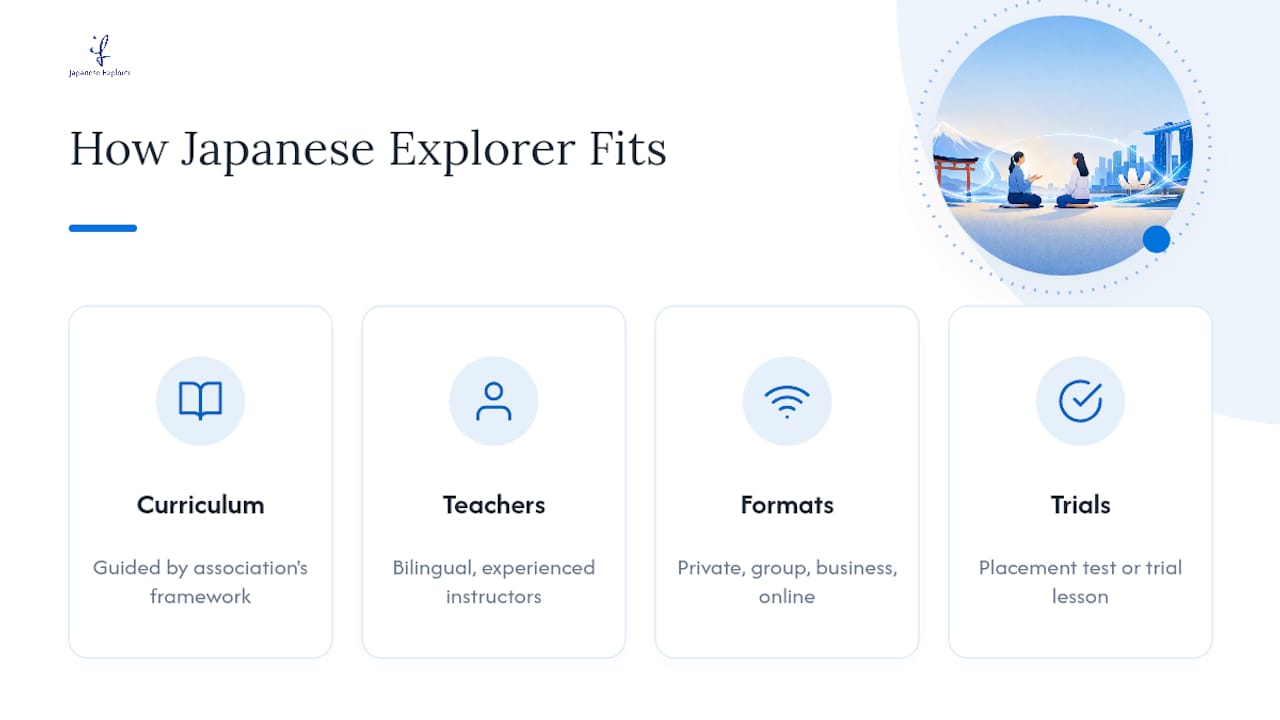
Every criterion covered above, structured curriculum, verified teacher quality, flexible formats, and a real trial process, maps directly onto how Japanese Explorer runs its programs.
The curriculum is guided by the Association for Japanese-Language Teaching, which means course progression follows a structured framework rather than an ad hoc mix of materials pulled together lesson by lesson. That structure matters most in the first few months, when a disorganized curriculum is the single biggest reason learners quit.
Instructors are bilingual and experienced, which addresses the pedagogical fit criterion directly: you get explanations in English when you need them, delivered by teachers who have taught adult learners with goals ranging from casual conversation to business fluency. That combination, native-level Japanese ability paired with the ability to teach in English, is exactly the trust signal worth checking for in any teacher search.
Delivery is flexible across private lessons, group classes, business Japanese, and online Zoom sessions, so you can match format to your actual goal rather than settling for whatever a single teacher happens to offer. If you’re weighing private tutoring specifically, this breakdown of the role a private language tutor plays in Japanese learning walks through what tailored one-to-one instruction looks like in practice.
The next step is straightforward: book a placement test or a trial lesson before committing to a full course. It’s the same advice this entire guide has built toward, and it applies whether you land here or with any other teacher you’re evaluating.
What the Research Actually Supports
Most advice on hiring a Japanese teacher fixates on finding a “native speaker,” as if fluency alone guarantees good teaching. It doesn’t. A native speaker with no training in pedagogy often struggles to explain why a grammar point works the way it does, which is precisely the moment a beginner needs the most help.
What the evidence actually points to is structure paired with responsiveness. Programs that follow a defined progression, with recognized textbooks and clear session lengths, consistently outperform loosely organized private arrangements, even when the private tutor is a lovely, patient person. That’s not an argument against private tutors; it’s an argument for demanding structure from whichever option you choose, tutor or school.
The other overlooked factor is trial lessons. Learners skip them to save time, then spend three months with a mismatched teacher instead. One thirty-minute trial is the cheapest insurance you’ll buy in this entire process. Prioritize it over price, over convenience, over anything else on your checklist.
— Paul
Start With a Placement Test, Not a Guess
Japanese Explorer gives you a direct alternative to the guesswork of sorting through unverified tutor listings: a structured curriculum guided by the Association for Japanese-Language Teaching, taught by bilingual instructors, with a placement test built into the process before you commit to anything.
If your goal is steady conversational progress, the group Japanese classes run at $350 one time give you a structured cohort setting without a private lesson budget. If you want lessons built entirely around your schedule and goals, the private conversational Japanese course runs $1,280 to $1,580 one time, plus a one-time registration fee starting at $50 per student. Professionals preparing for workplace use should look at the business Japanese course, which starts at $350 one time for the standard track. Prefer to learn remotely? The online Japanese course delivers the same structured curriculum over Zoom. Classes run in person at 10 Anson Road, Level 22, International Plaza, Singapore 079903, right above Tanjong Pagar MRT. Reach out to book your placement test and find the format that actually fits your goal.
Sources
A few institutional resources are worth bookmarking alongside any teacher you hire, since they reinforce lessons with free or structured practice between sessions.
- Japanese Language — Japan Society
- JF Japanese e-Learning Minato
- Marugoto Japanese Online Course
- Learn Japanese – NHK WORLD-JAPAN
FAQ
What Is a Japanese Teacher Called?
In Japanese, a teacher is called a sensei (先生), a title used respectfully for language instructors, professors, and other educators regardless of subject.
Where Can I Find a Private Japanese Tutor?
You can find private tutors through language schools with private lesson tracks, independent tutor marketplaces, university language departments, or job boards, though schools typically vet credentials more consistently than open marketplaces. Japanese Explorer’s private tutor program pairs learners with bilingual instructors and includes a placement test before lessons begin.
Can I Learn Japanese in Three Months?
You can reach basic conversational survival phrases in three months with consistent daily practice, but genuine conversational fluency or JLPT readiness typically takes six months to a few years depending on your study intensity and goals.
How Much Do Japanese Teachers Make?
Earnings vary widely by setting, experience, and whether the teacher works independently or through an institution, and current figures aren’t publicly listed here; a teacher’s own program or school can confirm specific rates directly.
How Much Does It Cost to Hire a Japanese Teacher in Singapore?
Costs depend on format: group classes at Japanese Explorer run $350 one time, while private lessons run $1,280 to $1,580 one time plus a registration fee starting at $50. Business Japanese courses start at $350 one time, with private business tracks running from $1,480 one time.