
Japanese course duration ranges from two weeks for a basic conversational intensive to two years for university or advanced work readiness. Short-term programs build survival phrases fast, part-time weekly classes take several months per JLPT level, and long-term intensive study runs six months to two years depending on your target fluency. The right length comes down to your goal and how many hours a week you can actually commit.
TL;DR:
- Increasing weekly contact hours significantly shortens the overall course duration, with near-daily classes enabling completion within a year for advanced levels.
- Short-term courses lasting a few weeks are suitable only for basic survival skills, while intensive programs of one to six months rapidly build foundational to intermediate proficiency.
- Part-time study over several months per level is ideal for working adults, but progress slows as lessons are spaced out across multiple months.
- Achieving JLPT N2 or N1 proficiency typically requires at least one year of consistent, intensive study, depending on starting level and contact hours.
- Selecting a course based solely on price or convenience risks misaligning with your actual goals; defining a measurable target guides the appropriate duration and intensity.
Table of Contents
- What Are the Typical Japanese Course Duration Options?
- How Do Contact Hours Per Week Affect Your JLPT Timeline?
- How Do You Choose the Right Course Length for Your Goal?
- How Japanese Explorer Matches Course Length to Your Goals
- What Learners Get Wrong About Course Length
- Ready to Find Your Right-Length Course?
- Sources
- FAQ
What Are the Typical Japanese Course Duration Options?
Course length in Japanese language education breaks into four rough bands, and each one serves a different kind of learner. Knowing which band you fall into saves you from either overpaying for intensity you don’t need or underestimating how long real fluency takes.
Short-term courses lasting a few weeks work well for travelers, culture enthusiasts, or anyone testing the waters before a bigger commitment. These typically run a handful of hours per week and get you through greetings, basic questions, and menu-reading survival skills. You won’t leave fluent, but you’ll leave functional for a short trip.
Intensive full-time courses (1 to 6 months) pack daily classes, often four to five sessions a week, into a compressed timeline. Program tables from the University of Tokyo’s engineering-focused Japanese course show intensive beginning tracks running 4 to 5 classes per week, compared with 2 to 3 for regular-paced courses covering the same material. That difference alone can cut your calendar timeline nearly in half.
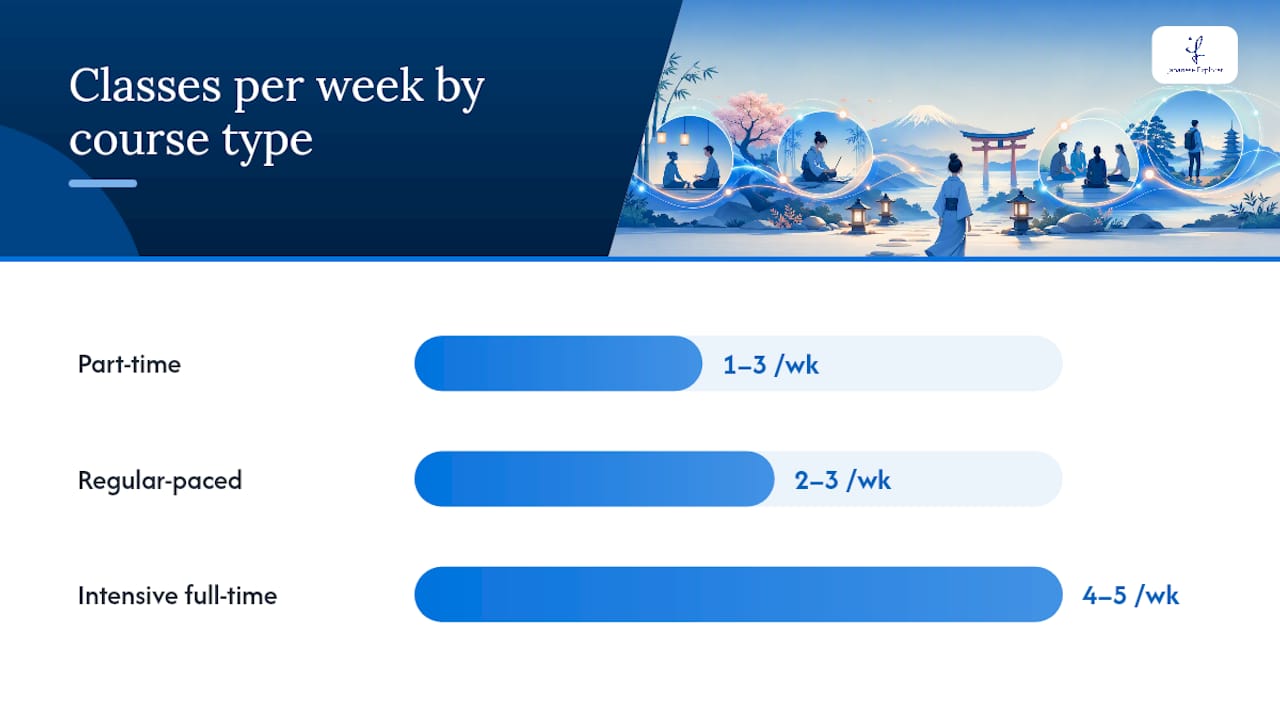
Part-time courses (3 to 12+ months per level) suit working adults and students balancing other obligations. Meeting once or twice a week, progress through a single JLPT level commonly stretches across several months, since spaced-out sessions mean more forgetting between classes and slower momentum.
Long-term programs (6 months to 2 years) target university admission, visa-sponsored study in Japan, or serious career fluency. Waseda University’s Center for Japanese Language documents both half-year (14-week) terms and full one-year intensive tracks, while Hokuriku University’s Japan International Exchange Center runs a one-year intensive course with April and September intakes, noting that students often extend enrollment to two years depending on their goals.
- Short-term: a few weeks, a few hours weekly, survival-level conversation
- Intensive full-time: 1 to 6 months, daily classes, rapid grammar and vocabulary gains
- Part-time: 3 to 12+ months per level, 1 to 3 classes weekly, steady but slower pace
- Long-term: 6 months to 2 years, semester or intake-based, academic or professional readiness
How Do Contact Hours Per Week Affect Your JLPT Timeline?
More hours per week compresses your calendar timeline. It’s the single biggest lever you control. A learner attending 3 hours a week and one attending 20 hours a week can cover the same syllabus, but the second finishes in a fraction of the time simply because repetition and retention compound faster with frequency.
Hokuriku University’s program structure reflects this directly: its intensive one-year track assumes near-daily contact, which is what makes a full JLPT progression from N5 through N2 or N1 realistic within that window. Compare that to a once-weekly evening class, where the same content might take two to three times longer to stick.
Pro Tip: If your goal has a deadline, like a job posting or university application, count your actual weekly contact hours before picking a course, not just the course’s advertised total length.
JLPT-linked timelines vary by starting point and intensity, but general patterns hold up across program progression charts at university-level language schools:
- N5 to N4: Often reachable within a short-term or beginning-level sequence of a few months, even at moderate intensity.
- N3: Typically requires 6 months to a year of consistent study, part-time or intensive.
- N2: Commonly takes a year or more of sustained study, especially without daily class contact.
- N1: Usually demands multiple years of cumulative exposure, or an intensive year-plus program stacked on existing intermediate skills.
Progress isn’t linear, either. Beginners often feel like they’re flying through material in the first few months, since everything is new and every lesson adds visible vocabulary. Once you hit intermediate territory, gains slow down. Grammar nuances, keigo (formal speech), and reading comprehension demand far more targeted practice per unit of progress than the basics did. If you’re aiming for N1, a realistic 6 to 12 month study plan built on top of solid intermediate footing tends to work better than cramming from scratch.
How Do You Choose the Right Course Length for Your Goal?
Picking a duration without a clear goal is how people end up either bored in a course that’s too slow or drowning in one that’s too fast. Work through this before you enroll anywhere:
- Define your target in measurable terms. “Learn Japanese” isn’t a goal. “Pass JLPT N3 by next spring” or “hold a basic work conversation in six months” is.
- Match intensity to your timeline. A daily intensive course fits fast JLPT deadlines; weekly group classes or private lessons suit steady, sustainable progress without burnout.
- Ask every school the same four questions: How many contact hours per week? What’s the class size? Can I see a sample syllabus? Is there a placement test before I start?
- Watch for red flags. Vague weekly hours, no placement test, and no clear path from one level to the next all suggest a program that hasn’t thought through its own structure.
- Weigh budget against speed. Private lessons or a blended online-and-in-person format can shave months off a timeline if your schedule allows for more frequent sessions.
A quick placement test before you commit also prevents the single most common timeline killer: starting in a class that’s below or above where you already are.
How Japanese Explorer Matches Course Length to Your Goals
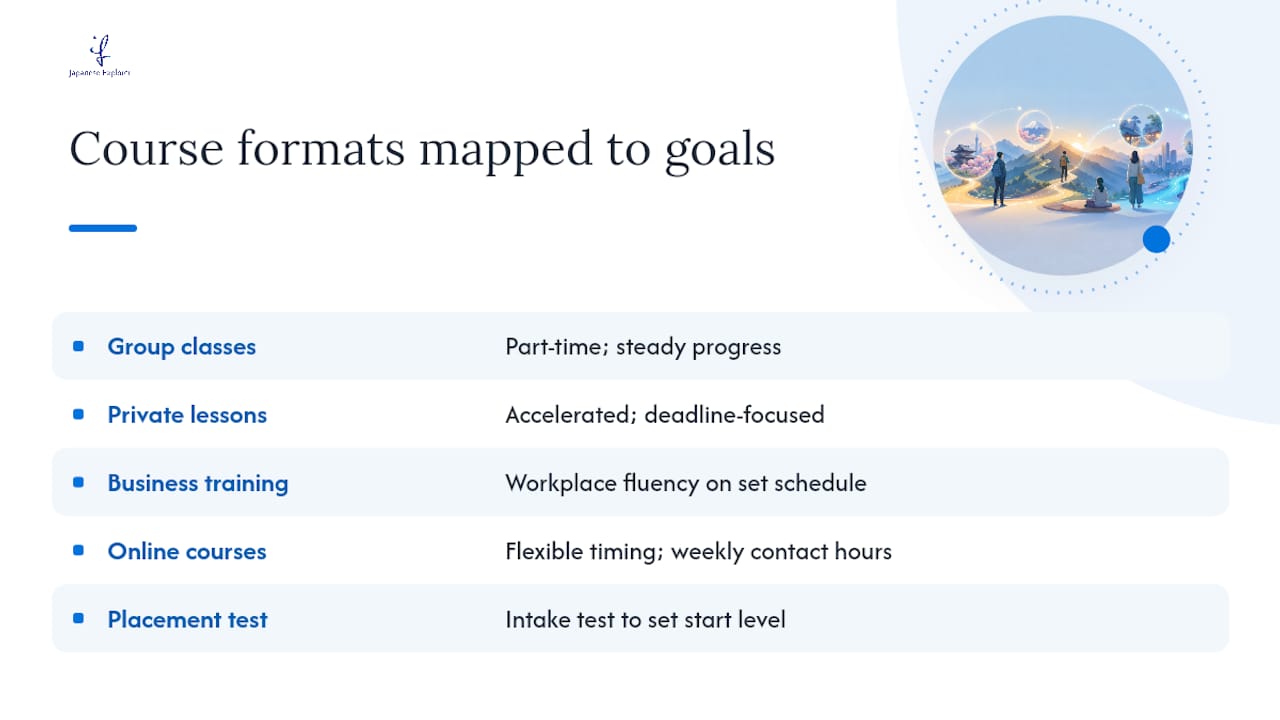
Course formats at Japanese Explorer map directly onto these duration bands. Group classes suit part-time, steady learners; private lessons compress timelines for people with a deadline; business Japanese and corporate training address workplace fluency on a set schedule; and online courses fit those who need flexibility without giving up weekly contact hours. Curriculum guidance follows structured, level-based progression from the Association for Japanese Language Teaching, delivered by bilingual, certified instructors. A placement test at intake keeps your starting level accurate, so your course length estimate actually holds up.
What Learners Get Wrong About Course Length
Most learners choose duration based on price or convenience, not their actual goal. A busy professional who books a slow, once-a-week class for a three-month deadline is set up to fail before the course even starts. Know your endpoint first, then pick the pace that gets you there realistically.
— Paul
Ready to Find Your Right-Length Course?
Once you know your target, whether that’s conversational travel Japanese, a JLPT deadline, or workplace fluency, the next step is matching it to the right format instead of guessing. Japanese Explorer runs group classes for steady part-time progress, private lessons for compressed timelines, and JLPT preparation courses for exam-driven goals, all taught by bilingual, certified instructors following a structured curriculum from the Association for Japanese Language Teaching.

If you’re not sure which duration fits your schedule and goal, take a placement test first. It tells you your real starting level, which is the single biggest factor in how long your course will actually take. From there, book a course online or visit the training centre at 10 Anson Road, Level 22, International Plaza, Singapore 079903, right above Tanjong Pagar MRT, to get a duration recommendation matched to your goal.
Sources
- About the Course | JLCSE | Japanese Language Course, School of Engineering, The University of Tokyo
- Japanese Language Program – Center for Japanese Language, Waseda University
- Japanese Language Course – Hokuriku University, Japan International Exchange Center
FAQ
How long is a Japanese language course?
It depends on the format: short-term intensives run a few weeks, part-time courses take several months per level, and long-term intensive programs commonly span 6 months to 2 years.
What is N1, N2, N3, N4, N5 in Japanese?
These are the five JLPT proficiency levels, with N5 the most basic and N1 the most advanced, each requiring progressively more study time to reach.
Can I learn Japanese in 3 months?
In 3 months of intensive daily study, most learners can reach basic conversational ability and possibly JLPT N5, but full fluency or higher JLPT levels take significantly longer.
How long will it take to fully learn Japanese?
There’s no fixed finish line, since fluency itself is a spectrum, but reaching advanced proficiency around JLPT N1 typically takes multiple years of sustained study, whether through intensive programs or steady part-time classes. Learners who want a clearer benchmark can review a realistic timeline based on study intensity and starting level.