The fastest way to learn Japanese in Singapore is to match your delivery mode to your actual goal, whether that’s group classes for conversation, private tutoring for flexibility, or online Zoom lessons for a packed schedule. Take a placement test before you commit to anything. From there, some providers offer group, private, and online formats built around exactly these goals.
TL;DR:
- Most learners in Singapore find that consistent daily review and active speaking practice significantly improve fluency, especially in the first six months.
- Selecting the right course depends on specific goals, with options ranging from group classes and private lessons to online courses, each with different costs and schedules.
- A placement test, instructor qualifications, curriculum scope, and clear scheduling are critical factors for choosing an effective course and ensuring ongoing motivation.
- Reaching basic conversational level takes three to six months of part-time study, while JLPT N5 or N4 usually requires six to twelve months, depending on effort and intensity.
- Engaging in language exchange, cultural events, and community groups accelerates learning by providing real-world practice outside structured lessons.
Table of Contents
- Types of Courses and Delivery Modes for Learning Japanese
- Where Singapore Learners Actually Find Japanese Courses
- How to Choose the Right Japanese Course for Your Goal
- Realistic Timelines and What Japanese Courses Cost in Singapore
- Why Japanese Explorer Fits Singapore’s Practical Learning Needs
- Understanding JLPT Levels for Singapore Learners
- Cultural Immersion Opportunities to Practice Japanese in Singapore
- Community and Institutional Support for Japanese Learners in Singapore
- What Actually Makes a Japanese Course Stick
- Ready to Start? Here’s How to Enroll With Japanese Explorer
- Sources
- FAQ
Types of Courses and Delivery Modes for Learning Japanese
Every course format teaches the same language, but the path looks different depending on how you learn best and how much time you actually have.
Group classes meet once or twice a week, usually in two-hour blocks, and work well if you’re motivated by classroom energy and structured pacing. Private tutoring bends around your calendar entirely. It costs more per hour but compresses timelines because every minute targets your specific gaps. Online Zoom courses have closed the gap between in-person and remote learning considerably. They suit shift workers, parents, and anyone who travels for their job. Intensive or full-time programs, often running Monday through Friday, exist mainly for learners preparing for study in Japan or a JLPT deadline. Study-in-Japan guides note that Singapore-based schools commonly offer both part-time and full-time tracks side by side, letting learners switch formats as their goals shift.
Here’s how the trade-offs actually break down:
- Group classes: lower cost per session, built-in speaking practice with peers, less flexible scheduling.
- Private lessons: highest cost per hour, fastest personalized progress, ideal for tight deadlines or specific business needs.
- Online/Zoom classes: no commute, comparable curriculum to in-person, requires more self-discipline to stay engaged.
- Intensive/full-time: rapid skill-building, heavy time commitment, best suited to career transitions or pre-departure prep for Japan.
Most adult learners in Singapore end up mixing two of these, typically a weekly group class paired with occasional private sessions before an exam or a work trip.
Where Singapore Learners Actually Find Japanese Courses
You’ve got more sourcing options than a quick search suggests, and most serious learners end up piecing together more than one.
Local language schools remain the most common entry point, offering structured, leveled courses you can walk into as a complete beginner. Private tutors, found through referrals or directories, fill the gaps a fixed classroom schedule can’t. Online platforms have made lessons genuinely provider-agnostic. You can now study with an instructor based anywhere while sitting in your own living room. Corporate trainers round out the picture for employees whose companies fund language development directly.
A few practical filters help you sort through the noise before you pay for anything:
- Ask whether a sample lesson or placement test is offered before you enroll.
- Check that class schedules are published clearly, not “to be confirmed.”
- Confirm whether make-up classes exist for missed sessions.
- Look for instructor bios that state qualifications, not just “native speaker.”
Scheduling matters more than most learners expect. A course that fits neatly around your work hours gets completed; one that fights your calendar gets abandoned by month three. Reddit threads from Singapore-based learners consistently point to instructor quality and placement accuracy as the two factors that predict whether someone sticks with a course past the first term.
How to Choose the Right Japanese Course for Your Goal
Start with the outcome you actually want, not the course that happens to have an open seat this month. Someone aiming for casual conversation before a trip to Osaka needs a completely different course than someone prepping for JLPT N4 or drafting emails in Japanese for a Tokyo client.
Once your goal is clear, run every provider through the same checklist:
- Placement test first. A real assessment (not a sales call disguised as one) tells you and the school exactly where to start.
- Instructor profile. Ask whether teachers are bilingual and formally trained, and whether the curriculum follows recognized language-teaching guidance such as that from the Association for Japanese-Language Teaching.
- Class size. Smaller groups mean more speaking time per person; ask for the actual average, not just the maximum.
- Curriculum scope. Confirm the course covers speaking, listening, and grammar together rather than isolating one skill.
- Schedule and make-up policy. Life happens. Know before you pay whether a missed class is gone for good.
- Pricing clarity. Get the full per-term cost in writing, including any material fees, before you sign up.
Pro Tip: Book a trial lesson and treat your placement test score as a baseline, not a grade. Set a 90-day milestone off that score (say, holding a two-minute self-introduction with no notes) so you have something concrete to measure against, rather than a vague sense of “getting better.”
If you’re just starting out, our beginner course breakdown walks through what a first term typically covers.
Realistic Timelines and What Japanese Courses Cost in Singapore
Basic conversational ability, enough to order food, introduce yourself, and handle simple small talk, typically takes 3 to 6 months of consistent part-time study. Reaching JLPT N5 or N4 usually takes 6 to 12 months, depending on how many hours a week you put in and whether you’re studying part-time or intensively. Intermediate proficiency, where you can hold a real workplace conversation, generally takes 1 to 2 years of sustained effort.
Pricing follows a few common shapes:
- Group class terms: charged per term or per level, usually covering 8 to 10 weeks of weekly sessions.
- Private tutoring: billed hourly, with rates rising for specialized content like business Japanese or exam coaching.
- Intensive programs: charged as a flat fee for a fixed block of weeks, often the most expensive option upfront but the fastest per hour of instruction.
Public course listings on MySkillsFuture show this tiered structure clearly: elementary through advanced levels, each with its own fee and start date, which is a useful benchmark when you’re comparing quotes from different schools.
What actually moves the needle beyond the classroom is daily repetition. Educators researching language practice in Singapore note that attendance alone rarely produces fluency; learners who fold Japanese into daily routines, ordering coffee in Japanese phrases, watching a drama with subtitles off, progress noticeably faster than those who only show up for class.
Why Japanese Explorer Fits Singapore’s Practical Learning Needs
Some language schools run group classes, private lessons, online Zoom courses, and corporate training, covering multiple delivery modes under one provider. That range matters because most learners don’t stay in one format forever. Someone might start in a group class and shift to private sessions before a JLPT exam six months later.
A few specifics worth knowing:
- The curriculum is guided by the Association for Japanese-Language Teaching, giving lessons a structured backbone rather than an ad hoc mix of worksheets.
- Instructors are bilingual and trained, which matters most when you hit a grammar point that simply doesn’t translate cleanly into English.
- Course goals map directly onto conversational, business, and corporate training needs, so you’re not forcing a general course to serve a specific workplace purpose.
| Decision Factor | What to Look For | Typical Approaches |
|---|---|---|
| Placement accuracy | A real test, not a guess | Placement test before enrollment |
| Instructor quality | Bilingual, trained instructors | Bilingual trained instructors |
| Curriculum structure | Aligned to recognized teaching standards | Curriculum guided by recognized frameworks |
| Format flexibility | Group, private, online options | Multiple teaching formats offered |
[Author credentials and additional student outcome data to be added.]
Understanding JLPT Levels for Singapore Learners
The Japanese Language Proficiency Test runs on five levels, N5 through N1, with N5 the easiest and N1 requiring near-native command of grammar, vocabulary, and reading speed. Most working adults in Singapore aim first for N5 or N4, both of which test basic to elementary grammar and everyday vocabulary, useful for travel, casual workplace interaction, or simply proving progress to yourself.
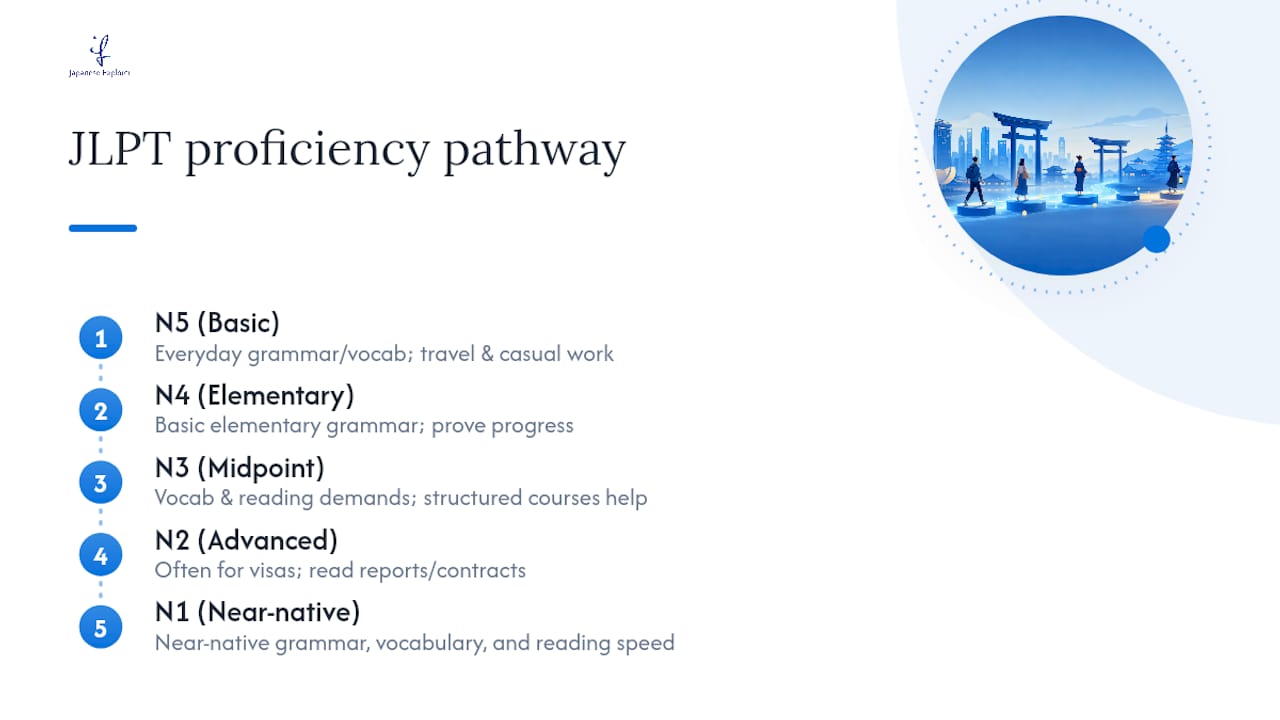
N3 sits at an awkward but important midpoint. It demands enough vocabulary and reading comprehension that self-study alone rarely gets learners there efficiently; structured coursework tends to close that gap faster. N2 and N1 are largely reserved for learners pursuing work or study visas in Japan, or professionals who need to read contracts and reports without translation support.
JLPT is held twice a year in most testing markets, and Singapore is no exception, which means your course timeline should work backward from the nearest sitting date rather than an arbitrary “someday.” A study-pathway resource for Japanese learners recommends treating each JLPT level as a checkpoint rather than the goal itself, since fluency for real conversation and passing a grammar-heavy exam are related but not identical skills. If your goal is workplace communication rather than a certificate, it’s worth telling your course provider that upfront so lesson time isn’t spent drilling exam-format questions you don’t actually need.
Cultural Immersion Opportunities to Practice Japanese in Singapore
Classroom hours only go so far. What separates learners who plateau from those who keep improving is exposure outside the lesson itself, and Singapore offers more of this than people expect.
Language exchange meetups, often organized informally through community boards or social apps, pair Japanese speakers living in Singapore with local learners wanting conversation practice. These sessions cost nothing beyond your own coffee and tend to expose you to natural speech patterns textbooks skip entirely, filler words, casual contractions, the rhythm of real conversation.
Japanese cultural events pop up regularly across the city, from seasonal festivals to food fairs tied to Japanese businesses and cultural associations. Attending one with even basic vocabulary in hand turns a passive outing into active practice: reading menu items, asking simple questions, catching snippets of conversation around you.

Japanese clubs and interest groups, some run through community centers, others informally through hobbyist circles centered on anime, cooking, or travel, give learners a lower-pressure setting than a classroom to test what they’ve learned. Combining club practice with structured coursework tends to accelerate speaking confidence faster than either alone, since you’re applying grammar points from class almost immediately in a social setting rather than waiting for the next lesson to use them.
Community and Institutional Support for Japanese Learners in Singapore
Beyond paid coursework, several institutional channels support Japanese language learning in Singapore. Cultural organizations tied to Japan’s government occasionally run community programs, talks, and cultural workshops open to the public, often at low or no cost, aimed at building broader interest in the language and culture rather than formal certification.
Some employers fund language training directly for staff who deal with Japanese clients or offices, treating it as part of professional development rather than a personal expense. If you work in a role touching Japanese business relationships, it’s worth asking your employer directly whether language training falls under existing professional development budgets before assuming you’ll cover the full cost yourself.
Community-run study groups, often free and organized through local associations or alumni networks of past Japan-based exchange programs, offer another low-cost supplement to formal coursework. These aren’t a replacement for structured lessons, since they rarely follow a fixed curriculum, but they extend practice time between paid sessions at no added cost. Combining one of these community touchpoints with a formal course, whether group, private, or online, tends to be how motivated learners keep momentum going during the months between visible progress milestones.
What Actually Makes a Japanese Course Stick
My honest read after looking at how courses in Singapore actually work: fifteen to thirty minutes of active review most days, plus one dedicated speaking session a week, does more for retention than a single long weekly class ever will. Passive review, just rereading notes, doesn’t count. Active recall, quizzing yourself, writing sentences from memory, does.
Use your placement test result as a starting line, not a verdict on your ability. Set a 90-day goal off it. A realistic beginner pathway looks like this: start in a group class, add a weekly tutor session for personalized correction, and expect a genuine conversational milestone, holding a short unscripted exchange, around the six-month mark if you’re consistent.
— Paul
Ready to Start? Here’s How to Enroll With Japanese Explorer
You don’t need to have your entire language goal mapped out before you start. What actually helps is booking a placement test or a sample lesson first, so you’re not guessing which level fits.
Compared to piecing together free apps and random online tutors, Japanese Explorer gives you one consistent path: a placement test to find your real starting point, then a choice between small-group classes, private lessons, or an online Zoom course that fits around a Singapore work schedule without forcing you to commute anywhere. Corporate teams can also explore business Japanese training built around real workplace scenarios rather than generic textbook dialogue.
Before your first lesson, prepare two things: a short note on why you’re learning (travel, work, exams) and a rough weekly time budget you can realistically commit to. That’s enough for an instructor to place you accurately and start building a plan around your actual goal. Visit the training center at 10 Anson Road, Level 22, International Plaza, Singapore 079903 right above Tanjong Pagar MRT, or book online to get your placement test scheduled this week.
Sources
For broader study-pathway context, see Ssaj and Study in Japan SG’s school listings. Learners relocating for study or work may also find VIVOS’s Singapore relocation guide useful for logistics planning.
FAQ
How Much Does It Cost to Learn Japanese in Singapore?
Costs vary by format: group class terms are typically billed per 8 to 10 week block, private tutoring is charged hourly, and intensive programs charge a flat fee for a fixed block of weeks. Public course listings on MySkillsFuture show fees varying by level and provider, so it’s worth comparing a few quotes at the same level before committing.
How Long Does It Realistically Take to Learn Japanese?
Basic conversational ability usually takes 3 to 6 months of consistent part-time study, JLPT N5 or N4 takes roughly 6 to 12 months depending on intensity, and genuine intermediate proficiency takes 1 to 2 years of sustained effort.
Can I Learn Japanese in 3 Months?
You can build basic conversational phrases and simple exchanges in 3 months with consistent daily practice, but genuine conversational fluency or JLPT-level proficiency typically takes longer, closer to the 3 to 6 month range for basics and 6 to 12 months for N5/N4 level competency.
Where Can I Find Japanese Classes Near Me in Singapore?
Local language schools, private tutors, online Zoom-based providers, and corporate trainers all offer Japanese courses in Singapore. Japanese Explorer offers group, private, and online options, with its training center located at 10 Anson Road, Level 22, International Plaza, right above Tanjong Pagar MRT.