Expect short online business-Japanese programs to run roughly ¥39,600 for an eight-session track, ten-week intensives to land closer to ¥88,000, and monthly in-person tuition at larger schools to sit between ¥50,000 and ¥100,000. Every quote should bundle tuition with an enrollment charge and materials, though how those pieces are billed (per lesson, per week, or per package) varies enough that comparing two providers side by side takes more than glancing at the headline number.
TL;DR:
- Most online programs cost around ¥39,600 for eight sessions, while ten-week intensives can reach ¥88,000, with larger schools charging ¥50,000 to ¥100,000 monthly for in-person classes.
- Fees typically include tuition, enrollment, materials, and assessment or certificate costs, but billing methods and extra charges vary widely by provider.
- Class format significantly impacts price, with private lessons costing the most, small groups offering a middle ground, and larger groups being the most affordable but offering less speaking practice.
- Premium content like keigo, negotiation skills, or industry-specific modules adds extra costs, especially if tailored to corporate needs or bilingual instructors.
- When selecting a course, verify syllabus relevance, instructor certification, class size limits, refund policies, and request a trial to ensure the course meets your workplace communication goals.
Table of Contents
- What do business Japanese course fees usually include?
- How does format and level change what you pay?
- What do real business Japanese course fees look like?
- How do I budget for a business Japanese course?
- What does a reputable business Japanese course fee actually buy you?
- Why business Japanese fees are an investment, not just an expense
- Which Japanese Explorer course fits your budget and goals?
- Sources
- FAQ
What do business Japanese course fees usually include?
Most quotes bundle three or four line items, and separating them is the fastest way to compare providers fairly. The enrollment or registration fee is a one-time charge for joining the school, separate from tuition itself. It typically includes a moderate enrollment fee at established schools, according to a fee comparison covering business Japanese programs, and it doesn’t shrink even if you sign up midway through a term.
Tuition is where the real variation lives. Some schools bill per lesson, others per week, and corporate packages often run as a flat fee for the whole engagement. Converting everything into a per-lesson rate is the only honest way to line up a subscription-style online course against a fixed intensive package.
Beyond tuition, watch for these recurring extras:
- Textbooks or printed materials, often ¥10,000 to ¥20,000 separately from tuition
- Certificate or assessment fees at course completion
- Administrative charges for scheduling changes or makeup lessons
- Bank or transfer charges if you’re paying from abroad through a service like Flywire, which some schools note gets passed to the student
Refund and cancellation terms matter more than they look. Some providers prorate tuition by week for late joiners and apply a cancellation fee inside the first week, a detail buried on course pages that can shift your effective cost by thousands of yen if your schedule changes mid-term.
How does format and level change what you pay?
Class format is the single biggest lever on price. Private lessons cost the most per hour because you’re buying a teacher’s full attention, small-group classes split that cost across three to six learners, and large-group classes bring the per-head price down further but at the expense of speaking time.
Specialist content adds a premium on top of format. A course built around keigo (formal business language), negotiation phrasing, or presentation skills demands more from an instructor than general conversation practice, and schools price that expertise accordingly. Corporate customization compounds this: on-site delivery, tailored case studies for your industry, and flexible scheduling around work hours all add cost versus a standard cohort class.
A few concrete cost drivers to check before comparing quotes:
- Class size caps (a “small group” advertised at 8 learners costs differently than one capped at 4)
- Teacher seniority and whether bilingual certification is guaranteed
- Whether course materials are included or billed as extras
- Whether the syllabus maps to a JLPT level or workplace outcome you actually need
Pro Tip: Ask for the syllabus before asking for the price. A cheaper course that skips negotiation phrasing or keigo entirely isn’t a bargain if it doesn’t prepare you for the meetings you’re actually walking into.
What do real business Japanese course fees look like?
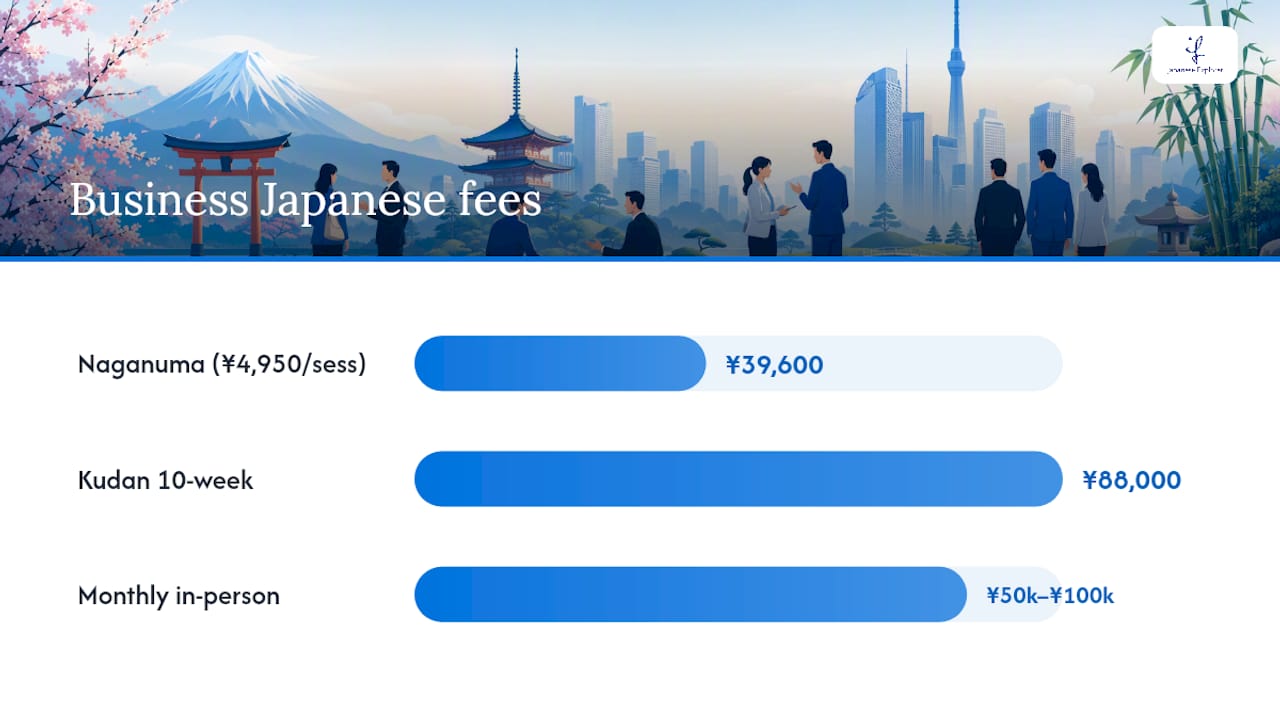
Numbers help more than ranges alone, so here’s what published pricing actually shows. Naganuma’s online Business Japanese tracks list both their Basic and Practical courses at ¥39,600 (tax included) for eight sessions, which works out to roughly ¥4,950 per session before factoring in any materials fee.
Across three representative providers, an eight-session online course, a ten-week intensive, and a monthly in-person program span roughly ¥39,600 to ¥100,000, depending almost entirely on format and duration rather than teaching quality alone.
At the longer end, Kudan Institute’s ten-week Business Japanese course is priced at ¥88,000, and it includes a free 15-minute class observation before you commit, a detail worth more than it sounds since it lets you sit in before paying anything. Monthly in-person tuition at larger schools tends to run ¥50,000 to ¥100,000 per month, per the fee comparison cited earlier, before enrollment and material charges are added on top.
To compare fairly, always divide the total package by the number of contact hours. A ¥39,600 package with eight one-hour sessions costs less per hour than a ¥50,000 monthly plan with only four sessions, even though the monthly plan’s sticker price looks smaller.
How do I budget for a business Japanese course?
Start with a short checklist before you request any quotes. Confirm your actual objective (client meetings, internal reports, negotiation), how many hours per week you can realistically commit, whether you learn faster in a group or one-on-one, and what a provider’s refund policy looks like if your schedule collapses mid-course.
When you do request a quote, ask for these specifically:
- A sample syllabus mapped to your target JLPT level or workplace scenario
- The teacher’s bilingual certification and years of business-Japanese teaching experience
- The maximum class size and what happens if enrollment drops below it
- The makeup-lesson and refund policy in writing, not just verbally
- For corporate buyers, the per-employee rate at two or three different headcounts, since corporate training pricing often includes volume discounts that vary by group size
Many schools run seasonal promotions in spring and fall that waive the enrollment fee or discount the first month, so timing your sign-up around these windows can meaningfully lower upfront cost. Treat a quote that hides class size, refuses to share a sample lesson, or won’t commit to a refund policy in writing as a red flag regardless of how attractive the headline price looks.
Pro Tip: If you’re comparing a private course against a small-group class, ask both providers for their price per contact hour, not per month. It’s the only number that controls for how many actual lessons you’re getting.
What does a reputable business Japanese course fee actually buy you?
Fee comparisons only tell half the story if you don’t know what separates a ¥40,000 course from an ¥80,000 one — especially when considering how to participate in class discussions in a foreign language effectively. At this level, you should expect certified bilingual instructors, not just fluent speakers, and a curriculum that follows structured guidance rather than an improvised mix of textbook chapters. Com’s business Japanese courses build lessons around a curriculum shaped by the Association for Japanese-Language Teaching, which keeps grammar, keigo, and workplace scenarios integrated rather than taught in isolation.
At this tier, a fair price typically includes:
- Bilingual, certified instructors with business-context teaching experience
- Modules built around real workplace situations: meetings, emails, client-facing conversations
- A placement test so you’re not paying to sit through material you’ve already mastered
- A free lesson observation or trial, letting you evaluate teaching style before paying full tuition
Why business Japanese fees are an investment, not just an expense
Paying for a business Japanese course really means investing in faster, less awkward relationships with colleagues and clients who default to Japanese. That’s the return worth measuring, not just the hourly rate. Prioritize programs that show you a syllabus and a placement test over ones that only show you a price sheet, because outcomes, not sticker price, determine whether the fee was worth paying.
Before you commit, request the syllabus, book a trial observation, and if you’re buying for a team, ask for a corporate quote broken down by headcount.
— Paul
Which Japanese Explorer course fits your budget and goals?
If you’ve been weighing an eight-session online package against a ten-week intensive, Com gives you that same range of formats without forcing you to piece together fee structures from three different providers. Our business Japanese courses cover the workplace scenarios this guide walked through, keigo, negotiation phrasing, and client communication, taught by certified bilingual instructors rather than general conversation teachers repurposed for business content.
For individuals, our small-group classes and online courses let you pick the format that matches your schedule and budget without paying private-lesson rates for group-sized learning goals. For HR teams and organizations, our corporate training programs are priced per headcount with customization built around your industry’s actual vocabulary needs. Our training centre sits at 10 Anson Road, Level 22, International Plaza, Singapore 079903, right above Tanjong Pagar MRT, if you’d rather discuss your syllabus in person. Reach out for a placement test or a corporate quote, and start with what your team’s meetings actually sound like rather than a generic price list.
Sources
FAQ
How much does it cost to learn Japanese in Singapore?
Costs vary by format and duration, but adult group courses commonly run from a few hundred dollars for short modules up to several thousand for extended programs, with online options typically priced lower than in-person small-group classes.
How much does a business Japanese course cost?
Published fees range from around ¥39,600 for an eight-session online track to ¥88,000 for a ten-week intensive, with monthly in-person tuition at larger schools typically between ¥50,000 and ¥100,000, according to the fee comparison referenced above.
How do I learn business Japanese effectively?
Focus on a curriculum that integrates keigo, meeting phrasing, and client communication rather than general conversation alone, ideally taught by a certified bilingual instructor who can explain workplace context, not just vocabulary.
What do JLPT levels N1 through N5 mean?
The JLPT scales from N5 (basic phrases and simple grammar) to N1 (near-native comprehension of complex, nuanced Japanese), and most business Japanese courses target N3 through N1 depending on your role and how much written or negotiation-level Japanese you need.
What should I ask a provider before paying business Japanese course fees?
Request a sample syllabus, the instructor’s bilingual certification, the maximum class size, and the refund or makeup-lesson policy in writing before comparing final prices across providers.