Group Japanese class fees typically run $150 to $600 per 8 to 12 week course, which works out to roughly $12 to $20 per hour once you factor in total classroom time. For most adult learners chasing conversational fluency or workplace Japanese, group classes deliver far better value than private tutoring, since you get structured curriculum and live speaking practice at a fraction of the one-on-one rate. The sections below break down exactly what drives that range and how to spot a fair deal.
TL;DR:
- Group Japanese classes generally cost between $12 and $20 per hour, depending on course length, format, and class size.
- Smaller classes with 6 to 8 students tend to be more expensive per person due to increased individual speaking time.
- Courses focused on business Japanese or exam prep usually carry higher fees because of specialized instruction and smaller groups.
- Bundling multiple courses, registering early, or using referral discounts can significantly reduce overall costs.
- In-person classes generally cost more than online sessions, but both formats follow similar curricula and pacing.
Table of Contents
- What Do Group Japanese Class Fees Typically Include?
- What Makes One Group Class More Expensive Than Another?
- How Do You Compare Group Class Value?
- Group Classes vs. Private Lessons: Which Costs Less Per Hour?
- How Can You Lower Your Effective Class Cost?
- Why Japanese Explorer Delivers Solid Value for Group Classes
- What Should You Do After Comparing Prices?
- Ready to Start? Here’s Your Next Step
- Sources
- FAQ
What Do Group Japanese Class Fees Typically Include?
Advertised prices for group Japanese classes cluster into three rough tiers, and knowing which tier you’re looking at helps you avoid comparing apples to oranges.
Community and cultural center programs tend to sit at the lower end. Published session fees for 8 to 12-class blocks at places like Japan Society’s spring courses commonly land between $150 and $400, with member rates pulling the lower number and non-member pricing pushing toward the top. Mid-range language schools, the kind most adult learners in Singapore actually enroll with, price a 10-class course closer to $250 to $360, while a longer 20-class program can run $600 or more, according to sample pricing from JASCO’s language program listings. Premium or intensive programs with smaller classes and more contact hours sit above that.
How you’re billed matters as much as the sticker price. Three billing models dominate the market:
- Per lesson or drop-in rate — flexible but usually the most expensive per hour.
- Per block or term (typically 8 to 12 weeks) — the most common structure, and usually where you’ll get the best per-hour value.
- Monthly subscription — convenient for ongoing study but harder to compare directly against fixed-term pricing.
Whichever model you pick, budget for extras beyond tuition. Textbooks are frequently sold separately, often $30 to $50 per level, and many providers tack on registration or administrative fees plus cancellation penalties if you drop out mid-term.
What Makes One Group Class More Expensive Than Another?
Four factors explain almost every price gap you’ll see between programs.
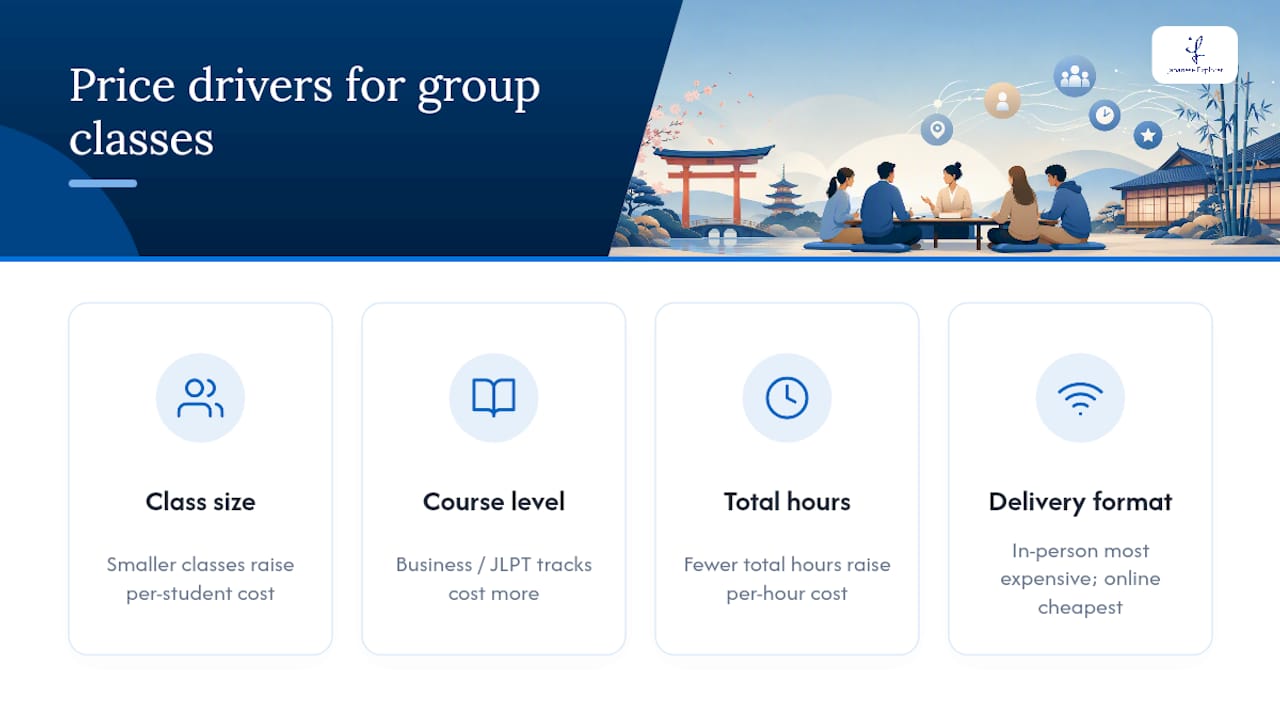
Class size is the biggest one. A session capped at 6 to 8 students costs more per head than one packed with 15, because you’re paying for more individual attention from the instructor. Smaller ratios mean more speaking time per person, which matters enormously in a language where pronunciation and pitch accent are notoriously hard to self-correct.
Course level and specialization add a premium too. A beginner conversational class usually costs less than a course built around business Japanese or JLPT exam preparation, since those tracks demand instructors with more targeted expertise and often smaller cohorts.
Total classroom hours change your effective hourly rate more than the headline price does. An 8-week course and a 12-week course might look similar in advertised cost, but if one packs in 24 contact hours and the other only 16, the per-hour math tells a very different story. Sample tuition tables for 12-week, 2-hour group sessions commonly price out to somewhere in the mid-teens per hour once you divide the total.
Finally, format matters. In-person classes generally cost more than online Zoom-based sessions, since online delivery cuts venue overhead. Blended models, part live instruction, part self-paced review, often price between the two.
How Do You Compare Group Class Value?
Don’t just compare sticker prices. Run each option through the same checklist before you commit:
- Total instructional hours across the full course, not just the number of weeks.
- Student to teacher ratio in the actual class you’d join, not a marketing average.
- Instructor qualifications and whether they’re bilingual and experienced teaching adults specifically.
- Curriculum standard the school follows, ideally one aligned with a recognized language teaching framework.
- What’s included versus billed separately (textbooks, assessments, materials).
- Progress checks or placement testing so you know the pacing suits your level.
- Refund and cancellation policy in writing, before you pay anything.
The math itself is simple: take the advertised price and divide by total classroom hours. A $360 course with 24 hours of instruction works out to $15 per hour. A $400 course with only 16 hours works out to $25 per hour, even though the sticker price looks similar.
Pro Tip: Always ask for the total contact hours in writing before comparing two programs. Schools sometimes quote “12 weeks” without specifying session length, and a 1-hour weekly class costs wildly less per course than a 2-hour one, even at the same weekly price.
Watch for red flags: no named instructor, a vague or shifting schedule, or fees that only appear after you’ve already paid the deposit.
Group Classes vs. Private Lessons: Which Costs Less Per Hour?
Private tutoring runs significantly higher per hour than group instruction, often several times the group rate, because you’re paying for one instructor’s full attention instead of splitting it across a room. That premium is worth it if you need targeted remediation, are prepping intensively for a JLPT deadline, or need executive-level business Japanese tailored to your specific industry vocabulary.
For most adults building conversational fluency or general workplace Japanese, group classes win on cost and often on outcomes too, since peer interaction forces you to actually use the language out loud. A $300 group course covering 20 hours beats a private tutor covering the same 20 hours by a wide margin, even before you factor in the community and accountability that a group setting provides.
How Can You Lower Your Effective Class Cost?
A few tactics reliably shrink what you actually pay without downgrading quality.
- Multi-course bundles. Some providers offer discounts of around 15% when you enroll in two courses at once, according to published Japan Society course notes. Group-buy structures like those seen at other language schools offering bundled enrollment follow a similar logic.
- Early-bird and off-peak pricing. Enrolling ahead of the term start or choosing daytime over evening slots sometimes unlocks a lower rate.
- Referral discounts. Bringing a friend along can cut costs for both of you.
- Corporate packages. If your employer is funding the course, ask about group rates for corporate training — providers often price these differently than individual walk-in enrollment.
- Installment plans. Many schools will split payment across the term if you simply ask.
When you inquire, ask directly: “Do you offer any bundle, referral, or installment options not listed on the website?” Unpublished discounts exist more often than course pages let on.
Why Japanese Explorer Delivers Solid Value for Group Classes
We built our group class structure around a simple idea: adult learners deserve a real curriculum, not just a conversation circle. Our courses follow guidance from the Association for Japanese-Language Teaching, which keeps grammar, speaking, and listening integrated into every session instead of treated as separate afterthoughts. That structure is what turns a course into measurable progress rather than a vague sense of “getting better.”
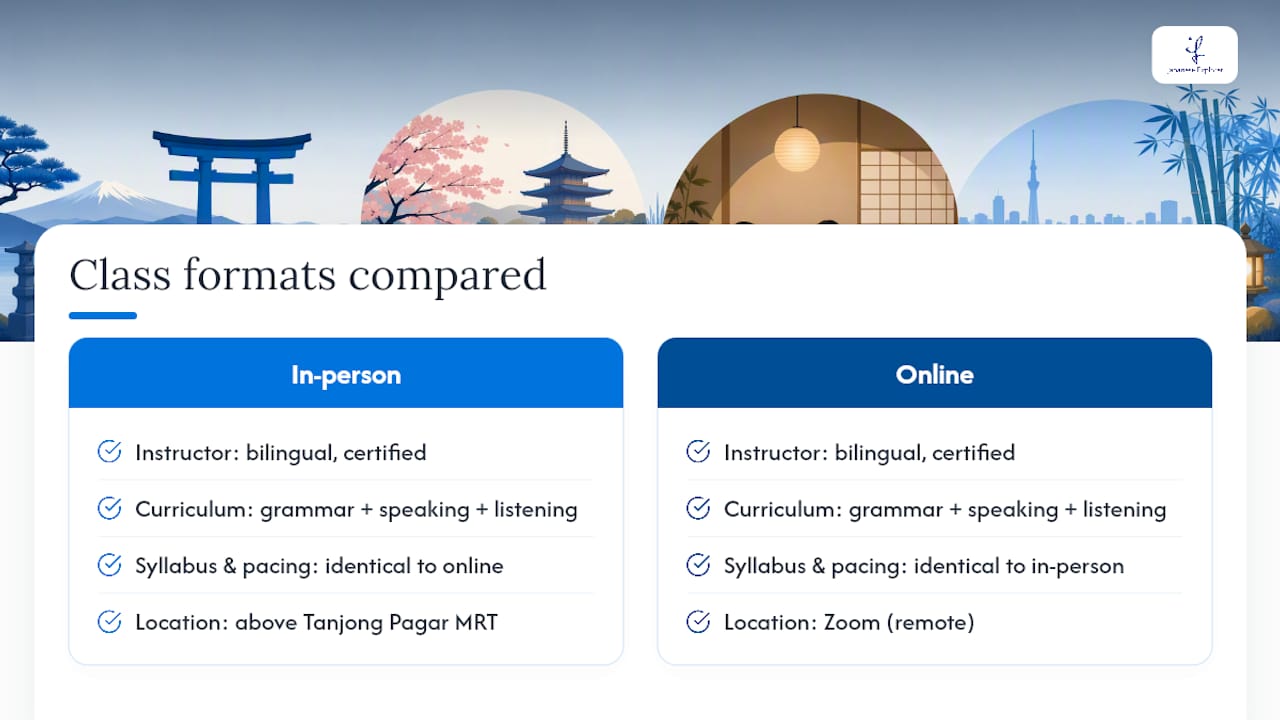
Every class is led by an experienced, bilingual, certified instructor who understands how adults actually learn a language while balancing work and life. You can join us in person at our city-center location, right above Tanjong Pagar MRT, or online over Zoom if flexibility matters more to you than a classroom seat. Both formats follow the same syllabus and pacing, so switching between them doesn’t set you back.
If you’re weighing proficiency levels or comparing schools generally, our guide on what to look for in a Japanese language school walks through the same checklist covered above, applied specifically to real course listings.
What Should You Do After Comparing Prices?
Calculate the cost per hour for your top two or three options before deciding anything else. Book a trial lesson if one’s offered, and ask for placement testing so you land in the right level rather than guessing. Confirm the refund and cancellation policy in writing.
Match the course type to your actual goal: conversational classes for everyday fluency, business-focused tracks if you need Japanese for work. Price matters, but the right fit matters more.
— Paul
Ready to Start? Here’s Your Next Step
You’ve seen the fee ranges, the billing models, and what actually drives cost per hour. Japanese Explorer’s group classes give you the AJLT-guided structure and bilingual, certified instructors that make those hours count, without the premium price tag of one-on-one tutoring.
Whether you want conversational fluency for an upcoming trip or business Japanese for work, our small group classes run both in person at our city-center location above Tanjong Pagar MRT and online over Zoom, so you can pick whichever fits your schedule. Browse our current course schedule and enrollment options and book a trial lesson to see the curriculum in action before you commit to a full term.
Sources
- 2026 SPRING JAPANESE COURSES (Japan Society) — tuition examples and session pricing
- Japanese group classes — Japan Society of Northern California — tuition and per-hour examples
FAQ
How much does a group Japanese class typically cost?
Group Japanese class fees usually range from $150 to $600 per 8 to 12 week course, which works out to roughly $12 to $20 per hour depending on class size, level, and format.
Are group Japanese classes cheaper than private lessons?
Yes, group classes cost significantly less per hour than private tutoring, since the instructor’s time is split across multiple students rather than dedicated to one person.
What extra fees should I expect beyond tuition?
Budget separately for textbooks, often $30 to $50 per level, plus possible registration, administrative, or cancellation fees that aren’t always included in the headline course price.
Does class size affect the fee I pay?
Yes, smaller class sizes with lower student to teacher ratios generally cost more per student, since each learner gets more individual speaking time and correction.
Is Japanese Explorer’s group class pricing competitive for adult learners?
Japanese Explorer structures group classes around an AJLT-guided curriculum taught by bilingual, certified instructors, offering both in-person and online Zoom formats so you get structured progress at a group-class price point.
Should I choose a shorter or longer course term?
It depends on your goal: shorter 8-week terms suit learners testing the waters, while 12-week terms typically offer more total classroom hours and a lower effective cost per hour.