Six phrases can carry you through the hardest moments of a Japanese job interview: 失礼いたします (shitsurei itashimasu, “excuse me for entering”), 本日はお時間をいただきありがとうございます (honjitsu wa ojikan wo itadaki arigatou gozaimasu, “thank you for your time today”), your name plus 〇〇と申します (…to moushimasu, “I am called…”), 本日はよろしくお願いいたします (honjitsu wa yoroshiku onegai itashimasu, “I appreciate your consideration today”), and at the end, 本日は貴重なお時間をいただきありがとうございました (honjitsu wa kichouna ojikan wo itadaki arigatou gozaimashita, “thank you for this valuable time”) followed by 何卒よろしくお願いいたします (nanitozo yoroshiku onegai itashimasu, a formal closing request for good favor).
Each one has a fixed moment. Say 失礼いたします the instant you open the door. Use your name plus と申します right after you’re invited to sit. Save 本日はよろしくお願いいたします for the very start of the conversation, and hold the thank you plus 何卒よろしくお願いいたします for your exit line. These Japanese job interview phrases work because they’re timed, not just memorized.
- 失礼いたします — say this while opening the door, then bow after you finish speaking
- 本日はお時間をいただきありがとうございます — deliver once seated, before the interview questions start
- (Name) と申します — pair with a light bow immediately after introducing yourself
- 本日はよろしくお願いいたします — closes your opening greeting
- 本日は貴重なお時間をいただきありがとうございました — your final thank you, said standing
- 何卒よろしくお願いいたします — the last words you say before leaving the room
Pro Tip: Never bow and speak at the same time. Say the phrase, pause, then bow. Doing both simultaneously is one of the fastest ways to look rushed rather than composed.
Key Takeaways
Mastering Japanese job interview phrases requires timed delivery, a fixed entering sequence, a 60 to 90 second self-introduction, and consistent keigo register throughout.
| Point | Details |
|---|---|
| Timing matters as much as wording | Say 失礼いたします while entering and save your thank you phrase for the exit, not the middle. |
| Keep 自己紹介 under 90 seconds | Structure it as name, background, one achievement, reason for applying, and close. |
| Use kenjōgo for yourself only | Verbs like 申します and いたします are safer than sonkeigo forms for describing your own actions. |
| Prepare two to three questions | Asking nothing at the end reads as low interest to most interviewers. |
| Rehearse with structured coaching | Private lessons and business Japanese courses at Japanese Explorer build mock-interview practice into real feedback sessions. |
Where to Study Keigo and Interview Phrases Further
A handful of sources are worth bookmarking as you keep practicing:
- JP YoKoSo’s interview guide for stage-by-stage phrase breakdowns
- Migaku’s phrase and Q&A guide for keigo verb tables
- Gaijin Hunter’s etiquette rules for unwritten cultural expectations
- BorderlessCV’s nonverbal communication guide for seating and bow protocol
Table of Contents
- Japanese Interview Etiquette Before You Even Sit Down
- How to Structure Your Self-Introduction (自己紹介)
- Common Interview Questions and How to Answer Them
- Keigo Basics You Actually Need for an Interview
- Questions to Ask and How to Close the Interview
- What Most Interview Guides Get Wrong
- Sources
- FAQ
Japanese Interview Etiquette Before You Even Sit Down
The moments before you say a single word about your résumé get evaluated just as closely as your answers. A structured entering sequence signals that you understand the room, not just the language.
Here’s the sequence to rehearse until it feels automatic:
- Knock (traditionally three times), then wait. Never open the door until you hear どうぞ (douzo, “please, go ahead”).
- Open the door, say 失礼いたします, and step in.
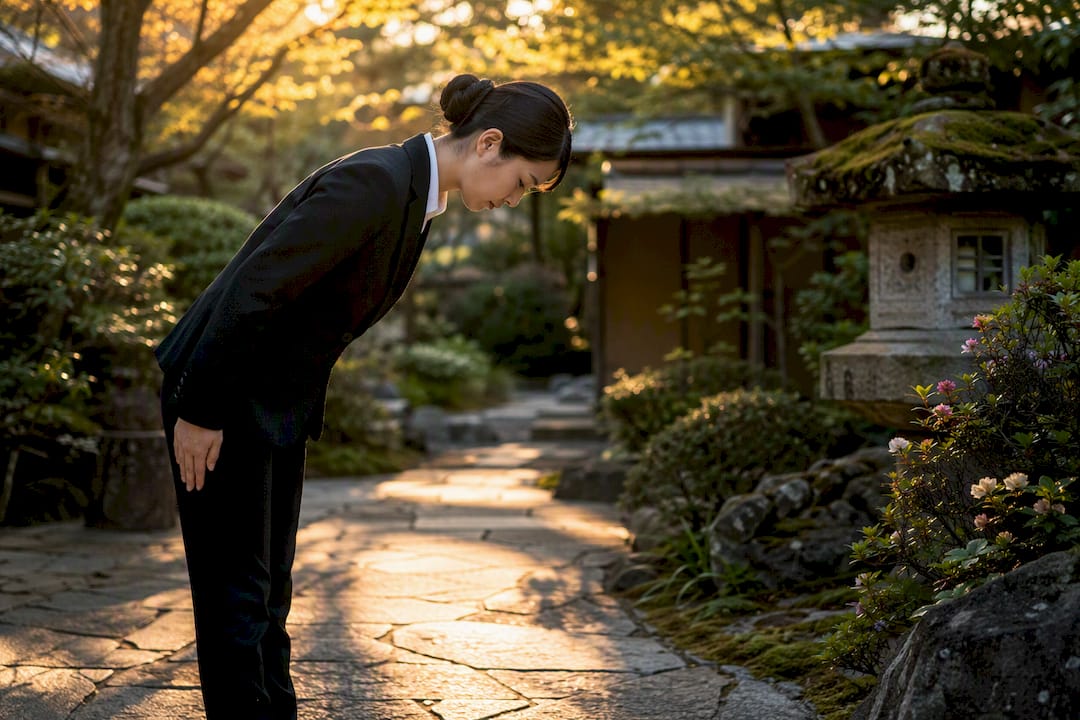
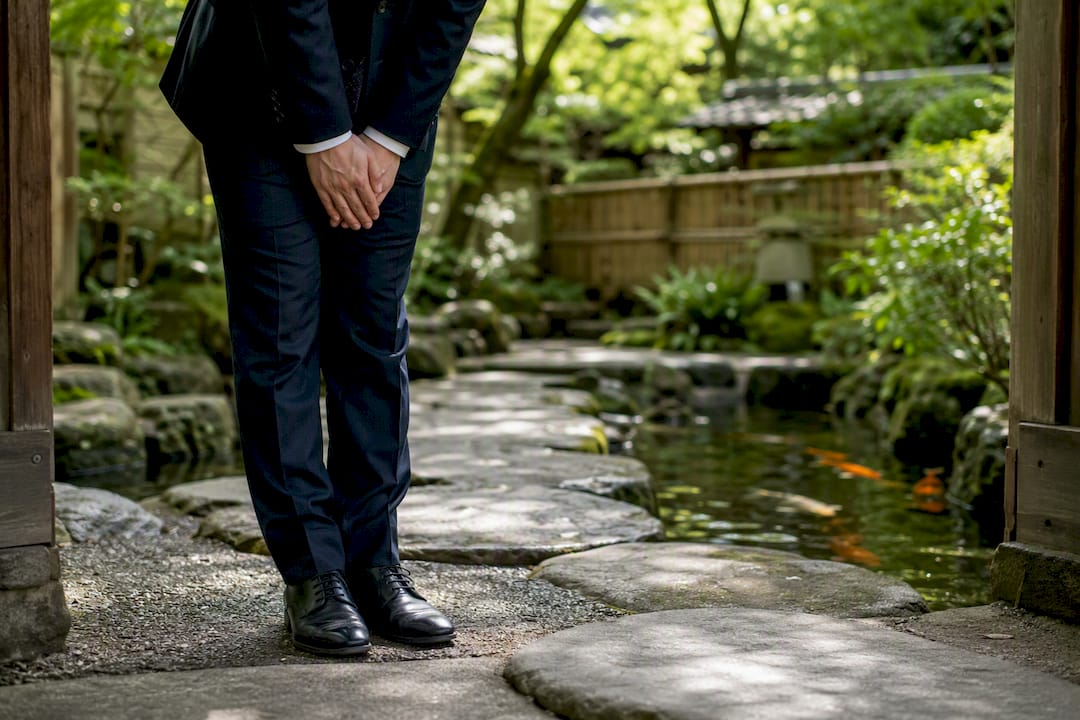
- Bow at roughly 30 degrees, the standard keirei used for greetings. Speak first, then bow. Never combine the two into one motion.
- Walk to the chair and stand beside it. Do not sit.
- Wait for どうぞおかけください (douzo okake kudasai, “please, have a seat”) before lowering yourself into the chair.
- Sit with your back straight, hands resting on your knees or lap, feet flat.
Seating in a Japanese interview room often follows a hierarchy tied to the door and the most senior seat in the room, so let the interviewer’s cue tell you exactly where and when to sit rather than assuming. Treat every action in this entering protocol as one continuous, evaluated performance rather than a checklist you rush through.
A few small mistakes undo all of that preparation fast: checking your phone in the waiting area, chewing gum, sitting before you’re invited, or letting your bag rest on your lap instead of by your side. None of these are language errors. They’re attention errors, and Japanese interviewers notice them just as quickly as a grammar mistake.
Pro Tip: Practice the knock, bow, and sit sequence as three separate, deliberate beats, not one fluid motion. Interviewers read hesitation as care, not weakness.
How to Structure Your Self-Introduction (自己紹介)
Most Japanese interviews open with 自己紹介 (jikoshoukai), and the timing matters more than people expect. Aim for 60 to 90 seconds, no more. Longer than that and you start repeating your résumé; shorter and you look underprepared.
The structure that works across almost every industry:
- Your name, delivered with と申します
- One or two lines of professional background
- A single, specific achievement, not a list of duties
- Your reason for applying to this company specifically
- A closing line handing the conversation back to the interviewer
Three short scripts show how this flexes by career stage:
- Entry-level: 田中と申します。大学では経営学を専攻し、インターンシップで営業のサポートを経験しました。貴社の〇〇という事業に強い関心があり、応募いたしました。よろしくお願いいたします。 (Tanaka to moushimasu. Daigaku de keieigaku wo senkou shi, intern shippu de eigyou no support wo keiken shimashita. “I’m called Tanaka. I majored in business management and supported sales during an internship. I’m applying because of my strong interest in your company’s [business area].”)
- Mid-career: 佐藤と申します。前職では5年間、プロジェクト管理に携わり、チームで納期を20%短縮した経験があります。貴社でその経験を活かしたいと考えております。 (Satou to moushimasu. “I’m called Satou. In my previous role, I spent five years in project management and helped my team cut delivery time by 20 percent. I’d like to bring that experience here.”)
- Career-changer: 鈴木と申します。これまで異なる業界におりましたが、貴社の分野に強く惹かれ、新しい挑戦をしたいと考え応募いたしました。 (Suzuki to moushimasu. “I’m called Suzuki. My background is in a different industry, but I was drawn strongly to your company’s field and wanted to take on a new challenge.”)
Keep a short mental checklist while you edit: cut anything from your childhood or unrelated hobbies, keep exactly one achievement sentence, and end on the company, not on yourself. A well-timed self-introduction in Japanese is the single highest-leverage 90 seconds of the entire interview, since it sets the tone for every question that follows.
Common Interview Questions and How to Answer Them
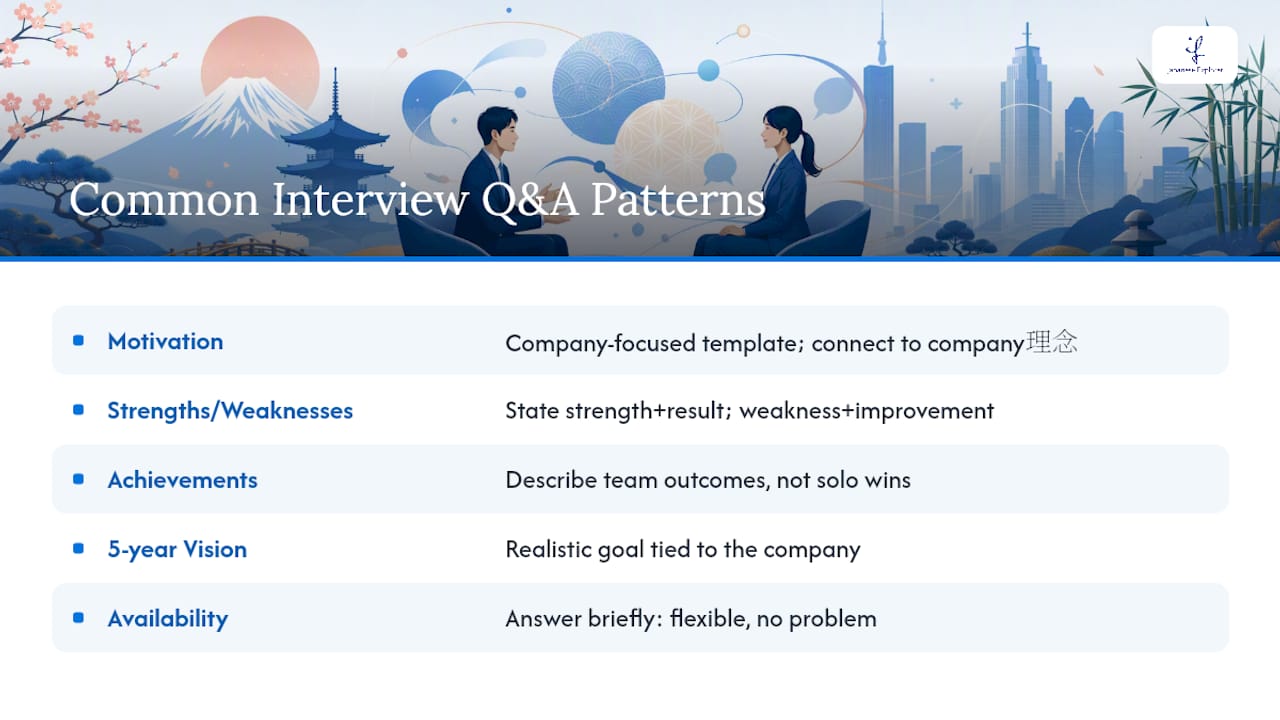
Five questions come up in nearly every Japanese job interview, and each one rewards a specific pattern of answer, not just a translated version of what you’d say in English.
志望動機 (why this company)
Model: 貴社の〇〇という理念に共感し、これまでの経験を活かして貢献したいと考え、志望いたしました。(“I connected with your company’s philosophy of [X], and I want to contribute using my experience, so I applied.”)
Template: 貴社の___という点に魅力を感じ、___の経験を活かして貢献したいと考えております。
長所・短所 (strengths and weaknesses)
For strengths, name one trait and one concrete result. For weaknesses, name a real one and immediately follow with the step you’re taking to improve it. Never end a weakness answer without that improvement clause. Model: 短所は慎重になりすぎることですが、期限を意識して優先順位をつけるよう心がけています。(“My weakness is being overly cautious, but I’m working on prioritizing tasks with deadlines in mind.”)
前職での実績 (past achievements)
Frame results as team outcomes, not solo wins. Japanese firms generally value contributions to team harmony over individual credit, so a line like チームで取り組み、〇〇を達成しました (“working as a team, we achieved [X]”) lands better than a purely first-person brag.
5年後のビジョン (five-year vision)
Keep it realistic and tied to the company, not a personal fantasy. Template: 5年後には___としてスキルを磨き、貴社の___に貢献したいと考えています。
残業・勤務条件 (availability and working conditions)
Answer directly and briefly: 特に問題ございません。柔軟に対応いたします。(“That’s not a problem for me. I can be flexible.”)
Pro Tip: For every question about a personal shortcoming, structure your answer as fact, then fix. State the weakness plainly, then name the one action you’re taking about it. Skipping the fix is the most common way candidates sound unprepared in this exact moment.
Keigo Basics You Actually Need for an Interview
You don’t need mastery of every honorific form to sound professional. You need one reliable baseline and a handful of safe substitutions. Interview-level Japanese runs mostly on 丁寧語 (teineigo) as the safe baseline, with 謙譲語 (kenjougo, humble forms) layered in for your own actions.
The rule of thumb: lower yourself with humble verbs, raise the interviewer and their company with respectful verbs, and never mix the two systems on the same subject.
| Meaning | Polite (丁寧語) | Humble, for yourself (謙譲語) | Respectful, for the interviewer (尊敬語) |
|---|---|---|---|
| Say | 言います (iimasu) | 申します (moushimasu) | おっしゃいます (ossharaimasu) |
| Go / come | 行きます (ikimasu) | 参ります (mairimasu) | いらっしゃいます (irasshaimasu) |
| Do | します (shimasu) | いたします (itashimasu) | なさいます (nasaimasu) |
| See / watch | 見ます (mimasu) | 拝見します (haiken shimasu) | ご覧になります (goran ni narimasu) |
| Know | 知っています (shitte imasu) | 存じております (zonjite orimasu) | ご存知です (gozonji desu) |
The most common register mistake is applying a respectful verb to yourself, saying something like いらっしゃいました about your own arrival instead of 参りました. When in doubt, kenjōgo II forms like いたします and 参ります are almost always the safer choice for describing what you did, since they’re simpler to construct correctly than full sonkeigo.
- Traditional domestic firms tend to weigh keigo precision more heavily
- Foreign-affiliated companies generally tolerate small slips if your content and confidence are strong
- 恐れ入りますが、もう一度お願いできますでしょうか is the phrase to use if you don’t catch a question, far better than guessing at an answer
Questions to Ask and How to Close the Interview
Nearly every Japanese interview ends with 最後に、何かご質問はありますか? (“Finally, do you have any questions?”), and showing up with nothing prepared reads as low interest.
Two or three questions is the right range. Good territory:
- Training and onboarding: 入社後の研修について教えていただけますか?
- Early success metrics: 入社後3ヶ月で期待される成果はございますか?
- Team structure: チームの構成について伺ってもよろしいでしょうか?
Lead any question with a soft opener like 一点伺ってもよろしいでしょうか (itten ukagatte mo yoroshii deshouka, “may I ask one thing?”). It cushions the question and reads as polished rather than abrupt.
When it’s time to leave, stand, bow, and say 本日は貴重なお時間をいただきありがとうございました, followed by 何卒よろしくお願いいたします. A short thank you note the same day or the next morning, three to five sentences, reinforces that closing impression without overdoing it.
Your 30 to 90 Minute Rehearsal Plan
Run this three-step sequence the night before or the morning of your interview, as suggested by the Arvo blog:
- Script drafting (15 to 30 minutes): write out your self-introduction and top five answers.
- Shadowing and timing (15 to 20 minutes): read them aloud, timing your self-introduction to stay inside 60 to 90 seconds.
- Mock interview (15 to 40 minutes): run through it with a partner or coach who interrupts you with follow-up questions.
Ask your partner to grade tone, register consistency, and pacing, not just word accuracy.
Pro Tip: Record your first 60 seconds on your phone and compare it against a model script. Pacing problems are almost invisible until you hear them played back.
Why Classroom Practice Beats Solo Memorization
This article draws on interview coaching approaches used at Japanese Explorer, where Paul and the teaching team work with adult learners on real interview scenarios, not just vocabulary lists.
- Private lessons let you run full mock interviews with immediate correction on keigo register
- Business Japanese coursework covers the exact vocabulary this article walks through: keigo, formal openers, and closing etiquette
- Group classes provide peer practice for candidates who want lower-pressure repetition before a live interview
What Most Interview Guides Get Wrong
Most advice on Japanese interview phrases treats language and etiquette as separate tracks: learn the words in one session, learn the bowing in another. That split doesn’t match how interviewers actually evaluate you. A perfectly conjugated 申します delivered while sitting down early cancels itself out. The sequence and the phrase are one skill, not two.
The bigger blind spot is over-indexing on keigo perfection at the expense of pacing. A candidate who nails every humble verb but rambles for three minutes on their self-introduction reads worse than someone who keeps it to 90 seconds with a few small register slips. Timing signals self-awareness. Grammar signals study. Interviewers in Japan tend to reward the first more than outsiders expect.
If you take one thing from this guide, make it this: rehearse the entering sequence and the self-introduction until they’re physical habit, not conscious translation. Everything else, the keigo tables, the sample questions, can be reviewed the morning of. Those two moments happen in the first ninety seconds, and they’re the ones nobody gets a second take on.
— Paul
Practice These Phrases With a Real Mock Interview
Reading through scripts gets you halfway there. The part that actually changes how you sound in the room is having someone push back on your timing and correct your keigo register in real time, which is exactly what one-on-one coaching is built for.
Japanese Explorer’s private Japanese course is built around this kind of targeted practice, and its business Japanese course covers the formal register this article walks through in depth, from entering phrases to closing lines. Classes run in person at 10 Anson Road, Level 22, International Plaza, right above Tanjong Pagar MRT, or over Zoom if you’d rather rehearse from home. If your interview is coming up soon, book a private lesson and run a full mock interview before the real one.
Sources
- Japanese Job Interview Phrases: What to Say from Entry to Exit | JP YoKoSo
- Japanese Job Interview Guide for Foreign Engineers & Professionals (2026) | Expat Japan
- Japanese Job Interview Phrases: Useful Phrases and QA Guide for 2026 | Migaku
- Japanese interview etiquette, the rules that aren’t on the job listing | Gaijin Hunter
FAQ
How Do You Impress a Japanese Interviewer?
Nail the entering sequence (knock, wait, 失礼いたします, bow), keep your self-introduction inside 60 to 90 seconds, and frame your achievements as team results rather than solo wins.
What’s the Japanese Phrase for “Good Job”?
お疲れ様でした (otsukaresama deshita) is the standard phrase colleagues use after finishing work together, though it’s rarely said by a candidate to an interviewer in a formal interview setting.
How Do You Introduce Yourself in a Japanese Job Interview?
State your name with と申します, add one or two lines of background, mention a single concrete achievement, then give your reason for applying, all within about 90 seconds.
What Are the Most Common Questions in a Japanese Interview?
Expect 志望動機 (why this company), 長所・短所 (strengths and weaknesses), past achievements, your five-year vision, and questions about availability or overtime.
What if I Don’t Understand a Question?
Ask for clarification with 恐れ入りますが、もう一度お願いできますでしょうか rather than guessing at an answer; it reads as professionalism, not weakness.