
A single downloadable, printable JLPT N4 grammar list sits right here, collecting the grammar points that show up most often on the exam. Counts vary depending on the source you check.
Statistic snapshot: Published N4 lists range from 57 points on the tighter end to over 132 lessons on the broader end, with several guides landing near 68 to 80 points in between.
- Download: JLPT_N4_Grammar_List_Printable.pdf
- Format: one-page index plus per-point lesson links
- Best for: daily review, print-and-annotate study, and quick pre-exam scanning
There is no single official JLPT grammar list published by the testing body itself, which is exactly why counts differ so much from site to site.
Key Takeaways
Passing the JLPT N4 requires working through a complete grammar list with active production practice, not passive rereading, paired with timed mock tests before exam day.
| Point | Details |
|---|---|
| Grammar counts vary by source | Published N4 lists range from 57 to over 132 points depending on the guide, since no single official list exists. |
| Use the list actively | Convert each entry into a written sentence, a spoken sentence, and a quiz question rather than just reading it. |
| Prioritize known bottlenecks | Conditionals, transitivity pairs, and potential versus passive forms cause the most errors across N4 candidates. |
| Grammar threads through every section | Reading and listening questions depend on grammar recognition, so never study grammar in isolation. |
| Classes convert review into results | Japanese Explorer’s group, private, and online N4 classes add instructor correction and timed mock tests a printed list can’t provide. |
Table of Contents
- What’s in the Full JLPT N4 Grammar List
- How Should You Actually Use This Grammar List?
- Which Textbooks, Flashcards, and Apps Are Worth Your Time?
- The N4 Grammar Points That Trip Up the Most Learners
- Why Structured Classes Turn a List Into Exam Results
- Common Mistakes to Avoid With N4 Grammar Points
- How the N4 Exam Is Structured, and Where Grammar Fits
- How Does N4 Grammar Compare to N5 and N3?
- A Quick Note on Turning Review Into Actual Fluency
- Ready to Turn Your Grammar List Into Exam Confidence?
- Sources
- FAQ
What’s in the Full JLPT N4 Grammar List
Every N4 grammar list is really doing the same job: sorting new grammar into something you can drill point by point. This one organizes entries two ways: alphabetically for quick lookup, and grouped by theme (conditionals, giving/receiving, potential/passive forms) so you can see what’s genuinely new since N5.
Each entry in the downloadable list gives you:
- The grammar form written in Japanese script
- The English meaning or function
- A short example sentence with furigana
- A link to a full lesson page with conjugation tables and usage notes
That per-point lesson link matters more than it sounds. A bare list of 80 grammar patterns is nearly useless without worked examples. J-Compass’s curated checklist puts the “new beyond N5” figure at roughly 80 points and flags this as a textbook-consensus number, not an official count. Meanwhile, GyanMirai’s printable list covers 68 patterns aimed specifically at what you need to recognize across the grammar, reading, and listening sections.
Here’s what a few sample entries look like in the downloadable index:
- 〜てもいい — “It’s okay to…” → 食べてもいいです (You may eat.)
- 〜なければならない — “Must do…” → 行かなければなりません (I must go.)
- 〜そうだ — “Looks like…” → 雨が降りそうです (It looks like it will rain.)
- 〜ておく — “Do in advance / leave as is” → 準備しておきます (I’ll prepare in advance.)
Print the PDF, three-hole punch it, and keep it next to your textbook. Most learners find it faster to flip a physical page during review than to scroll a phone screen mid-drill.
How Should You Actually Use This Grammar List?
A list on its own doesn’t teach you anything. It becomes useful only when you turn it into a schedule with deadlines attached.
- Weeks 1 to 2: Work through the first third of the list alphabetically, focusing on forms that build directly on N5 verb conjugation.
- Weeks 3 to 5: Shift to thematic review — conditionals (〜ば, 〜たら, 〜なら, と) together, giving/receiving grammar together, potential and passive forms together.
- Weeks 6 to 8: Run full mock sections under timed conditions, revisiting only the points you keep missing.
If you’ve got less than eight weeks, compress the schedule but keep the same three phases. Cutting phase three to save time is the most common mistake, and it’s the phase that actually predicts your score.
Pair grammar study with a spaced repetition system like Anki, sentence mining from graded readers, and shadowing audio clips out loud. Grammar you can only recognize on paper often collapses the moment you hear it spoken fast — practice with intonation patterns in academic English helps bridge that gap.
Pro Tip: Turn every grammar entry into three active outputs before moving on: write one original sentence using the form, say that sentence aloud from memory, then write one quiz question testing a friend or study partner on it. Passive rereading rarely sticks; production does.
Aim for at least 20 minutes of grammar review daily rather than one long weekend cram session, and always pair it with either a listening practice session or a short reading passage so the grammar shows up in context, not isolation.
Which Textbooks, Flashcards, and Apps Are Worth Your Time?
Minna no Nihongo II remains one of the most widely used textbooks for N4 level grammar, largely because its grammar sequencing lines up closely with what shows up on the actual test. Genki II covers similar ground with more English-language scaffolding, which suits learners who want fuller grammar explanations in English rather than Japanese.
For flashcards, ready-made Anki decks tagged “JLPT N4 grammar” exist in large numbers, but quality varies a lot. Check that example sentences include furigana and that the deck separates grammar cards from vocabulary cards, otherwise your reviews turn into a slog.
- Textbooks: Minna no Nihongo II, Genki II
- Flashcards: Anki (search community decks tagged N4 grammar)
- Apps: grammar-quiz apps with example-sentence banks
- Video channels: channels that walk through one grammar point per short video, ideal for a five-minute daily habit
Most of these are available through public libraries, Japanese bookstores, or the publishers’ own sites directly.
The N4 Grammar Points That Trip Up the Most Learners
Some grammar points cause disproportionate trouble relative to how often they appear on the test. These are worth over-studying:
- 〜ば / 〜たら / 〜なら / と — four conditional forms with overlapping but distinct usage rules
- 〜てある vs 〜ておく — resultant state versus preparatory action, easy to swap by accident
- Potential form (〜られる) vs passive form (〜られる) — identical conjugation, opposite meaning, context is everything
- 〜てもらう / 〜てくれる / 〜てあげる — the giving/receiving grammar family that tracks social direction
- 〜そうだ vs 〜ようだ — both mean “seems like,” but source of evidence differs
- 〜のに — expresses contrast or complaint, frequently confused with plain “but” (〜が)
- 〜間に vs 〜間 — one marks a point within a duration, the other the whole duration
- causative 〜させる — a common gap for learners moving up from N5
Each of these deserves its own lesson page in the full downloadable list, where you’ll find conjugation tables and multiple example sentences per pattern. J-Compass specifically flags conditionals and transitivity pairs as the two biggest N4 bottlenecks, which matches what most instructors see in the classroom.
Why Structured Classes Turn a List Into Exam Results
A grammar list tells you what to study. It doesn’t correct you when you use 〜ば where you needed 〜たら, and it can’t run a timed mock section with you under real exam pressure. That’s the gap instructor-led classes fill.
A solid N4 prep course typically runs weekly grammar drills, timed quizzes on mixed grammar points, and dedicated listening blocks, since the listening section trips up more candidates than the grammar section does on its own. Japanese Explorer runs flexible group, private, and online classes taught by bilingual, certified instructors, which matters most for catching the exact conditional and passive-form errors listed above before they show up on test day.
Before enrolling anywhere, ask directly:
- How large are the classes, and how much speaking time does each student get?
- How often do mock tests run, and are they timed under real exam conditions?
- What’s the instructor’s own certification and teaching background?
Pro Tip: Ask any course you’re considering to show you a sample timed mock quiz before you commit. If they can’t produce one, their exam prep is probably lighter than advertised.
Common Mistakes to Avoid With N4 Grammar Points
The single biggest mistake is treating grammar review as recognition only. You read a form, nod because it looks familiar, and move on. Then the exam asks you to select the correct form in a fill-in-the-blank context, and recognition alone doesn’t produce the right answer fast enough.

A second common mistake is ignoring transitivity pairs. Japanese verbs often come in transitive and intransitive pairs (開ける vs 開く, for example), and N4 grammar questions frequently test whether you can pick the correct pair member for a given sentence structure. Skipping this because it “feels like vocabulary” rather than grammar costs points.
Third, learners frequently over-study rare grammar points they found in an exhaustive 132-item list while under-studying the dozen high-frequency patterns that appear across multiple past-test formats. Frequency should drive your priority, not alphabetical order or personal curiosity.
Finally, many learners study grammar completely divorced from listening practice, then get surprised when the same grammar point sounds unrecognizable spoken at natural speed versus written on a flashcard. Grammar you can’t hear is grammar you don’t actually know yet for exam purposes.
How the N4 Exam Is Structured, and Where Grammar Fits
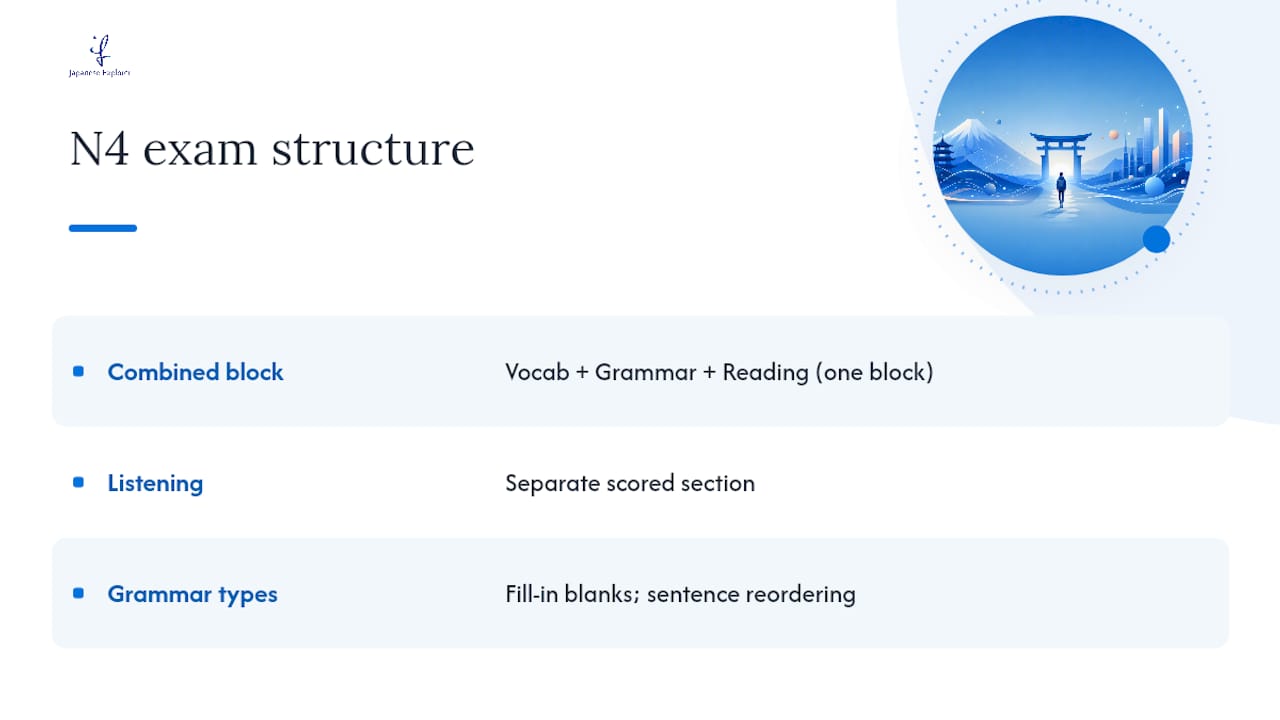
The N4 exam splits into three scored sections: vocabulary and grammar combined with reading comprehension in one time block, and listening scored separately. Grammar questions appear as fill-in-the-blank sentence completion and sentence reordering, where you arrange scrambled word chunks into a grammatically correct sentence.
Grammar isn’t tested in isolation, which is exactly why a list alone won’t get you across the finish line. Reading passages assume you can parse conditional clauses and giving/receiving structures without stopping to translate them word by word. Listening questions often hinge on hearing a grammar form correctly, not just understanding vocabulary. Japanese Explorer’s guide to JLPT levels breaks down how each section weights against the others, which helps you decide how much time to allocate to grammar drilling versus listening or reading practice specifically.
Because grammar threads through every section rather than sitting in its own isolated box, the study plan earlier in this article deliberately pairs grammar review with listening and reading, never grammar alone.
How Does N4 Grammar Compare to N5 and N3?
N5 grammar covers basic sentence structure: present and past tense, simple particles, and elementary connectors like から and ので. N4 grammar builds directly on top of that foundation rather than replacing it, adding conditionals, potential and passive forms, giving/receiving grammar, and causative structures.
The jump from N4 to N3 is steeper than the jump from N5 to N4. N3 introduces more nuanced expressions of speculation, indirect speech, and formal register shifts that assume you’ve fully internalized N4’s conditional and passive systems already. If your N4 conditionals are shaky, N3 grammar becomes nearly impossible to parse, since N3 lessons routinely combine two or three N4 structures inside a single sentence.
This is one more reason the prioritization advice above matters: shaky N4 fundamentals compound into much bigger problems one level up, not smaller ones.
A Quick Note on Turning Review Into Actual Fluency
Grammar lists are only as good as what you do with them once you close the PDF.
Two things consistently separate learners who pass N4 from those who retake it: they attack their weakest patterns first instead of last, and they convert every passive review session into something spoken or written, not just read. Scheduled mock tests, taken under real time pressure, tend to expose exactly which patterns still need work.
Ready to Turn Your Grammar List Into Exam Confidence?
A printable list gets you organized. A trained instructor gets you exam ready, catching the conditional mix-ups and transitivity errors a list can’t correct on its own. Japanese Explorer runs N4 prep through flexible group classes, private lessons, and fully online options over Zoom, all taught by bilingual, certified instructors who build in timed mock tests as part of the course.

If you’re not sure which class format or level fits where you currently stand, take the Japanese language placement test first. It only takes a few minutes and points you toward the right starting class instead of guessing. From there, browse the online Japanese course if Zoom flexibility suits your schedule, or check private tutoring if you want one-on-one correction on exactly the grammar points giving you trouble. Classes run out of 10 Anson Road, Level 22, International Plaza, Singapore 079903, right above Tanjong Pagar MRT, for learners who prefer in-person sessions.
Sources
- Jlptsensei
- JLPT N4 Grammar List – 68 Patterns | GyanMirai
- JLPT N4 Grammar List: All 57 Points | Yomimaru
- JLPT N4 Grammar Checklist: The Curated List | J-Compass
FAQ
How many grammar points are on the JLPT N4?
Published lists range from 57 points to over 132 depending on the source, since no single official JLPT grammar list exists.
Is there an official JLPT N4 grammar list?
No. Every published N4 list, including the downloadable one on this page, is compiled from past test data and cross-referenced against other lists, not issued by the testing body itself.
How long does it take to study the full N4 grammar list?
Most learners need six to eight weeks of consistent daily review to move through the full list and reach mock-test readiness, though pacing depends on prior N5 grammar strength.
What’s the biggest difference between N4 and N5 grammar?
N4 adds conditionals, potential and passive forms, giving/receiving grammar, and causative structures on top of the basic sentence patterns covered at N5.
Can instructor-led classes really speed up N4 grammar study?
Yes. Structured classes like those at Japanese Explorer add error correction and timed mock tests that a self-study list alone can’t provide.