
Pick your timeline based on where you stand today: three months at 15 to 20 hours a week if you passed N3 comfortably and can clear your schedule, six months at 8 to 10 hours a week if you’re working full-time with steady discipline, or 12 months at 4 to 6 hours a week if you’re rebuilding grammar and vocabulary from a shakier N3 (or lower) foundation. Whichever you choose, the daily contract is the same: one spaced-repetition session for vocabulary and kanji, two focused blocks for grammar and timed reading or listening, and a weekly mock test once you’re past your first month.
That’s the entire skeleton of an effective JLPT N2 study plan. Everything else in this guide is about filling it in correctly for your timeline.
Before you build a calendar, handle three things this week:
- Take a diagnostic mock test to find your current baseline, ideally using a placement test or old JLPT papers.
- Set up an Anki deck (or download a pre-made N2 deck) so spaced repetition starts on day one, not week three.
- Buy one grammar reference now. So-matome or Shin Kanzen Master both work; the mistake is buying both and using neither properly.
Key Takeaways
A structured JLPT N2 study plan works because it matches your timeline to your available hours, cycles through foundation, integration, and simulation, and uses mock tests as a diagnostic loop rather than a scoreboard.
| Point | Details |
|---|---|
| Match timeline to hours | Choose 3 months at 15 to 20 hrs/week, 6 months at 8 to 10 hrs/week, or 12 months at 4 to 6 hrs/week based on your N3 baseline. |
| Hit the milestone numbers | Target roughly 1,000 kanji, 6,000 vocabulary words, and 200 to 250 grammar patterns before your exam date. |
| Use mocks as diagnostics | Test weekly to biweekly depending on timeline, then drill the exact error categories each mock reveals. |
| Prioritize timed reading | Reading under real time pressure, not just untimed comprehension, is the most common gap in failed attempts. |
| Consider guided instruction | Japanese Explorer’s instructor-led courses offer structured pacing and fast error feedback for learners on tight timelines. |
Table of Contents
- What Does the JLPT N2 Exam Actually Test?
- How Do You Choose the Right Timeline?
- Building Your Weekly Study Structure Around Three Phases
- Three Ready-to-Use JLPT N2 Study Schedules
- Which Study Materials Should You Actually Use?
- Turning Mock Tests Into a Diagnostic Loop
- Skill-by-Skill Tactics That Actually Move the Needle
- How Do You Know You’re Ready for Exam Day?
- Why Guided Instruction Speeds Up N2 Prep
- What Actually Separates a Pass From a Near Miss
- Want Structured Guidance Instead of Solo Prep?
- Sources
- FAQ
What Does the JLPT N2 Exam Actually Test?
The N2 exam splits into two testing blocks: Language Knowledge & Reading (105 minutes, combining vocabulary, grammar, and reading comprehension) and Listening (about 50 minutes), given as a separate section with its own timing. You cannot treat these as one undifferentiated mass of study time. They’re scored and paced differently, and the exam punishes anyone who runs out of time on reading far more than it punishes weak listening recall.
Passing requires two things simultaneously, not one. You need an overall score of at least 90 out of 180 points, and you need to clear a sectional minimum, typically around 19 out of 60, in each of the three scored sections. Score a 95 overall but a 15 in listening, and you fail. This sectional minimum is the single most common reason competent students miss N2, and it’s why your study plan needs a mock-test strategy specifically built to catch sectional weak spots before exam day, not after.
Language Knowledge & Reading carries the heavier structural weight of the exam, which is part of why grammar and reading get the largest share of most effective study schedules.
The N2 target, by the numbers: roughly 1,000 kanji, 6,000 vocabulary words, and 200 to 250 grammar patterns form the practical syllabus. Every schedule in this guide is built to hit those numbers on time.
If you’re unsure whether N2 is even the right level for you, it’s worth checking how it compares to N3 and N1 before committing months of study to it.
How Do You Choose the Right Timeline?
Run through this quick self-check before you commit to a calendar:
- How comfortable was your N3 pass (or equivalent knowledge)? A clean N3 pass with strong recall means you can realistically compress into three months. A shaky N3, or self-taught knowledge with no formal test behind it, points toward six or 12 months.
- How many hours can you protect weekly, not hope to find? Three-month plans need 15 to 20 hours; six-month plans run on 8 to 10 hours; 12-month plans work with 4 to 6.
- Have you sustained a daily study habit before, or does motivation usually collapse after two weeks? Long timelines are less forgiving of inconsistency because the payoff is farther away.
- Can you already read at a reasonable clip without translating word by word in your head? If timed reading feels impossible right now, you need the extra runway of a six or 12-month plan to build automaticity.
What this means for pacing:
- Intensive (3 months): Best for recent N3 passers who can front-load 15 to 20 hours weekly. This pace is aggressive, and a 6-month plan is already considered aggressive by most standards, so three months leaves almost no room for a bad week. Build in a buffer week at month two.
- Balanced (6 months): The default for working adults with steady N3 fundamentals and 8 to 10 hours a week to spend. This is the most common path and the one most study materials are pegged to.
- Extended (12 months): Right for anyone rebuilding grammar, expanding a thin vocabulary base, or juggling N2 prep around unpredictable work hours. Lower weekly hours are offset by spaced consolidation, which tends to produce stronger long-term retention than cramming.
Once you’ve picked a lane, take a baseline mock immediately, choose your primary grammar resource, and block the recurring calendar slots today. A plan that lives only in your head rarely survives its first busy week.
Building Your Weekly Study Structure Around Three Phases
Every timeline in this guide, whether three months or 12, moves through the same three phases. Only the amount of time in each phase changes.
Foundation is where you build raw material: kanji recognition, core vocabulary, and basic-to-intermediate grammar patterns. Integration is where you start combining that material under realistic conditions, timed reading passages, real audio, grammar used in context rather than isolated drills. Simulation is full mock exams under exact timing, followed by targeted repair of whatever the mock exposes. Cycling through these three phases, with mock tests introduced early as diagnostics rather than saved for the final week, is what separates students who pass comfortably from those who scrape by or miss sectional minimums.
Time allocation should roughly track the exam’s own content weighting: vocabulary and kanji take up the largest single share of your effort, with grammar, reading, and listening dividing the rest.
That split comes from a realistic N2 study breakdown cross-checked against the exam’s own content weighting. Notice listening gets slightly less raw study time than its exam weight might suggest. That’s intentional. Listening improves more from consistent daily exposure than from marathon sessions, so it’s spread thin across every day rather than concentrated.
A sample week, scaled to your available hours, looks like this:
- Monday to Friday: 20 to 30 minutes of Anki review (vocab and kanji), one grammar lesson with example sentences, 15 to 20 minutes of listening practice.
- Saturday: One timed reading passage under real exam conditions, followed by error analysis on anything missed.
- Sunday: Review the week’s weak points, light Anki maintenance, rest or a shorter session.
Before moving from Foundation to Integration, confirm you can recognize roughly the first third of your kanji and vocabulary targets and have covered basic grammar patterns. Before moving into Simulation, you should be reading passages at close to exam pace and completing full grammar coverage. Skipping this checkpoint is how students end up doing full mocks against material they haven’t actually learned yet, which produces demoralizing scores that don’t reflect real ability.
Three Ready-to-Use JLPT N2 Study Schedules
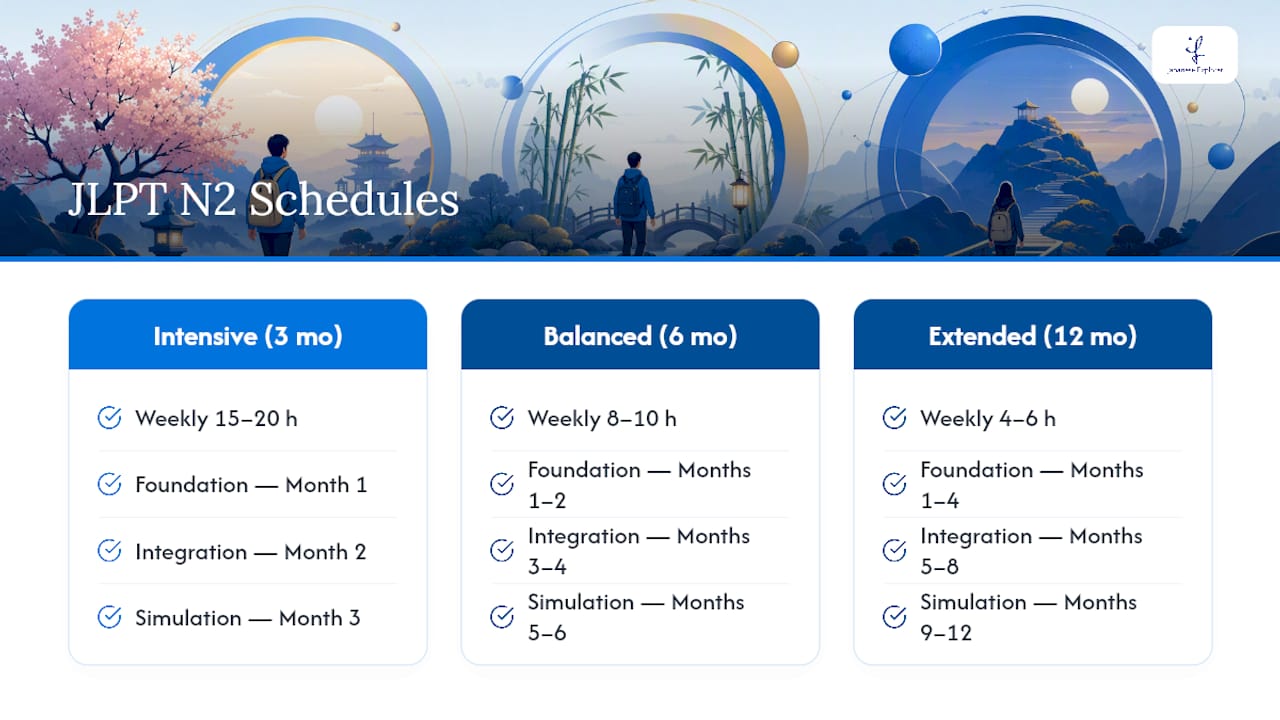
Here’s how each timeline breaks down month by month.
Intensive, 3 months (15 to 20 hours/week): Month one is almost entirely Foundation, aggressive Anki new-card pace, daily grammar lessons, kanji drilling. Timed reading and listening practice start in week three, earlier than in longer plans, because there’s no time to delay. Month two shifts to Integration: full grammar coverage, daily timed reading, listening drills against real N2-style audio. Month three is Simulation, with a full mock test every week and the final week reserved for review only, no new material.
Balanced, 6 months (8 to 10 hours/week): Months one and two build Foundation at a sustainable pace. Months three and four are Integration, with timed reading introduced around month three and listening ramping up steadily. Section-specific mock tests start around month two; full mocks begin around month four and run every two weeks through months five and six, which are pure Simulation and gap repair.
Extended, 12 months (4 to 6 hours/week): Months one through four cover Foundation at a relaxed pace with built-in maintenance weeks to prevent burnout. Months five through eight are Integration, giving plenty of runway for timed reading speed to develop naturally rather than under pressure. Months nine through 12 shift into Simulation, with monthly full mocks starting around month six and increasing to biweekly by month 10.
The intensive plan compresses everything, which is why a 6-month plan is already considered an aggressive but achievable pace for most learners, and three months asks for roughly double the weekly intensity to hit the same milestones.
Which Study Materials Should You Actually Use?
Five resources cover nearly everything the N2 exam demands. You don’t need more than these, and buying more often just fragments your review time.
- Official JLPT sample questions and the Official Practice Workbook are the only materials written by the actual test organizers, which makes them the authentic reference for format and question style. Use these in the Simulation phase and periodically earlier to check your instincts against the real format.
- So-matome (N2) series breaks grammar, vocabulary, and kanji into manageable daily units. It’s the gentler on-ramp, best for Foundation phase or for 12-month learners who want steady daily structure.
- Shin Kanzen Master (N2) series goes deeper into grammar nuance, the fine distinctions between similar-looking grammar points that the exam loves to test. Bring this in during Integration, once basic grammar recognition is solid.
- Anki handles spaced repetition for vocabulary and kanji at scale. This is non-negotiable for hitting the 6,000-word target inside any realistic timeline.
- Past JLPT papers and official mock tests are your Simulation-phase backbone, used under strict timing every time.
For a three-month timeline, lean hard on Shin Kanzen Master and skip most of So-matome; you don’t have time for the gentler pace. For six months, use So-matome in Foundation and transition to Shin Kanzen Master by month three. For 12 months, So-matome can carry you further into the plan since the slower pace suits its structure well.
Anki deserves its own rule set. Cap new cards at a number you can actually review daily without the backlog snowballing, somewhere in the range most learners find sustainable rather than aspirational. A card with vague or missing context, just an isolated word with no example sentence, wastes review time because your brain has nothing to anchor the meaning to. Rewrite or delete those cards rather than letting them clutter your deck.
Turning Mock Tests Into a Diagnostic Loop
A mock test that only produces a score is half as useful as one that produces a plan. Treat every mock as a diagnostic, not a report card.
Recommended cadence by timeline:
- Intensive (3 months): Weekly sectional mocks starting week two, full mocks every two weeks from week five onward.
- Balanced (6 months): Sectional mocks starting month two, full mocks every two weeks starting month four.
- Extended (12 months): Sectional mocks from month four, monthly full mocks starting around month six, increasing to biweekly in the final quarter.
The loop itself has five steps: take the mock under real time pressure, mark it honestly, categorize each error by type, build a targeted drill set for the two or three weakest categories, then retest just that skill within a week. Mock tests deliver their real value as diagnostics, not as a way to chase a perfect score. The goal is systematic error elimination, one category at a time.
When you mark a mock, use this checklist rather than just tallying right and wrong:
- Time lost: did you run out of time, or answer wrong with time to spare?
- Vocabulary gaps: unknown words that blocked comprehension entirely.
- Grammar confusion: misapplied or misread grammar patterns.
- Reading speed: passages you understood but couldn’t finish in time.
- Listening misses: did you miss the answer cue itself, or mishear vocabulary?
If a sectional score sits below the roughly 19-point minimum, that section becomes your top priority for the next two weeks, even if your overall score already clears 90. The sectional rule punishes imbalance, so a lopsided plan that ignores a weak section is a plan built to fail on a technicality.
Skill-by-Skill Tactics That Actually Move the Needle
Vocabulary and kanji. Keep new Anki cards to a daily number you can sustain for months, not the number that feels productive on a good day. Write cards with a full example sentence, not an isolated word, so the context does the memory work. Review daily without exception; this is the one habit that compounds fastest.

Grammar. Recognition is not the same skill as production. Students who convert recognition drills into active production, writing your own original sentences with each new grammar point rather than just picking the right answer on a worksheet, retain grammar better and perform stronger on sentence-construction questions. Pair similar grammar points (Shin Kanzen Master is built around exactly this) and drill the distinction between them explicitly.
Reading speed. Slow, untimed reading is the most common quiet failure point in N2 prep. Practice under real time constraints from the Integration phase onward, and when you miss a question, don’t just note it wrong. Find the exact sentence, connective, or referent that caused the miss and drill that specific pattern.
Listening. Shadowing (repeating audio in real time, matching rhythm and pronunciation) builds the kind of automatic processing passive listening never does. Separately, instant-response question formats need their own dedicated drills, since answering correctly under a hard time limit is a different skill from simply understanding spoken Japanese.
Pro Tip: Write your Anki example sentences using vocabulary and grammar you’ve already learned, not brand-new material stacked on brand-new material. A card that teaches two unknowns at once takes three times longer to stick, and it’s one of the most common reasons students burn out on SRS by month two.
How Do You Know You’re Ready for Exam Day?
Set your practice-test target above the bare minimum, not exactly at it. Aim for consistent scores of 100 to 110 out of 180 on full mocks, comfortably clear of the 90-point pass threshold, with every section clearing its roughly 19-point minimum by a visible margin. A mock score sitting right at the line means one bad day on the actual exam puts you below it.
Check these signals alongside your score:
- Can you finish the reading section with time to review at least two questions, not just barely finish?
- Are you completing full-length listening sections without losing focus in the last 10 minutes?
- Have your error categories from mock tests shrunk to one or two persistent weak spots rather than being scattered across every section?
Exam-day basics matter more than they should. Bring your admission voucher and photo ID, arrive early enough to find the room without rushing, and use a timing heuristic during the test itself: answer questions with a clear line reference first, securing quick, certain points before spending time on ambiguous items. This kind of test-taking strategy often matters as much as raw language ability in borderline outcomes.
One rule for the final two weeks: no new material. Consolidate what you already know, sleep properly, and let your brain finish absorbing months of work instead of cramming a fresh grammar point that won’t have time to stick.
Why Guided Instruction Speeds Up N2 Prep
Self-study works, and everything above is built to support it. But a structured classroom changes the error-correction speed in ways self-study can’t easily replicate. An instructor spots a mispronunciation, a grammar misuse, or a recurring reading mistake in real time, rather than you discovering it three mock tests later.
Japanese Explorer’s instructors are bilingual and experienced in exam-focused instruction, which means feedback on your mock-test errors comes fast and specific rather than generic. A syllabus built around N2 requirements also removes the guesswork of sequencing So-matome against Shin Kanzen Master correctly, something self-studiers often get wrong in their first month.
Here’s a copyable four-week listening micro-plan you can run inside any timeline, self-guided or instructor-led:
- Week 1: Baseline listening mock, identify whether misses are vocabulary gaps or missed instant-response cues.
- Week 2: Daily 15-minute shadowing practice with N2-level audio, plus one instant-response drill set targeting quick-answer formats.
- Week 3: Increase audio difficulty, add note-taking practice for longer listening passages, retest the instant-response format.
- Week 4: Full listening section mock under real timing, compare against week one’s baseline, and identify the one or two remaining error patterns to carry into your next study block.
Guided instruction pays off most for candidates with limited time, inconsistent self-discipline, or a strong preference for immediate feedback over solo error-hunting. It compresses months of trial and error into a syllabus someone else has already stress-tested.
What Actually Separates a Pass From a Near Miss
Most advice about JLPT N2 treats vocabulary count as the whole battle. It isn’t. The research behind this guide points somewhere else: the students who fail rarely fail from not knowing enough words. They fail from timing mismanagement in reading, from ignoring a sectional minimum while chasing an overall score, or from listening prep that was passive exposure instead of targeted drilling.
The conventional wisdom oversells raw study hours and undersells structure. A 12-month learner doing four unfocused hours a week will likely underperform a six-month learner doing focused, mock-test-driven prep at the same total hour count, because the second learner is constantly correcting course based on real diagnostic data. Hours matter, but only when they’re spent on the categories your last mock actually flagged.
If you take one thing from this guide, make it the mock-test loop. Not the schedule, not the resource list, the loop. Test, mark honestly, categorize the error, drill it, retest. Everything else in a JLPT N2 study plan exists to feed that loop with material worth testing.
Want Structured Guidance Instead of Solo Prep?
Self-study can absolutely get you to N2, but it demands discipline most working adults struggle to sustain for six to 12 months straight. If your schedule is tight, your motivation dips without external accountability, or you’d rather have someone catch your grammar mistakes in real time than discover them three mock tests later, a guided course closes that gap fast.

Japanese Explorer runs several formats built around exactly the timelines in this guide:
- Online Japanese courses for learners who need flexible scheduling around a 3-month intensive or 6-month balanced timeline.
- Small-group classes for structured, instructor-paced progress over a 6 or 12-month timeline with peer accountability built in.
- Private lessons for learners who want a fully personalized pace, ideal for closing specific grammar or listening gaps a mock test just exposed.
Classes run at Japanese Explorer’s centre at 10 Anson Road, Level 22, International Plaza, right above Tanjong Pagar MRT, with both weekday and weekend slots available. Check current class schedules and start with a placement conversation to see which format fits your N2 timeline best.
Sources
Lean on these throughout your plan, especially as you move into the Simulation phase:
- JLPT N2 overview
- JLPT N2 study tips
- JLPT sample questions
- A realistic JLPT N2 study plan (3 months vs 6 months)
- Free JLPT N2 Study Guide 2026: Exam Prep | OpenExamPrep
- The Ultimate JLPT N2 Mastery Guide
FAQ
How Long Should You Study for JLPT N2?
Budget three months at 15 to 20 hours a week if you passed N3 recently, six months at 8 to 10 hours a week for a typical working adult, or 12 months at 4 to 6 hours a week if you’re rebuilding fundamentals.
How Do You Study for JLPT N2 Effectively?
Cycle through foundation (vocabulary, kanji, basic grammar), integration (timed reading and listening), and simulation (full mocks), using weekly or biweekly mock tests to diagnose and correct weak sections as you go.
Is JLPT N2 Difficult to Pass?
N2 requires an overall score of at least 90 out of 180 plus roughly 19 points in each section, so it’s demanding but achievable with a structured plan; most failures come from missing a sectional minimum rather than lacking overall ability.
Can You Pass JLPT N2 in Six Months?
Yes, a six-month timeline at 8 to 10 hours a week is considered an aggressive but realistic pace for someone with a solid N3 foundation, provided mock tests start by month two and full mocks run every two weeks from month four onward.