The fastest way to raise your JLPT listening score is a combination of one-shot mock tests, focused shadowing, and levelled audio with transcripts. Start this week with three resources: JLPT official sample questions, JSempai, and NihongoNow. Run one simulated set daily, shadow one short passage, then look up every word you missed.
Your 1-week sprint (15–40 minutes a day):
- Day 1–2: Download the official JLPT sample audio for your level. Listen once, no replays. Mark your answers, then check the script.
- Day 3–4: Open JSempai or NihongoNow. Complete one levelled listening unit. Shadow the audio twice after reading the transcript.
- Day 5–6: Run a timed set on Japanesetest4you. Log every question you got wrong and the reason why.
- Day 7: Repeat Day 1’s set cold. Compare your score to Day 1.
Pro Tip: Train under one-shot conditions from day one. Replaying audio during practice feels helpful but actually weakens your stamina for the real exam, where every item plays exactly once.
Key Takeaways
Consistent one-shot practice with transcript analysis, combined with daily shadowing, is the most direct path to measurable JLPT listening improvement in four weeks.
| Point | Details |
|---|---|
| Start with official samples | Use JLPT official audio and scripts first to calibrate format before any third-party material. |
| Train one-shot from day one | Never replay audio during drills; single-playback builds the stamina the real exam demands. |
| Shadow and dictate daily | Shadowing builds phonological recognition; dictation forces syllable-level processing. |
| Track errors by category | Log mistakes as vocabulary, particle, speed, or inference failures to focus your next study block. |
| Japanese Explorer for structured prep | JLPT prep courses, private lessons, and online Zoom options support every stage of the plan. |
Table of Contents
- Where can you find levelled JLPT listening practice materials?
- How does the JLPT listening section actually work?
- Step-by-step active listening methods that build real comprehension
- Sample 4-week JLPT listening study plan for N5–N3
- How to simulate real JLPT listening conditions and score yourself
- Common JLPT listening mistakes and how to fix them
- Why active, task-based practice produces faster score gains
- How to handle fast speech, accents, and background noise
- Supplemental materials that support JLPT listening prep
- The honest take on JLPT listening prep
- Japanese Explorer can support your JLPT listening prep
- Sources
- FAQ
Where can you find levelled JLPT listening practice materials?
The best sources cover every level from N5 to N1, provide transcripts alongside audio, and let you practice in exam format. Here is how they break down:
Official and canonical sources
The JLPT official sample questions page is your first stop. It provides audio files and PDF scripts for every level and task type, making it the authoritative format reference before you touch any third-party material.
Dedicated JLPT practice sites
Japanesetest4you maintains a large archive of N5 practice sets that closely mimic real exam item types. Ideal for rapid repetition at the beginner level. Era-Bridge publishes a daily three-question quiz covering N5 through N2, which is perfect for building a daily habit without a heavy time commitment.
Apps
JSempai offers thousands of levelled listening exercises from N5 to N1, integrates textbook content including Minna no Nihongo, and lets you tap any word in the script for an instant definition. Available on both iOS and Android.
University and YouTube playlists
NihongoNow provides structured listening units with audio, comprehension questions, and transcripts. The YouTube playlists work well for classroom-style shadowing drills and are free.
Textbook audio
Genki’s companion audio (available through MyKikitori at mykikitori.com) gives beginners Genki-aligned listening exercises with quizzes and repeat-for-mastery options.
Transcripts and SRT files
SozAI hosts downloadable transcripts and SRT files for JLPT practice tests. The sentence-level timestamps make dictation practice and targeted shadowing much more efficient.
| Resource | Level coverage | Audio + transcript | Best use |
|---|---|---|---|
| JLPT official samples | N5–N1 | Both | Format calibration, mock tests |
| JSempai | N5–N1 | Both + vocab lookup | Daily drills, shadowing |
| NihongoNow | N5–N3 | Both | Classroom-style units, YouTube |
| Japanesetest4you | N5 (extensive) | Audio + answer key | Rapid repetition drills |
| Era-Bridge | N5–N2 | Audio only | Daily micro-practice |
| SozAI | N4–N3 | Transcript + SRT | Dictation, targeted shadowing |
| MyKikitori | N5 (Genki-based) | Audio + quiz | Beginner textbook alignment |
How does the JLPT listening section actually work?
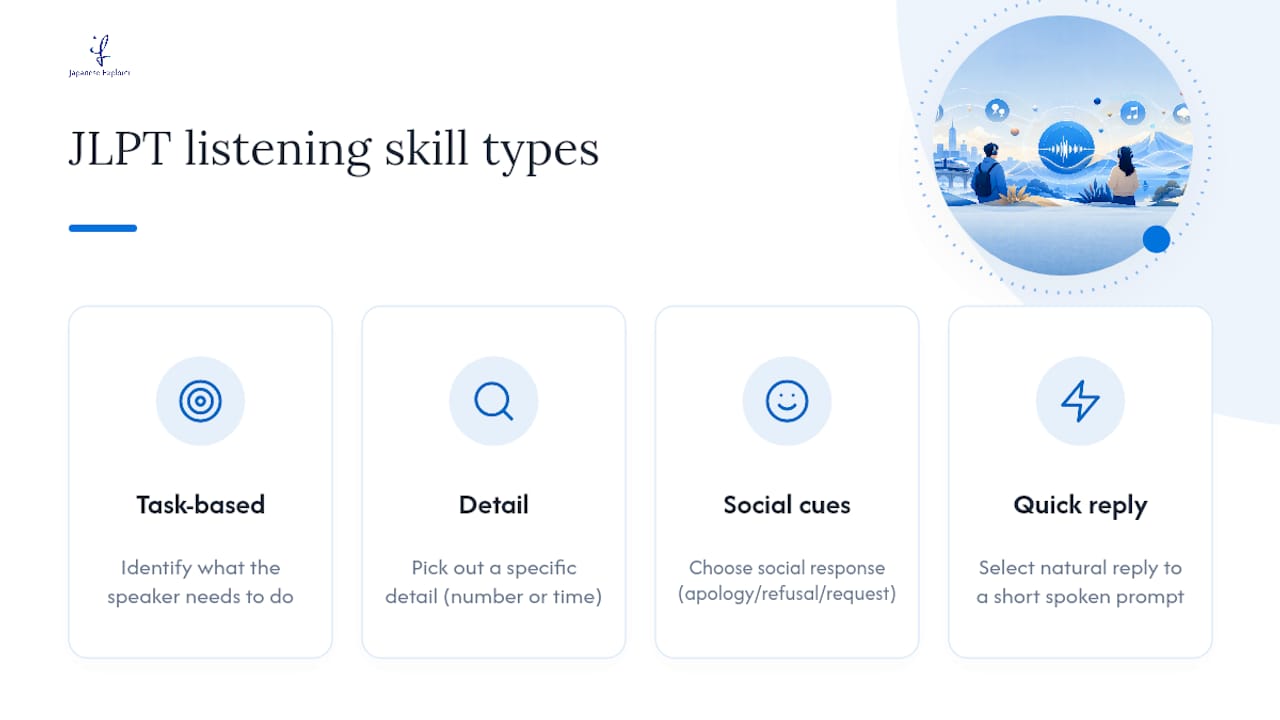
The listening section runs across all five levels and tests four core skill types: task-based comprehension (identify what the speaker needs to do), point comprehension (pick out a specific detail), utterance expressions (choose the appropriate social response), and quick response (select the natural reply to a short spoken prompt).
Every audio item plays exactly once. No replays, no pausing. That single-playback rule is the most important structural fact to understand, because it means your practice must mirror that constraint from the start. Learners who replay audio during drills often find themselves lost on test day when the track moves on without them.
Timing varies by level. N5 and N4 sections run roughly 30–35 minutes; N2 and N1 push closer to 55–60 minutes. The exam tests gist understanding (what is the main point?), detail listening (what exact number or time was mentioned?), inference (what does the speaker imply?), and social cue recognition (is this an apology, a refusal, or a request?). Each task type needs a slightly different practice approach, which is why mapping your weak spots by category matters more than just tracking your overall score.
Pro Tip: Before using any third-party material, run through the official JLPT sample audio and scripts for your level. They calibrate your expectations for audio quality, speaker speed, and item phrasing in a way no unofficial source can replicate.
Step-by-step active listening methods that build real comprehension
Passive listening, where you play Japanese audio while doing something else, produces minimal gains for exam prep. Active, task-based practice where you answer first and analyze second consistently outperforms it. Here is the sequence that works:
- Step 1 — One-shot listen: Play the audio once. Answer the question. Do not pause or replay.
- Step 2 — Transcript check: Read the script immediately after. Identify exactly where your comprehension broke down: a word, a particle, a speed issue, or a missed social cue.
- Step 3 — Shadowing: Play the audio again and speak along simultaneously, matching the speaker’s rhythm and pitch. This builds phonological recognition faster than any other technique.
- Step 4 — Dictation: Play short segments and write out what you hear. Then compare to the transcript. This forces you to process every syllable rather than guess from context.
- Step 5 — Vocabulary drilling: Pull every unknown word from the transcript into a spaced repetition system like Anki. Review before your next session.
Once you identify the issue, return to native speed. Training at slow speed as a default creates a dependency that hurts you on exam day.
Keep a mistake log organized by error type: vocabulary gaps, particle mishearing, speed issues, and inference failures. Revisiting categories with targeted micro-drills is more efficient than redoing whole tests.
Pro Tip: Combine shadowing with deliberate mouth-shape mimicry. Watching yourself in a mirror while shadowing accelerates phonological pattern recognition, especially for sounds that do not exist in English.

Sample 4-week JLPT listening study plan for N5–N3
This plan builds progressively. Week 1 establishes the habit and baseline; Week 4 simulates full test conditions.
Week-by-week progression:
- Week 1: Build the one-shot habit. Focus on N5/N4 sets. Aim for 60% accuracy on mock tests.
- Week 2: Add daily shadowing and vocabulary drilling. Target 70% accuracy. Identify your two weakest task types.
- Week 3: Shift to inference and detail-listening drills. Introduce N3 material if you are targeting N3 or above. Target 75% accuracy.
- Week 4: Full simulations only. Score by task type. If quick-response accuracy lags, add five extra items per day from that category.
Measuring progress: Track accuracy per task type, not just overall score. When you hit your target accuracy two sessions in a row, move up a level or add a harder resource.
How to simulate real JLPT listening conditions and score yourself
Recreating exam conditions at home is straightforward when you follow a consistent checklist.
- Use headphones in a quiet room with no background noise.
- Set a timer matching your level’s listening section length (roughly 30–35 minutes for N5/N4, up to 60 minutes for N1/N2).
- Print or draw an answer sheet. Fill it in by hand, not on screen.
- Play each audio track exactly once. No pausing, no rewinding.
- Mark the time you answered each question. If you are still writing when the next item starts, log that as a timing failure.
- After the session, score by task type: task-based comprehension, point comprehension, utterance expressions, and quick response separately.
- Calculate your accuracy per category. Any category below 60% becomes your next week’s drill focus.
- Repeat the same mock test only after two weeks of targeted practice. Repeating it sooner inflates your score through memory, not skill.
Below that, return to the study plan and focus on your lowest-scoring category before running another full simulation.
Common JLPT listening mistakes and how to fix them
Most learners hit the same walls. Recognizing your pattern early saves weeks of wasted practice.
Replaying audio too often during drills. This feels productive but trains a dependency the exam will not allow. Fix: commit to single-playback from your very first practice session, even when it is uncomfortable.
Relying on inference when vocabulary is missing. Guessing from context works sometimes, but JLPT items are designed to test specific words. Fix: build vocabulary through transcript review after every session, not before.
Ignoring quick-response and utterance items. These short items feel easy to skip in practice because they are brief. On exam day, they move fast and punish learners who have not drilled social-cue phrases. Fix: dedicate at least one session per week exclusively to quick-response items.
Misreading answer timelines. In task-based comprehension, the answer often appears mid-conversation, not at the end. Learners who wait for a summary miss it. Fix: practice identifying the decision point in each conversation during transcript analysis.
Pro Tip: Organize your mistake log into four columns: vocabulary gap, particle mishearing, speed issue, inference failure. After two weeks, the column with the most entries tells you exactly where to spend your next study block.
Why active, task-based practice produces faster score gains
Passive exposure to Japanese audio builds familiarity, but it rarely translates to exam-day performance. The gap between “I understand this drama” and “I can answer a JLPT listening item correctly on one play” is significant, and it comes down to how you train.
Active, task-based listening trains you to identify the speaker’s goal, extract the relevant detail, and commit to an answer under time pressure. That is exactly what the exam demands. Passive listening trains recognition; active practice trains retrieval under constraint.
At Japanese Explorer, the curriculum integrates listening into every lesson rather than treating it as a separate module. Experienced bilingual instructors use task-based drills, shadowing, and targeted transcript work in both group and private settings. Learners who combine structured classroom practice with the self-study methods in this guide tend to close their weak spots faster than those working from materials alone. You can also take a placement test to identify your current level before committing to a study plan.
How to handle fast speech, accents, and background noise
The JLPT uses standard Tokyo-dialect Japanese, but speakers vary in pace and register across levels. N1 audio tends to feature faster, more natural speech with fewer pauses. N5 audio is slower and more deliberate.
Understanding pitch accent helps with fast speech because it trains your ear to parse word boundaries even when speakers run syllables together. Shadowing at native speed, rather than slowed-down audio, is the most direct way to build this tolerance.
For ambient noise, the JLPT exam hall itself can be distracting. Practice with headphones but occasionally run a session without them to build tolerance for imperfect conditions. If a specific audio environment (a café, a commute) is where you study, use it deliberately for review sessions rather than first-listen practice.
Supplemental materials that support JLPT listening prep
Beyond dedicated practice sites, these formats build the listening stamina and vocabulary range that drills alone cannot cover.
Podcasts: Nihongo con Teppei for Beginners (N5–N4) and the standard Nihongo con Teppei (N3–N1) use natural conversational Japanese at a pace learners can follow. Both are free and release frequent short episodes, making them easy to fit into a commute.
Dramas and variety shows: NHK World’s “Easy Japanese” series uses slow, clear speech with on-screen text. For N3 and above, standard NHK news broadcasts and slice-of-life dramas like “Shirokuma Cafe” expose you to natural pacing without heavy slang.
News broadcasts: NHK Web Easy (nhk.or.jp/news/easy) pairs simplified news articles with audio. Reading along while listening reinforces vocabulary in context and mirrors the transcript-study technique from the active practice sequence.
The key is to treat supplemental listening as exposure, not practice. Run your active drills first, then use podcasts or dramas as a cool-down. Mixing the two modes in the same session dilutes both.
The honest take on JLPT listening prep
Most advice on JLPT listening prep focuses on finding more resources. The real problem is almost never a shortage of audio. Learners who plateau usually have one of two issues: they replay audio too much during practice, or they study vocabulary in isolation without connecting it to listening comprehension.
The conventional wisdom of “listen to lots of Japanese” is not wrong, but it is incomplete. Volume matters less than format. Thirty minutes of active, one-shot practice with transcript analysis produces more measurable improvement than two hours of background listening. The exam is a retrieval task under time pressure, and the only way to train for that is to practice under those exact conditions.
What most learners underestimate is the quick-response section. It moves faster than any other part of the exam and tests social-cue recognition that passive listening rarely builds. Drilling utterance expressions and quick-response items specifically, even for ten minutes a day, closes that gap faster than any other single intervention.
Start with the official samples. Build the one-shot habit. Then add shadowing. Everything else is supplemental.
Japanese Explorer can support your JLPT listening prep
Structured coaching accelerates what self-study starts. Japanese Explorer offers JLPT preparation courses that integrate listening drills, shadowing, and task-based comprehension into every session, taught by certified bilingual instructors who know exactly where learners at each level tend to stall.

Prefer flexibility? The online Japanese course runs via Zoom and fits around a full work schedule. Private lessons let you target your specific weak spots, whether that is quick-response utterances or N2-level inference tasks, without spending time on areas you have already mastered. Take a free placement test to find your level, then book a consultation to match the right course format to your exam timeline.
Sources
- New Japanese-Language Proficiency Test Sample Questions | JLPT
- Free JLPT N5 Listening Test with Answers – JLPT Samurai
- Japanese Listening – JSempai on the App Store
- Listening Practice – 日本語 NOW!
- Japanesetest4you
FAQ
What is the best free resource for JLPT listening practice?
The official JLPT sample questions page provides audio and scripts for every level at no cost and is the most accurate format reference available. Pair it with JSempai or NihongoNow for additional levelled exercises.
How often should you do JLPT listening practice?
Daily sessions of 15–30 minutes outperform longer weekly sessions because consistency builds the automatic recognition the exam requires. Even a three-question daily quiz on Era-Bridge maintains momentum on busy days.
Why does replaying audio hurt your JLPT listening score?
The JLPT plays each audio item exactly once, so practicing with replays trains a habit the exam will not allow. Single-playback drills from the start build the stamina and focus needed to catch key details on the first listen.
What task types appear in the JLPT listening section?
The four main types are task-based comprehension, point comprehension, utterance expressions, and quick response. Each tests a different skill, so tracking your accuracy by category reveals where to focus your practice.
Can Japanese Explorer help with JLPT listening preparation?
Yes. Japanese Explorer offers structured JLPT prep courses, private lessons targeting specific weak spots, and online Zoom classes for learners who need schedule flexibility. A free placement test helps match you to the right level before you start.