Whether you want to learn Japanese with a teacher or land your first Japanese-teaching role, the fastest path depends on one decision: are you hiring or applying? Learners should start with online tutor marketplaces, local language schools, or corporate training programs. Jobseekers should target school district HR portals, university language departments, and online tutoring platforms. Private online tutors in the U.S. typically charge an hourly rate within a range common for the field, while group classes can reduce the effective rate per hour significantly.
Top channels at a glance:
- Learners: online tutor marketplaces, local language schools, community college courses
- Jobseekers: K–12 school districts, university language departments, online tutoring platforms
Key Takeaways
Finding a skilled Japanese teacher or landing a teaching role both require knowing which channel matches your specific goal, then acting on it quickly.
| Point | Details |
|---|---|
| Start with your goal | Align your channel choice (marketplace, school, corporate) to your specific aim: conversation, JLPT, or business Japanese. |
| Always take a trial lesson | Use 15–30 minutes to test pace, correction style, and whether the teacher speaks mostly in Japanese. |
| Pricing varies by format | Private online tutors run $25–$80/hr; group classes bring effective rates down to $15–$30/hr. |
| K–12 needs state licensure | For school-based roles, check your state’s requirements via the Japan Foundation’s licensure guidance before applying. |
| Japanese Explorer | Offers certified bilingual instructors, group and private formats, and corporate training for adult learners. |
Table of Contents
- Where can you find a qualified Japanese teacher?
- How do you choose the right Japanese teacher for your goals?
- What does it cost to learn Japanese with a teacher?
- How do you become a Japanese teacher in the U.S.?
- What should your Japanese teacher CV and demo lesson include?
- What makes online Japanese lessons actually work?
- What does a native Japanese teacher bring that textbooks can’t?
- Japanese Explorer: structured lessons with certified instructors
- An honest take on finding and becoming a Japanese teacher
- Sources
- FAQ
Where can you find a qualified Japanese teacher?
Finding the right Japanese language tutor depends on your schedule, budget, and how structured you want your lessons to be. Each channel below has a distinct profile.
Online tutor marketplaces connect you with independent instructors who set their own rates and schedules. Profile pages typically show lesson counts, student reviews, JLPT pass rates, and sample lesson videos, all of which help you gauge fit before booking. Established teacher profiles on these platforms highlight specializations like business Japanese and structured JLPT prep as key trust signals.
Private independent tutors often run their own websites and offer more customized programs. Instructors with backgrounds in corporate training or TESOL frequently list those credentials openly, which matters if you need business Japanese. Sites like Izumi Sensei’s demonstrate how personal teacher pages can show qualifications, client types, and lesson philosophy in one place.
Local language schools offer structured curricula, regular cohorts, and in-person accountability. They suit learners who prefer a classroom rhythm and benefit from peer interaction.
Community colleges and universities provide credit-bearing courses with formal syllabi. Costs are generally lower per credit hour than private instruction, though scheduling is less flexible.
Corporate training providers design programs around workplace communication goals, often delivering lessons on-site or via Zoom for teams.
Conversation exchange groups (Meetup, language exchange apps) are free or low-cost but lack structured teaching. They work best as a supplement, not a primary channel.
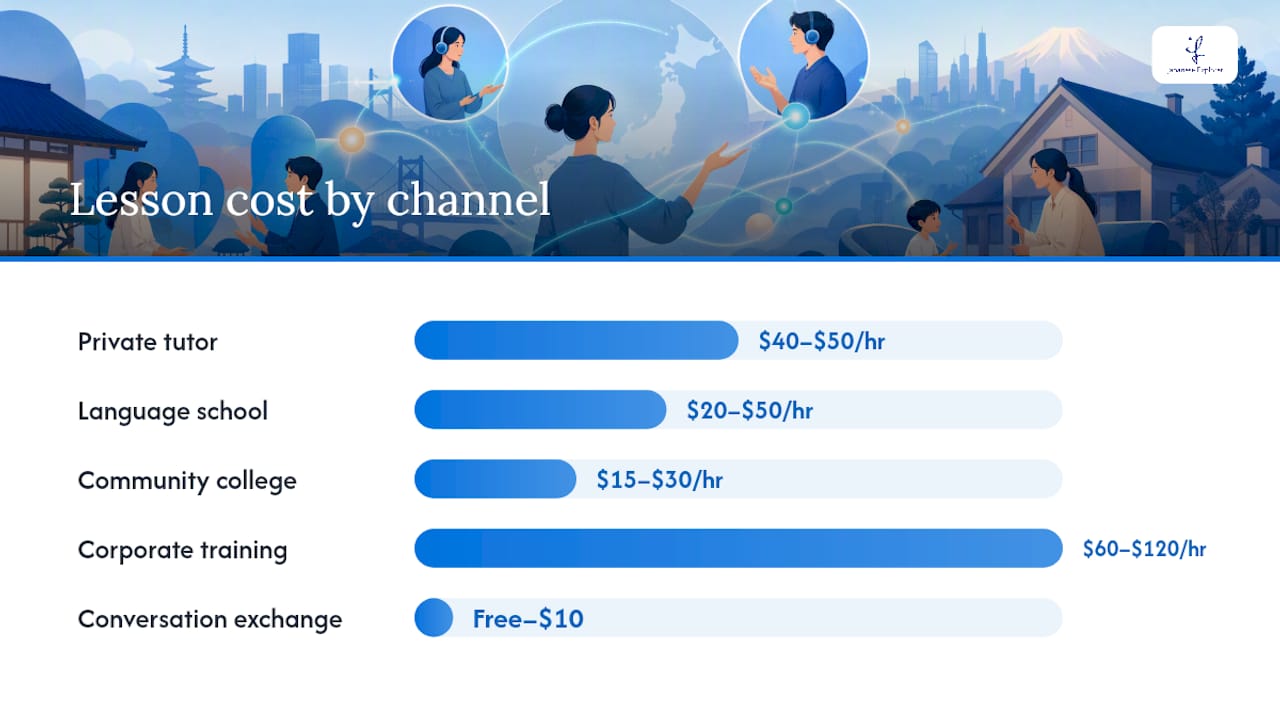
| Channel | Cost range | Scheduling | Specialization available |
|---|---|---|---|
| Online tutor marketplace | varies by tutor | Flexible | JLPT, business, conversation |
| Private independent tutor | $40–$50/hr | Flexible | Business, corporate, heritage |
| Local language school | $20–$50/hr (group) | Fixed schedule | Conversation, JLPT |
| Community college | $15–$30/hr equiv. | Fixed semester | General proficiency |
| Corporate training provider | $60–$120/hr | Custom | Business, workplace |
| Conversation exchange | Free–$10 | Ad hoc | Conversation only |
Pro Tip: If your goal is JLPT prep or business Japanese, start with an online marketplace or independent tutor who lists those specializations explicitly. For general conversation fluency, a local language school’s group format often gives you more speaking time per dollar.
How do you choose the right Japanese teacher for your goals?
Start with your goal, not the teacher’s credentials. A native speaker with years of experience may be a poor fit if their teaching style doesn’t match how you learn. Here’s a practical framework.
Align your goal first:
- Conversation fluency: look for communicative teaching methods, high student-speaking ratios, and frequent short sessions
- JLPT preparation: look for teachers who list pass rates, structured syllabi, and timed practice materials
- Business Japanese: prioritize instructors with corporate client experience and workplace vocabulary modules
- Heritage maintenance: seek teachers comfortable with mixed-proficiency learners and cultural context
Credentials worth checking:
- Years of active teaching (not just native fluency)
- Stated specializations (JLPT levels, business, conversation)
- Sample lesson materials or demo videos
- Student outcomes (pass rates, testimonials from named learners)
The CEFR framework gives you a shared language for goal-setting: ask any prospective teacher which CEFR level they’ll target with you and how they’ll measure progress. Setting one concrete CEFR target per three-month block keeps both of you accountable.
Community feedback also matters. Threads on forums like r/LearnJapanese regularly surface honest peer experiences with platforms and individual tutors, which complements the polished reviews on teacher profile pages.
Trial lesson checklist (15–30 minutes):
- Does the teacher speak mostly in Japanese, or do they default to English at the first sign of confusion?
- Do they correct errors in a way that feels constructive rather than disruptive?
- Is the lesson paced for your level, or does it feel rushed or too slow?
- Do they ask about your goals, or do they run a one-size-fits-all script?
- Is there a clear cancellation and reschedule policy stated upfront?
A teacher who can’t articulate their correction philosophy in a trial lesson probably hasn’t thought about it much. That’s a real gap in adult language instruction.
What does it cost to learn Japanese with a teacher?
Private online tutoring in the U.S. is generally priced within common market ranges depending on instructor experience and specialization. In-person private lessons often cost somewhat more due to additional factors. Group classes at language schools typically cost less per hour.
| Format | Typical U.S. rate | Session length | Best for |
|---|---|---|---|
| Private online tutor | varies by tutor | 25–60 min | Flexible goals, fast progress |
| In-person private lesson | $20–$45/hr | 45–60 min | Accountability, pronunciation |
| Group class (language school) | varies by class | 45–60 min | Conversation, peer interaction |
| Corporate training (per person) | $60–$120/hr | 45–60 min | Workplace Japanese, teams |
Lesson length shapes outcomes as much as price. Short 25–30 minute sessions work well for conversation practice and vocabulary drilling, where frequency matters more than depth. JLPT prep benefits from longer 45–60 minute blocks that allow full reading and listening practice sets. Intensive weekly packages (three or more sessions per week) accelerate progress but require consistent scheduling discipline.
Corporate training contracts usually include a fixed number of hours per quarter with a defined curriculum scope.
Pro Tip: Online Japanese classes offer scheduling flexibility that in-person formats can’t match. If your calendar is unpredictable, an online package with a clear reschedule policy protects your investment.
How do you become a Japanese teacher in the U.S.?
The route into Japanese teaching depends on which employer type you’re targeting. K–12 public schools require state licensure; online tutoring platforms require almost none. Here’s how the pathways break down.
Step-by-step entry pathway:
- Confirm your Japanese proficiency level (JLPT N2 or higher is a common employer benchmark for formal roles).
- Decide on your target employer: K–12, university, language school, corporate trainer, or online platform.
- For K–12 roles, research your state’s teacher licensure requirements. The Japan Foundation’s licensure guidance summarizes typical qualification pathways and what school-based employers expect.
- For online tutoring or private language school work, build a demo lesson and a profile page while pursuing formal credentials in parallel.
- Apply to openings on Indeed’s online Japanese teacher listings, school district HR portals, and university language department pages.
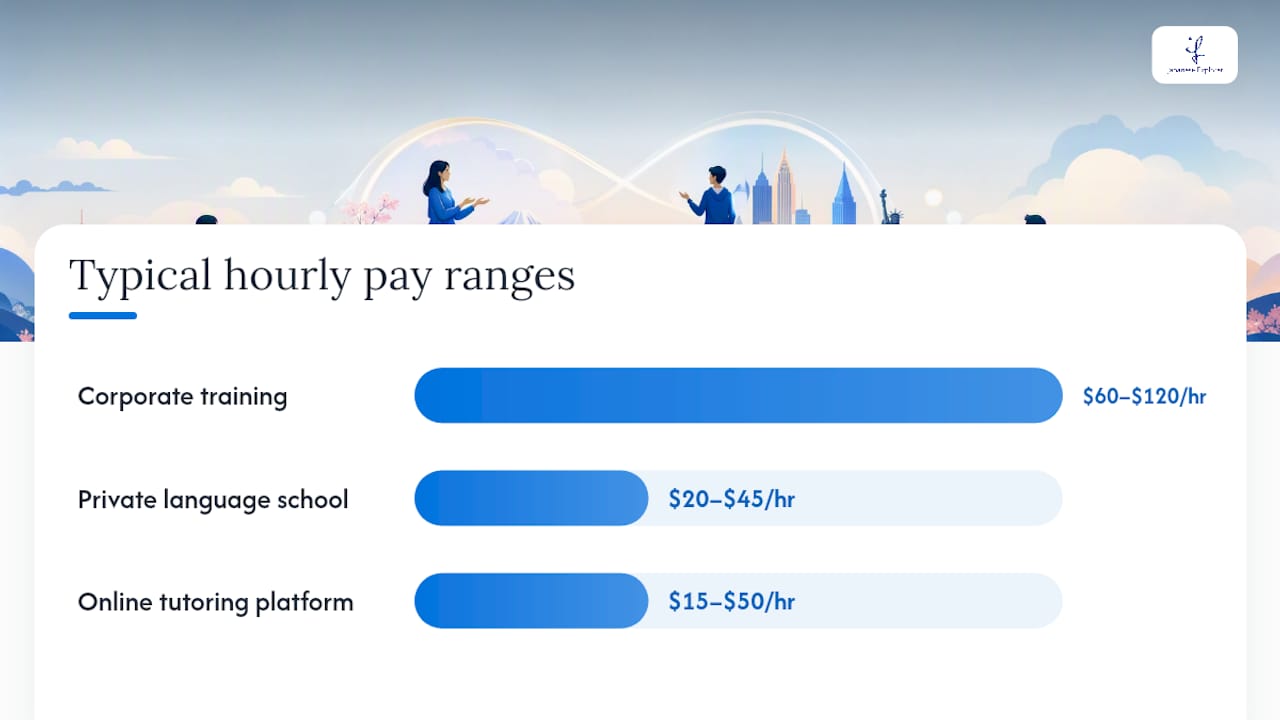
Employer types and typical pay ranges:
- K–12 public school (licensed): $40,000–$65,000/year salary (varies widely by state and district)
- Community college (adjunct): $3,000–$6,000 per course section
- Private language school: $20–$45/hr
- Corporate training (contract): $60–$120/hr
- Online tutoring platform: $15–$50/hr depending on platform and student volume
Many high-quality language school openings don’t appear on general job boards. School websites and university HR pages often post positions weeks before they reach aggregators, so check those directly and set up alerts.
Pro Tip: For professional development as a language educator, resources like the IB Educator Professional Development Guide offer frameworks for structuring your own growth plan, even if you’re not teaching in an IB context.
What should your Japanese teacher CV and demo lesson include?
A strong application for a Japanese-teaching role has two parts: a CV that signals trust quickly and a demo lesson that shows you can actually teach.
CV checklist:
- Teaching experience (years, student levels, employer types)
- Stated specializations: JLPT levels, business Japanese, conversation, corporate training
- Links to sample lesson materials or a recorded demo video
- Student outcomes: pass rates, level progressions, or employer testimonials
- Tech skills for online delivery: Zoom, digital whiteboard tools, screen-sharing
Sample 45-minute demo lesson outline:
- Warm-up (5 min): brief conversation in Japanese at the target level to gauge current ability
- Vocabulary introduction (10 min): three to five new items with contextual sentences, not isolated word lists
- Communicative task (15 min): role-play or real-world scenario using the new vocabulary
- Correction and feedback (10 min): targeted error correction with explanation, not just repetition
- Wrap-up and preview (5 min): summarize what was covered and set one homework task
During a demo, avoid reading from slides. Hiring managers want to see you adapt in real time. If a student gives an unexpected answer, work with it rather than redirecting to your script.
Pro Tip: Record a 3–5 minute demo video showing one complete teaching exchange. Upload it to YouTube (unlisted) and include the link in your CV. Hiring managers can view it in two minutes, which is far more persuasive than a written description of your teaching style. For ideas on organizing your teaching materials for a portfolio, the IB Biology Teaching Resource Categories guide shows one effective approach to resource categorization.
What makes online Japanese lessons actually work?
Teaching Japanese online requires more deliberate structure than in-person instruction because you lose the physical cues that help learners stay engaged. These practices make a real difference.
Essential tech setup:
- Stable wired internet connection (not Wi-Fi if avoidable)
- Dedicated headset with a microphone (not laptop speakers)
- Screen-sharing capability for shared documents and digital whiteboards
- A clean, well-lit background that doesn’t distract
Pedagogical approach that works:
- Open every lesson with a short speaking task in Japanese, not a grammar explanation.
- Use task-based activities: ordering food, navigating a schedule, writing a short email.
- Apply shadowing exercises for pitch accent and natural rhythm, especially for intermediate learners.
- Link progress explicitly to CEFR levels so students can see movement over time.
- Use targeted correction: note errors during fluency tasks, then address them in a dedicated feedback slot rather than interrupting mid-sentence.
Materials that transfer well online:
- Digital textbooks (Genki, Minna no Nihongo) shared via screen
- Graded readers for reading practice at the right level
- Spaced-repetition vocabulary apps (Anki) assigned as homework
- Short authentic video clips (2–3 minutes) for listening comprehension
Many teachers who use communicative methods and CEFR alignment report stronger student retention than grammar-only approaches, as seen across independent teacher sites that document their methodology openly.
Pro Tip: Mix short drills (5 minutes), a communicative task (15 minutes), and a real-world application (10 minutes) within a single 45-minute session. Students speak more, and the variety keeps attention sharp throughout.
What does a native Japanese teacher bring that textbooks can’t?
Native-instructor-led classes expose you to natural pitch accent, colloquial phrasing, and cultural context that no textbook captures fully. A native teacher corrects the subtle errors that learners don’t even know they’re making, the ones that make fluent speakers pause mid-conversation.
Japanese Explorer: structured lessons with certified instructors
If you want structured, goal-oriented Japanese lessons taught by experienced bilingual and certified instructors, Japanese Explorer offers exactly that. The school’s curriculum follows the Association for Japanese-Language Teaching, integrating grammar, speaking, and listening in every session so you build real communication skills, not just textbook knowledge.
Whether you’re preparing for JLPT, building business Japanese for your career, or starting from zero, Japanese Explorer has a format that fits. Small-group classes keep per-hour costs accessible, while private lessons give you a fully customized pace. Corporate teams can access dedicated corporate training programs designed around workplace communication goals. Online learners can join via Zoom with the same certified instructors and structured curriculum. Browse the full course range and book a trial lesson at Japaneseexplorer.
An honest take on finding and becoming a Japanese teacher
The conventional advice tells learners to “find a native speaker” and tells jobseekers to “get certified.” Both are oversimplifications that waste time.
Native fluency and teaching ability are different skills. A native speaker who has never thought about correction strategies or lesson pacing can actually slow your progress, because they’ll correct your accent and miss the grammar pattern that’s holding you back. What you actually want is a teacher who has a method, states it clearly, and can show you evidence it works. That’s why teacher profiles that list student outcomes and JLPT pass rates matter more than a profile that just says “native speaker, 10 years experience.”
For jobseekers, the certification-first path makes sense for K–12 public school roles, but it’s the wrong starting point for everyone else. Online tutoring platforms and private language schools hire on demonstrated teaching ability, not paper credentials. Build your demo lesson, record it, and start applying while you pursue formal qualifications in parallel. The market for online Japanese instruction is active right now, and waiting until you have every credential in place means leaving real income and real teaching experience on the table.
One more thing that rarely gets said: the learners who progress fastest are the ones who set a CEFR target with their teacher at the start of every three-month block and measure against it. Not because CEFR is magic, but because a shared, concrete target forces both the teacher and the learner to be honest about what’s actually happening in lessons. Without it, it’s easy to spend six months on “intermediate” and never quite know why you’re still there.
Sources
FAQ
What do you call a teacher in Japanese?
The word is sensei (先生), used as both a title and a form of address for teachers, doctors, and other respected professionals. You address your Japanese teacher directly as “Sensei” rather than using their first name.
Is sensei the Japanese word for teacher?
Yes. Sensei (先生) literally means “one who has gone before” and is the standard term for a teacher in Japanese. It’s used across academic, martial arts, and professional contexts.
What is the average salary of a Japanese teacher in the U.S.?
Salaries vary significantly by employer type. K–12 licensed teachers typically earn $40,000–$65,000 per year, while online tutors earn $15–$50 per hour and corporate trainers can charge $60–$120 per hour on contract.
What is a Japanese martial arts teacher called?
In martial arts contexts, the instructor is often called sensei for most disciplines, or shihan for a senior master-level instructor. The specific title varies by art form and rank.
Do you need a license to teach Japanese in the U.S.?
K–12 public school positions require state teacher licensure, which varies by state. Private language schools, corporate training roles, and online tutoring platforms generally do not require formal licensure, though demonstrated teaching ability and Japanese proficiency are expected.