
Language proficiency is the measurable ability to use a language reliably across real-world tasks, and it directly shapes where you get placed in school, whether you get called for an interview, and how effectively you lead across cultures. This is not a soft skill in the vague sense. It is a documented, testable capability with concrete outcomes attached to it.
Here is what that means in practice for you:
- Academic placement and credit: Colleges and universities use proficiency scores to place students in the right course level or award credit for demonstrated ability.
- Employment screening: Employers use language requirements in job postings as a signal of adaptability and communication skill, not just linguistic ability.
- Leadership and negotiation: Advanced proficiency supports trust-building, cross-cultural influence, and more deliberate decision-making in high-stakes conversations.
Pro Tip: Before you register for any language test or training program, clarify your goal first. Academic admission, employment screening, and workplace communication each call for a different assessment and a different preparation path.
Table of Contents
- What does language proficiency actually mean?
- How do ACTFL, CEFR, and ILR compare?
- Which proficiency test should you take?
- What does research say about the impact of language skills?
- How long does it take to reach a useful proficiency level?
- How proficiency is used in education, work, and leadership
- How to improve your proficiency and demonstrate it credibly
- Common myths about language proficiency you should stop believing
- Key Takeaways
- Why measurable proficiency beats vague language goals
- Useful sources and recommended reading
- FAQ
What does language proficiency actually mean?
People use “proficiency,” “fluency,” and “performance” interchangeably, but they mean different things in education and hiring contexts. Getting this right matters because the word you use on a resume or application carries specific expectations.
Proficiency describes consistent capability across unfamiliar, unrehearsed contexts. If you can handle a conversation you have never prepared for, that is proficiency. Fluency is a popular term but lacks a standardized definition and it often implies native-like speed and ease, which sets an unrealistic bar for most learners. Performance refers to what you can do in a specific, often prepared situation, like a rehearsed presentation or a scripted customer service call.
The ACTFL Proficiency Guidelines (2024) frame this clearly: proficiency is what you can do across contexts, not just what you scored on a single test. That distinction is why performance-based interviews and Can-Do statements carry more weight than a multiple-choice grammar test.
Language proficiency spans four modes of communication:
- Speaking: Can you hold an unrehearsed conversation, negotiate, or present an argument?
- Listening: Can you follow native-speed speech, news broadcasts, or workplace discussions?
- Reading: Can you process authentic texts, contracts, or technical documents?
- Writing: Can you produce clear, organized written communication for professional or academic purposes?
Can-Do statements make these modes concrete. Here are examples across levels:
- Beginner: “I can introduce myself and ask simple questions about familiar topics.”
- Intermediate: “I can handle most routine workplace conversations and write short professional emails.”
- Advanced: “I can discuss complex, abstract topics, negotiate, and produce detailed written reports.”
When an employer says they want someone “proficient” in a second language, they typically mean intermediate to advanced on a recognized scale, capable of handling real work tasks without constant support.
How do ACTFL, CEFR, and ILR compare?
Three scales dominate proficiency measurement in the United States: ACTFL, CEFR, and ILR. Each was designed for a different context, but they overlap enough that crosswalks between them are widely used.
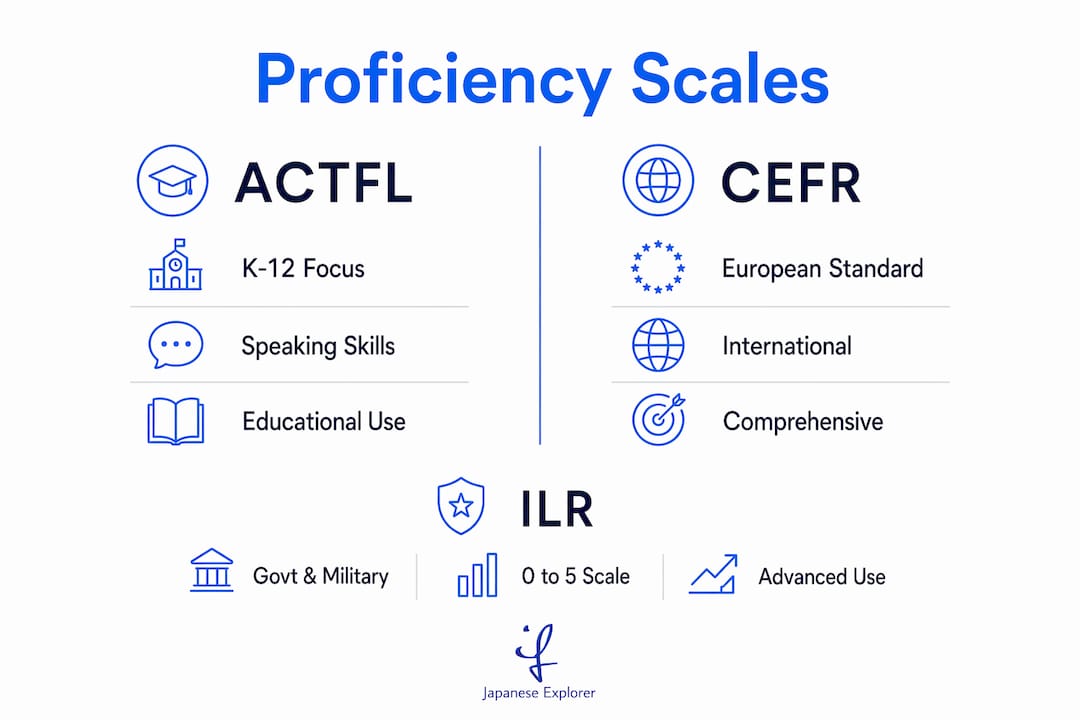
ACTFL (American Council on the Teaching of Foreign Languages) is the primary scale used in U.S. K-12 and higher education. It uses Can-Do descriptors and performance-based evidence. Levels run from Novice (Low/Mid/High) through Intermediate and Advanced to Superior and Distinguished.
CEFR (Common European Framework of Reference) is the international standard, used widely by European institutions and increasingly by multinational employers. Its six levels run A1 through C2, each defined by what a learner can do communicatively.
ILR (Interagency Language Roundtable) was developed for U.S. government and military use. It runs from 0 to 5, with half-point increments, and is used by federal agencies, the Foreign Service, and defense contractors.
Using Can-Do descriptors reduces measurement error compared with coarse self-report labels, which is why all three scales now emphasize task-based performance over vague level names.
| Scale | What it measures | Level labels | Typical uses | Evidence format | Approx. crosswalk |
|---|---|---|---|---|---|
| ACTFL | Speaking, listening, reading, writing via performance tasks | Novice / Intermediate / Advanced / Superior / Distinguished | U.S. K-12, higher ed, OPI testing | Can-Do statements, OPI score | Intermediate High ≈ B1; Advanced ≈ B2; Superior ≈ C1 |
| CEFR | All four skills; communicative competence | A1 / A2 / B1 / B2 / C1 / C2 | European institutions, multinational employers, IELTS/TOEFL reporting | Level descriptors, test scores | B2 ≈ ACTFL Advanced; C1 ≈ ACTFL Superior |
| ILR | Functional ability in real-world tasks | 0 / 1 / 2 / 3 / 4 / 5 | U.S. federal agencies, military, Foreign Service | Oral proficiency interview, written test | ILR 2 ≈ B2/ACTFL Advanced; ILR 3 ≈ C1/ACTFL Superior |
One important caveat: crosswalk mappings are approximate. A learner who scores ACTFL Advanced in speaking may not perform at the equivalent CEFR B2 level in writing. Skills develop unevenly across modes, and no crosswalk fully accounts for that variation.
Statistic to know: A one-point rise in national average TOEFL scores (on a 120-point scale) is associated with a 6–13% increase in real per capita income across countries, suggesting that language proficiency has measurable economic weight at both the individual and national level.
Which proficiency test should you take?
The right test depends entirely on what you need the result for. Here is a breakdown of the most common assessments used in the U.S. context.
- TOEFL (Test of English as a Foreign Language): Computer-delivered, measures reading, listening, speaking, and writing. Widely accepted by U.S. universities for admission. Scores reported on a 0–120 scale, with section scores mapped to CEFR levels.
- IELTS (International English Language Testing System): Available in Academic and General Training versions. Accepted by most U.S. universities and many employers. Scores reported on a 1–9 band scale, directly aligned with CEFR.
- OPI / OPIc (Oral Proficiency Interview / OPI by Computer): Performance-based speaking assessment developed within the ACTFL framework. The OPI is a live interview with a certified tester; the OPIc is a computer-delivered version. Both produce ACTFL level ratings and are used by employers, government agencies, and academic programs as evidence of speaking ability.
- Language Testing International (LTI): The official testing provider for ACTFL assessments. LTI administers OPI, OPIc, and writing proficiency tests across more than 120 languages. Results are reported as ACTFL proficiency levels and are accepted by universities, employers, and government agencies.
- Institution-specific placement tests: Many universities and language instruction programs use their own placement assessments to assign students to the right course level, often drawing on ACTFL or CEFR descriptors.
Pro Tip: If your goal is university admission in the U.S., take the TOEFL or IELTS. If you need speaking evidence for a job application or government role, the OPI or OPIc through Language Testing International gives you a recognized, performance-based credential. For immigration or citizenship purposes, check the specific agency’s requirements directly, as accepted tests vary.
Short examples of when each test fits:
- TOEFL: Applying to a U.S. graduate program
- IELTS: Applying to a U.S. or international university, or for certain visa categories
- OPI/OPIc via LTI: Demonstrating speaking ability for a federal job, a corporate role, or a language teaching credential
- Placement interview: Entering a university language program or corporate training track
What does research say about the impact of language skills?
The evidence connecting language proficiency to earnings and hiring is stronger than most people realize, and it goes beyond simple correlation.
A German labor-market study found that English skills carried an average 13% wage premium, and moving up three skill levels increased wages by about 11% on average. A cross-country analysis linked higher national average English scores to higher real per capita income, with a one-point rise in TOEFL scores associated with a 6–13% income increase in some specifications. These are associations, not causal proofs, but the consistency across studies is notable.
Statistic callout: In a 2026 field experiment published in the Journal of Human Resources, including second-language cues on immigrant resumes substantially increased invitations to job interviews, even for entry-level positions. This suggests the labor-market effect of language proficiency extends well beyond specialized or high-skilled roles.
Employers treat language skills as a signal of non-cognitive strengths too. Adaptability and openness are traits employers read into candidates who demonstrate second-language ability, which affects both hiring decisions and internal mobility. That is a meaningful insight: your language proficiency is not just a communication tool; it shapes how decision-makers perceive your overall profile.
ACTFL also documents cognitive benefits of language learning, including improved memory, stronger problem-solving, and reduced cognitive decline over time. These benefits compound with career outcomes, making language investment one of the higher-return personal development choices available to adults.
A few honest caveats:
- Most wage studies show association, not causation. Other factors (education level, industry, job type) influence earnings alongside language skill.
- The wage premium varies by language pair, industry, and geography. A bilingual premium in a service-sector role may look different from one in a finance or legal context.
- Self-reported proficiency levels are less reliable than performance-based assessments, which is why test scores and OPI results carry more weight with employers.
How long does it take to reach a useful proficiency level?
There is no single answer, but there are honest ranges. The U.S. Foreign Service Institute (FSI) categorizes languages by difficulty for English speakers and publishes estimated study hours to reach professional working proficiency (roughly ILR 2 / CEFR B2).
- Category I languages (Spanish, French, Italian): approximately 600–750 class hours
- Category II languages (German, Indonesian): approximately 900 class hours
- Category III languages (Russian, Hebrew, Thai): approximately 1,100 class hours
- Category IV languages (Arabic, Chinese, Japanese, Korean): approximately 2,200 class hours
These are FSI estimates for intensive, full-time study. Part-time adult learners working 5–10 hours per week will take proportionally longer. Reaching basic conversational ability (ACTFL Intermediate / CEFR A2-B1) typically takes 150–300 hours depending on the language and learner background.
Key factors that speed or slow progress:
- Study hours and consistency: Regular, spaced practice outperforms cramming. Daily 30-minute sessions beat a single weekly three-hour block.
- Quality of input: Comprehensible input slightly above your current level (Stephen Krashen’s “i+1” principle) drives faster acquisition than content that is too easy or too hard.
- L1-L2 distance: The closer your native language is to the target language, the faster you progress. Japanese is a Category IV language for English speakers precisely because the grammar, writing systems, and phonology differ so dramatically.
- Immersion and output: Passive exposure helps, but speaking and writing output accelerates proficiency gains. Making mistakes in real conversations is not a setback; it is how language resiliency develops.
- Motivation and deliberate practice: Learners with clear, task-based goals (e.g., “I want to conduct a business meeting in Japanese”) progress faster than those with vague aspirations.
Pro Tip: Track your progress using Can-Do statements rather than hours logged. Ask yourself: “Can I now do X that I could not do three months ago?” That question keeps your study focused on real-world capability, not just time spent.
How proficiency is used in education, work, and leadership
Education
Universities and colleges use proficiency scores for three purposes: placing students in the right course level, awarding credit for demonstrated ability, and meeting admission requirements for language-intensive programs. Schools draw on Can-Do statements and standardized test scores to make these decisions. A student who enters with ACTFL Advanced or CEFR B2 evidence may skip introductory courses entirely and earn credit toward their degree.
Language instruction programs at the K-12 level use placement assessments to match learners to appropriate instruction. The same logic applies to adult education and corporate training: starting at the wrong level wastes time and erodes motivation.
Workplace
Proficiency requirements in the workplace vary by role, but the pattern is consistent: the more a job involves external communication, negotiation, or client relationships, the higher the language bar. Here is how proficiency levels map to common job tasks:
- ACTFL Intermediate / CEFR B1: Handle routine customer inquiries, participate in team meetings, write clear internal emails.
- ACTFL Advanced / CEFR B2: Lead project discussions, write professional reports, manage client relationships in the target language.
- ACTFL Superior / CEFR C1: Negotiate contracts, present to senior stakeholders, handle ambiguous or high-stakes conversations without support.
Language skills also enhance career prospects in ways that go beyond the immediate job description. Employers who see second-language ability on a resume often read it as evidence of discipline, cultural awareness, and the kind of adaptability that transfers across roles.
Leadership

At the leadership level, advanced proficiency does something specific: it supports trust-building and cross-cultural influence in ways that working through a translator cannot replicate. Research also suggests that using a second language can promote more reason-driven decision-making by creating a degree of emotional distance from the topic, which is particularly useful in negotiation and conflict resolution contexts.

For immigration and citizenship purposes, U.S. naturalization requires demonstrating English proficiency through a civics interview, and certain visa categories require language test scores from TOEFL or IELTS as part of the application. Requirements vary by visa type, so always verify directly with the relevant agency.
How to improve your proficiency and demonstrate it credibly
A step-by-step improvement plan
- Diagnose your current level. Take a placement test or a recognized assessment to establish your baseline. Guessing your level leads to mismatched study materials.
- Set Can-Do goals. Write down two or three specific tasks you want to be able to perform in the target language within 90 days. Keep them concrete: “I can conduct a 10-minute business meeting in Japanese” beats “I want to get better at Japanese.”
- Build focused input habits. Use comprehensible input at your level plus one step above. Podcasts, graded readers, and structured lessons all work. Variety keeps engagement high.
- Practice output deliberately. Speaking and writing are where proficiency is built, not just tested. Find a conversation partner, join a class, or record yourself speaking on a topic you care about.
- Create a feedback loop. Get corrections from a qualified instructor or language partner. Unaddressed errors become fossilized habits that are harder to fix later.
- Prepare for your target assessment. Whether it is the JLPT, OPI, TOEFL, or an employer interview, practice the specific format. Test-taking skill is separate from language skill, and both matter.
Practice methods that actually work
- Shadowing: Listen to a native speaker and repeat immediately, matching rhythm and intonation. Builds speaking fluency faster than most other methods.
- Spaced repetition for vocabulary: Tools like Anki use spaced repetition algorithms to surface words just before you forget them, making vocabulary retention far more efficient than rereading lists.
- Task-based learning: Structure practice around real tasks (writing a work email, describing a process, summarizing a news article) rather than grammar drills in isolation.
- Targeted listening: Choose listening material slightly above your current level and focus on meaning, not every word.
How to demonstrate proficiency on a resume and in interviews
- List your proficiency level using a recognized scale: “Japanese: JLPT N3 / ACTFL Intermediate High” is far more informative than “conversational Japanese.”
- Include a test score with the testing body and date: “TOEFL iBT: 105 (2025)” or “IELTS Academic: 7.5 (2025).”
- For speaking evidence, an OPI result from Language Testing International gives you a performance-based credential that employers and academic programs recognize.
- Link a portfolio or recorded sample if the role involves communication-heavy tasks.
- In interviews, offer to demonstrate: a brief exchange in the target language is more convincing than any score.
For adult professionals and corporate teams, structured training with certified instructors is often the most time-efficient path. Japanese Explorer’s corporate training programs are designed for exactly this: building measurable, task-based proficiency for professionals who need results without wasting time on content that does not apply to their work.
Common myths about language proficiency you should stop believing
A few persistent misconceptions make language learning harder than it needs to be, and some of them affect how employers and institutions use proficiency data unfairly.
Myths worth correcting:
- “Fluency means sounding like a native speaker.” No recognized scale uses native-like accent as a criterion. ACTFL, CEFR, and ILR all measure communicative effectiveness, not phonetic perfection.
- “A test score captures everything about your language ability.” A single test is a snapshot. It measures performance on that day, in that format. Can-Do statements and performance portfolios give a fuller picture.
- “If you make mistakes, you are not proficient.” Errors are part of every proficiency level except the highest. ACTFL’s own descriptors acknowledge that even Advanced speakers make errors under pressure.
- “Language proficiency is fixed once you reach a level.” Proficiency can atrophy without use. Maintaining a level requires ongoing practice, especially in speaking and listening.
Standardized tests also have real limits. They cannot fully capture sociolinguistic competence (knowing when and how to adjust register), pragmatic nuance, or the kind of cultural knowledge that makes communication effective across contexts. That is why multiple evidence types, including performance samples, Can-Do self-assessments, and course completion records, together build a stronger case than any single score.
Equity concerns are real too. Access to test preparation, testing fees, and quality instruction is not evenly distributed. High-stakes use of language tests in hiring or immigration without accommodations or alternative evidence pathways can disadvantage qualified candidates who simply lacked access to preparation resources. Portfolio assessments and workplace performance tasks offer fairer alternatives in many contexts.
Key Takeaways
Language proficiency is a measurable, improvable capability that directly affects academic placement, hiring outcomes, wages, and leadership effectiveness, and it is best demonstrated through recognized scales, performance-based tests, and concrete Can-Do evidence.
| Point | Details |
|---|---|
| Proficiency vs. fluency | Proficiency means consistent capability across unfamiliar contexts; fluency has no standardized definition and sets an unrealistic bar. |
| Scale mapping matters | ACTFL, CEFR, and ILR crosswalks are approximate; skills develop unevenly across modes, so always specify the scale and skill area. |
| Wage and hiring evidence | English skills carried an average 13% wage premium in a German labor-market study, and moving up three skill levels increased wages by about 11% on average. A 2026 field experiment showed language cues on resumes increased interview invitations. |
| Choose the right test | TOEFL and IELTS suit academic admission; OPI/OPIc via Language Testing International provides performance-based speaking evidence for employment and government roles. |
| Demonstrate with specifics | List your level with the scale name and test date on your resume; offer a live demonstration in interviews to make your proficiency concrete and credible. |
Why measurable proficiency beats vague language goals
Most people who say they want to “learn a language” never define what that means. That vagueness is the single biggest reason adult learners stall. The research is clear: proficiency gains that translate into career outcomes are tied to specific, task-based goals and verified through recognized assessments, not hours logged or apps completed.
What the evidence points to is this: the learners and organizations that get the best return on language investment are the ones who treat proficiency as a measurable target, not a feeling. They set Can-Do goals, track progress against a recognized scale, and use performance-based evidence to demonstrate what they have built. For organizations, that means investing in structured, instructor-led training with clear performance benchmarks, not just access to a language app. The difference in outcomes between those two approaches is substantial, even when the time investment is similar.
One recommendation worth making directly: if you are a professional or a corporate team targeting Japanese for business use, start with a placement assessment to establish your baseline, then build toward specific workplace tasks. Structured programs with certified instructors, like those offered by Japanese Explorer, give you the feedback loop and accountability that self-study rarely provides. The goal is not to sound impressive. The goal is to perform reliably when it counts.
Useful sources and recommended reading
The sources below are the primary references behind this article. Each one is worth bookmarking for your own research or verification.
- ACTFL Proficiency Guidelines (2024): The authoritative U.S. source for Can-Do descriptors and performance-based proficiency levels. Use this when designing learning goals or interpreting OPI results.
- ACTFL: The Benefits of Learning Languages: ACTFL’s summary of cognitive, career, and social benefits. Useful for making the case to employers or institutions for language investment.
- CEFR Reference Document (Council of Europe): The foundational document for the A1-C2 scale. Use this when mapping CEFR levels to curriculum or test requirements.
- The Value of Foreign Language Skills in the German Labor Market: The source for the 13% wage premium and 11% per-three-level wage increase figures. Use this when making the economic case for language training.
- The Impact of English Language Skills on National Income: Cross-country analysis linking TOEFL scores to per capita income. Useful for policy-level arguments about language investment.
- Employers’ Language Proficiency Requirements and Hiring of Immigrants (Journal of Human Resources, 2026): The 2026 field experiment showing language cues on resumes increase interview rates. The most current hiring-related evidence in this article.
- Labor Market Outcomes of Bilinguals in the United States (PMC): A 15-year Census data analysis of bilingual earnings in the U.S. Use this for U.S.-specific labor market context.
- Language Learning: A Key Skill for the Present and Future (EPALE): Covers employer signaling effects and non-cognitive trait associations. Use when explaining why language skills affect hiring beyond pure communication ability.
- Language Instruction Educational Program (LIEP): Explains how schools use proficiency assessment for placement and instruction design. Useful for education-context applications.
| Source | Best used for |
|---|---|
| ACTFL Guidelines (2024) | Can-Do goal setting, OPI interpretation, classroom placement |
| CEFR Reference Document | Mapping levels across European and international contexts |
| German Labor Market Study | Quantifying wage returns to language skill improvement |
| Journal of Human Resources (2026) | Hiring and resume evidence for language proficiency |
| PMC Bilingual Earnings Study | U.S.-specific earnings data for bilinguals and late learners |
| ACTFL Benefits Page | Cognitive and career benefits for advocacy or personal motivation |
FAQ
Why is language proficiency important?
Language proficiency directly affects academic placement, hiring decisions, wages, and leadership effectiveness. Research links measurable language skill improvements to wage premiums and higher interview rates, making it one of the most concrete professional development investments available to adults.
What is the purpose of a language proficiency assessment?
A proficiency assessment establishes what you can reliably do in a language across real-world tasks, not just what you have studied. Schools use results for placement and credit decisions; employers use them as hiring signals; government agencies use them for security clearances and immigration determinations.
How is language proficiency different from fluency?
Proficiency is a measurable, scale-defined capability across unrehearsed contexts, assessed through recognized frameworks like ACTFL, CEFR, or ILR. Fluency has no standardized definition and is often used informally to mean native-like ease, a bar that no recognized proficiency scale actually requires.
Which test should I take to prove my language proficiency?
For U.S. university admission, TOEFL or IELTS is the standard. For performance-based speaking evidence accepted by employers and government agencies, the OPI or OPIc through Language Testing International is the most recognized option. For Japanese specifically, the JLPT provides a widely recognized certified level credential that employers and academic programs across the U.S. and Japan accept.
How long does it take to reach workplace-level proficiency in Japanese?
For English speakers, the U.S. Foreign Service Institute estimates approximately 2,200 class hours to reach professional working proficiency in Japanese, given its Category IV difficulty. Part-time learners working 5–10 hours per week will need several years to reach that level, though basic conversational ability is achievable much sooner with consistent, structured practice.