
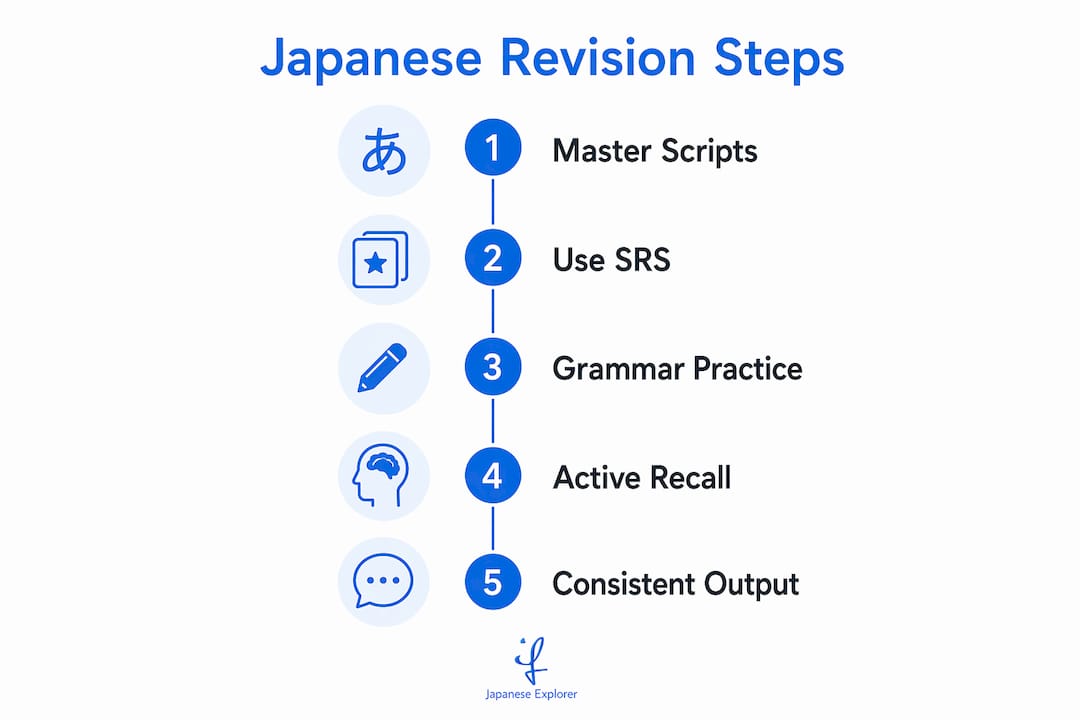
The most effective Japanese revision steps follow a clear sequence: master the scripts first, build vocabulary through a Spaced Repetition System (SRS), study grammar in context, practice active recall daily, and integrate all four language skills throughout the week. Learners who follow this structure consistently outpace those who study harder but without a plan. Here is what that looks like in practice:
- Master Hiragana and Katakana before anything else. These two phonetic scripts are the foundation of everything.
- Use an SRS tool like Anki for vocabulary. Keep new cards to 10–20 per day to avoid burnout.
- Study grammar contextually, not in isolation. Write example sentences. Keep a short journal.
- Practice active recall after every study session. Test yourself before you check the answer.
- Produce output early. Write one sentence in Japanese every day, even from week one.
- Rotate all four skills across the week: reading, listening, speaking, and writing.
- Track your mistakes and ask why you got something wrong. That question builds stronger memory than re-reading ever will.
- Set a daily minimum you can hit even on your worst day. Fifteen minutes of focused study beats a two-hour session you do once a week.
Table of Contents
- 1. How to master Japanese scripts and build a solid foundation
- 2. How SRS transforms your Japanese vocabulary practice
- 3. How to study Japanese grammar so it actually sticks
- 4. Active recall and output techniques that reinforce what you know
- 5. How to break through the intermediate wall and keep progressing
- 6. How to build a revision plan that covers all four language skills
- 7. Common pitfalls in Japanese revision and how to avoid them
- 8. Expert revision practices from Japanese Explorer
- Key Takeaways
- Ready to study smarter with structured Japanese classes?
- FAQ
1. How to master Japanese scripts and build a solid foundation
Every effective Japanese revision strategy starts here. Hiragana and Katakana are phonetic alphabets, each with 46 base characters, and most learners can read both fluently within two to four weeks of focused daily practice. Kanji comes next, learned progressively through vocabulary rather than as isolated stroke memorization.
The order matters. Hiragana first, then Katakana, then Kanji tied to real words. Skipping ahead or trying to learn all three simultaneously leads to confusion. More importantly, dropping romaji early forces your brain to process Japanese the way native speakers do, which accelerates natural language acquisition significantly.
Here is how to approach each script stage:
- Hiragana: Use mnemonics and write each character by hand repeatedly. Apps like Dr. Moku use visual associations that make the 46 characters stick faster.
- Katakana: Study it immediately after Hiragana. Katakana appears constantly in modern Japanese for foreign loanwords, menus, and product names.
- Kanji: Learn characters through vocabulary, not stroke order alone. When you learn the word 食べる (taberu, “to eat”), you learn the kanji 食 in context, which is far more durable than drilling it in isolation.
- Avoid romaji dependency. Reading Japanese in Roman letters feels comfortable at first but creates a ceiling. Native-script immersion from day one is the single biggest structural advantage you can give yourself.
Pro Tip: Label objects around your home in Japanese using Hiragana or Katakana. Seeing 冷蔵庫 (れいぞうこ) on your refrigerator every morning creates passive exposure that reinforces script recognition without any extra study time.
2. How SRS transforms your Japanese vocabulary practice
A Spaced Repetition System works by showing you a flashcard just before you are about to forget it. The algorithm spaces out reviews over increasing intervals, so words you know well appear less often and words you struggle with appear more. The result is dramatically better long-term retention compared to reviewing everything at the same frequency.
Anki is the most widely used SRS tool for Japanese learners, and it is free on desktop. The key is not just using it but using it correctly.
Study smarter: Keeping new cards to 10–20 per day prevents the review backlog that burns most learners out within a month. More than 20 new words daily is unsustainable for anyone studying less than an hour per day, because the review burden compounds quickly.
Practical SRS habits that actually work:
- Use sentence cards, not isolated words. A card that shows a full sentence with one word blanked out forces you to understand context, not just recognize a character.
- Do reviews in the morning, add new cards in the evening. Splitting SRS work this way aligns with your brain’s natural memory consolidation cycles.
- Add cards from real mistakes. Words that tripped you up in conversation or reading are the highest-value additions to your deck because they are already personally meaningful.
- Suspend cards that keep failing. If a card defeats you every single session, suspend it and revisit after a week. Forcing a broken card through the system wastes time.
- Keep your deck lean. A focused deck of 1,000 well-reviewed cards beats a bloated deck of 5,000 half-learned ones.
For a deeper look at building sustainable vocabulary habits, the approach of tying new words to real sentences you have encountered is one of the most reliable methods experienced learners use.
3. How to study Japanese grammar so it actually sticks
Grammar study fails when it becomes a reading exercise. You recognize a pattern in a textbook, nod along, and move on. Two weeks later, you cannot produce it. The fix is simple: every grammar point you study needs to come out of your mouth or appear in your writing before you move to the next one.

Steady, contextual grammar learning beats rushing through a textbook. Two to three new grammar points per week, each practiced with three original sentences, produces better long-term results than ten points per week that are immediately forgotten.
Grammar focus by level:
- Beginner (N5/N4): Core sentence structure (Subject-Object-Verb), verb conjugations (て-form, ます-form, ない-form), particles は, が, を, に, で, and basic adjective forms.
- Intermediate (N3): Conditional forms (たら, ば, と, なら), causative and passive constructions, and connecting clauses with から, ので, のに, and けど.
- Upper intermediate (N2+): Formal written grammar, keigo (polite/honorific speech), complex sentence patterns, and nuanced particle usage.
Practical grammar study habits:
- Write three original sentences per grammar point. Not copied from the textbook. Your own sentences about your own life.
- Keep a short Japanese journal. Even three sentences about your day recycles high-frequency vocabulary and forces you to apply grammar you have studied.
- Use Tae Kim’s Guide to Learning Japanese as a free, grammar-first reference that explains patterns logically rather than through rote memorization.
- Combine grammar study with listening. After studying a pattern, find a short audio clip or dialogue that uses it naturally.
4. Active recall and output techniques that reinforce what you know
Active recall is the practice of retrieving information from memory rather than re-reading it. It is consistently one of the most effective revision methods across all subjects, and Japanese is no exception. After studying a section, close the book and try to reproduce what you just learned from memory before checking.

Two specific techniques stand out for Japanese learners:
Ondoku (音読): Reading aloud forces you to engage your mouth, ears, and eyes simultaneously. You cannot skim when you are reading aloud. It also trains pronunciation and pitch accent in a way that silent reading never does. Read a paragraph aloud, then try to summarize it in Japanese without looking.
Jiko Setsumei (自己説明): Teaching a concept to yourself out loud. Explain a grammar point as if you were explaining it to a friend who has never studied Japanese. This technique forces you to identify exactly what you do and do not understand, which is far more valuable than the comfortable feeling of re-reading familiar material.
Additional output habits worth building:
- Write one Japanese sentence every day. Start with simple observations: 今日は晴れです (It is sunny today). The act of producing language is fundamentally different from recognizing it.
- Record yourself speaking. Even 30 seconds of self-talk in Japanese, played back, reveals pronunciation and fluency gaps that you cannot hear in real time.
- Use language exchange apps to find native Japanese speakers who want to practice English. Tandem and HelloTalk both have active Japanese-speaking communities.
Pro Tip: After every study session, ask yourself “Why did I get that wrong?” rather than just marking the answer incorrect and moving on. Analytical thinking about your mistakes builds stronger neural connections than brute repetition.
5. How to break through the intermediate wall and keep progressing
The intermediate wall is real, and it has a specific cause. Most learners hit it when they have learned enough Japanese to get by on word lists and romaji but not enough to process native content naturally. Progress feels invisible because the gap between “textbook Japanese” and “real Japanese” is enormous.
The root of the problem is dependency on romanized text and disconnected vocabulary lists. When you have been reading Japanese in Roman letters, your brain has never had to process the actual writing system automatically. Switching to native scripts feels slow and frustrating at first, but it is the only path through.
Strategies for breaking through:
- Switch all your study materials to native script. No more romaji. If a resource uses it heavily, replace it.
- Start consuming native content at a level slightly above your comfort zone. Graded readers, NHK Web Easy (a simplified Japanese news site), and beginner manga with furigana are good entry points.
- Build output confidence deliberately. The intermediate wall is partly psychological. Producing imperfect Japanese regularly, and accepting that imperfection, is what moves you forward.
- Analyze sentences, not just words. When you encounter an unfamiliar sentence, break it into its grammatical components. Ask what each particle is doing, what verb form is being used, and why.
- Set a specific, measurable goal like passing JLPT N4 or holding a five-minute conversation on a familiar topic. Vague goals (“get better at Japanese”) do not create the structure needed to push through a plateau.
Pro Tip: Incremental exposure works better than immersion shock. Start with five minutes of native content daily, even if you understand only 30% of it. Comprehension builds faster than it feels like it is building, especially when you are also reviewing vocabulary consistently.
For learners specifically working on progressing beyond beginner level, the shift from passive recognition to active production is the single most important transition to make.
6. How to build a revision plan that covers all four language skills
A well-rounded Japanese study plan gives each skill its due without letting any one of them dominate. Balanced study allocates roughly 30–35% to reading, 25–30% to listening, 15–20% to writing, and 15–20% to speaking, rotated across the week with daily SRS reviews as the constant anchor.
What this looks like in practice:
- Daily (non-negotiable): SRS reviews. This takes 10–20 minutes and should happen every single day, even when nothing else does.
- Monday/Wednesday/Friday: Reading and grammar focus. Work through a graded reader, a manga chapter, or a short NHK Web Easy article. Study two to three grammar points and write original sentences using them.
- Tuesday/Thursday: Listening focus. Shadow a short audio clip, watch a Japanese YouTube video with subtitles, or listen to a podcast like Nihongo con Teppei for Beginners.
- Saturday: Speaking and writing output. Write a short journal entry, record a voice memo in Japanese, or practice with a language exchange partner.
- Sunday: Light review and planning. Clear any remaining SRS backlog, review the week’s mistakes, and set goals for the coming week.
Adding 30–60 minutes of passive input daily, such as listening during a commute or reading while eating, increases your total exposure without requiring dedicated study time. Passive input is not a replacement for active study, but it compounds your progress meaningfully over months.
Schedule based on your energy, not just your calendar. If you are sharpest in the morning, do SRS reviews and grammar then. Save passive listening for lower-energy periods. Forcing high-concentration tasks into low-energy windows is one of the quieter reasons study routines collapse.
7. Common pitfalls in Japanese revision and how to avoid them
Most learners do not fail because they lack motivation. They fail because of specific, avoidable structural mistakes in how they study. Recognizing these patterns early saves months of wasted effort.
Adding too many new flashcards. This is the most common technical mistake. Exceeding 10–20 new cards per day creates a review backlog that grows exponentially. Within weeks, the queue becomes so large that reviews alone consume all available study time, leaving no room for new learning. The fix: stop adding new cards for one to two weeks, clear the backlog, then resume at a lower daily limit.
Passive learning without output. Reading and listening feel productive because they are comfortable. But the shift from passive understanding to active use is what separates learners who plateau from those who advance. If you have been studying for three months and cannot write a simple paragraph, your output practice is insufficient.
Other pitfalls to watch for:
- Neglecting one skill entirely. Many learners avoid speaking because it feels embarrassing. Others skip writing because it is slow. Neglecting any skill creates an imbalance that eventually limits all the others.
- Studying without tracking. If you cannot answer “What did I study this week and how did it go?” you are not tracking. A simple notebook or spreadsheet with daily entries takes two minutes and reveals patterns you would otherwise miss.
- Switching methods too often. Trying a new app or method every two weeks prevents any single approach from compounding. Pick a core system, give it six to eight weeks, and evaluate honestly before changing.
- Ignoring pitch accent. Japanese pitch accent affects comprehension and naturalness. You do not need to master it immediately, but ignoring it entirely creates habits that are harder to correct later.
Pro Tip: When a flashcard keeps defeating you, suspend it rather than forcing it through. Come back after a week with fresh eyes, and consider rewriting the card as a sentence card with more context. A card that fails repeatedly is usually a card design problem, not a memory problem.
8. Expert revision practices from Japanese Explorer
Japanese Explorer’s certified instructors follow a curriculum aligned with the Association for Japanese-Language Teaching standards, which means every lesson integrates grammar, speaking, and listening rather than treating them as separate subjects. That integration is not just a teaching philosophy. It reflects how language acquisition actually works: skills reinforce each other when practiced together.
For adult learners with busy schedules, the school’s instructors recommend a set of practical habits that fit real life:
- Set a non-negotiable daily minimum. Even 15 minutes of consistent daily study produces measurable proficiency improvements over time. The habit matters more than the volume on any single day.
- Review mistakes in every session. Before starting new material, spend five minutes on what went wrong last time. This is the highest-return five minutes in any study session.
- Use a study log. Write down what you studied, what was difficult, and one thing you want to revisit. This takes two minutes and creates accountability.
- Practice speaking from lesson one. Interactive communication is central to the school’s approach because confidence in speaking comes from doing it early and often, not from waiting until you feel “ready.”
- Tie revision to real goals. Whether you are preparing for the JLPT, working with Japanese colleagues, or planning a trip to Japan, connecting your study to a concrete purpose keeps motivation grounded in something real.
The school offers small group classes and online Japanese courses via Zoom for adult learners at all levels, from complete beginners through to business Japanese. Instructors are bilingual and certified, and the interactive format means you get speaking practice built into every session, not as an afterthought.
For learners building their own Japanese study plan, the school’s structured approach offers a useful framework: identify your level, set a realistic daily minimum, balance all four skills, and review mistakes systematically every week.
Key Takeaways
Consistent daily practice with active recall and balanced skill development is the most reliable path to Japanese proficiency.
| Point | Details |
|---|---|
| Scripts come first | Master Hiragana and Katakana before vocabulary or grammar; drop romaji as early as possible. |
| SRS is non-negotiable | Use Anki or a similar tool daily; cap new cards at 10–20 per day to prevent review backlog. |
| Output from day one | Write one Japanese sentence daily and speak early; passive study alone will not build fluency. |
| Balance all four skills | Rotate reading, listening, speaking, and writing across the week with daily SRS as the anchor. |
| Japanese Explorer | Offers structured adult courses online and in-person, aligned with professional teaching standards. |
Ready to study smarter with structured Japanese classes?
Self-study gets you far, but there is a ceiling most learners hit when they are working alone without feedback. Japanese Explorer closes that gap. The school’s certified, bilingual instructors bring the Association for Japanese-Language Teaching curriculum into every session, which means your grammar, speaking, and listening develop together rather than in separate silos.

For adult learners, Japanese Explorer offers flexible online Japanese courses via Zoom and in-person small group classes at the International Plaza campus above Tanjong Pagar MRT. Whether your goal is conversational confidence, business Japanese, or JLPT preparation, there is a course designed for where you are right now. Take a free placement test to find your level, then book a class that fits your schedule.
FAQ
What are the most effective steps to revise Japanese?
The most effective revision steps are: master Hiragana and Katakana first, use a Spaced Repetition System for vocabulary, study grammar contextually with original sentences, practice active recall after every session, and produce output daily through writing or speaking.
What is the 80/20 rule in Japanese learning?
The 80/20 principle applied to Japanese suggests that a small portion of vocabulary and grammar patterns cover most everyday communication. Focusing first on the highest-frequency words and core grammar structures gives you the fastest return on study time.
What are the JLPT levels N1 through N5?
The Japanese Language Proficiency Test has five levels: N5 is beginner (basic phrases and simple sentences), N4 is elementary (everyday conversation), N3 is intermediate (natural speech in familiar situations), N2 is upper intermediate (near-native reading and listening), and N1 is advanced (complex texts and nuanced expression). You can find a full breakdown at the JLPT levels guide from Japanese Explorer.
How do I memorize Japanese vocabulary faster?
Use sentence-based SRS cards in Anki rather than isolated word cards, keep new additions to 10–20 per day, and add words from real mistakes in conversation or reading. Engaging multiple senses by reading aloud and writing by hand deepens retention beyond flashcards alone.
How long does it take to reach conversational Japanese?
Most adult learners reach basic conversational ability in six to twelve months with consistent daily study of 30–60 minutes. Reaching natural, comfortable conversation typically takes two to three years, depending on study quality, output practice, and how much exposure to native content you build into your routine.