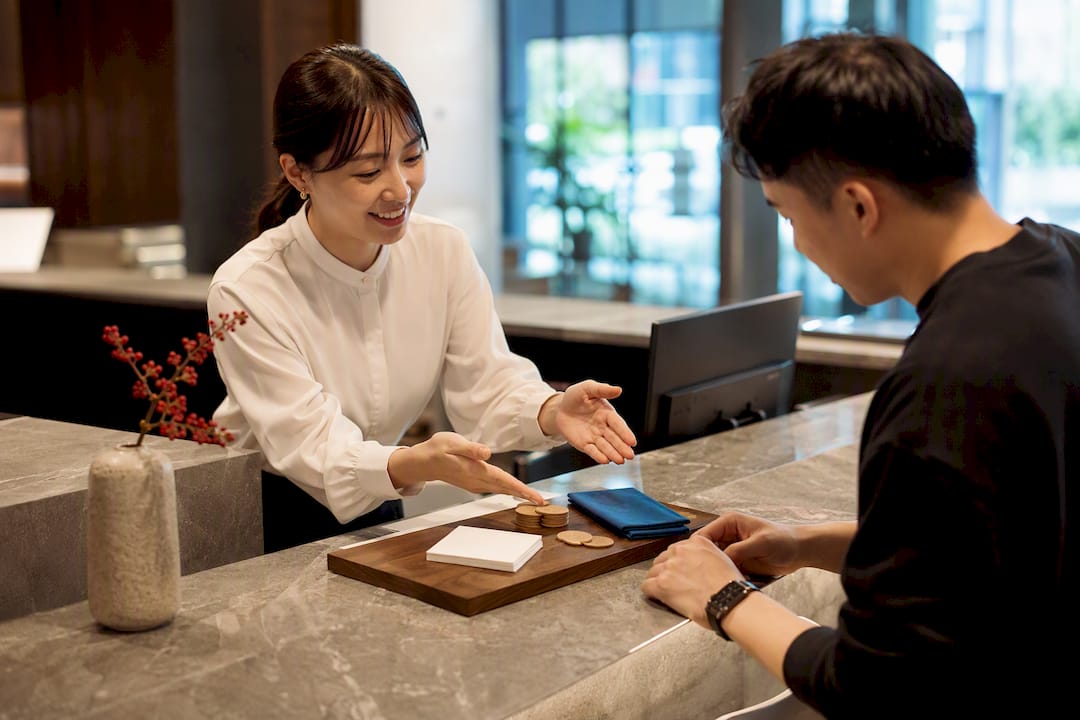
What is Japanese for corporate clients? The essential terms you need
The Japanese terms for corporate clients are houjin kokyaku (法人顧客) and kokyaku kigyou (顧客企業). Both are formal written terms used in contracts, proposals, and official documents to refer to a business entity as your client. Day-to-day professional speech and emails use different vocabulary, and getting that distinction right is where most learners stumble.
Here is a quick-reference breakdown of the core terms:
- Houjin kokyaku (法人顧客): “Corporate client” in the most literal sense. Used in formal documents and business reports to classify a client as a legal entity rather than an individual.
- Kokyaku kigyou (顧客企業): “Client company.” Slightly more relational in tone, often used when discussing the client’s organization as a whole.
- Kokyaku (顧客): The general word for “customer” or “client,” covering both individuals and companies. You will see this constantly in sales and marketing contexts.
- Irainin (依頼人): “Client” in the professional-services sense, as the Cambridge Dictionary confirms with the example “a lawyer’s clients” (弁護士の依頼人). Use this for legal, consulting, or advisory relationships.
- Kisha (貴社): The honorific term for “your company” used in written communication. This is what you write in emails and letters when referring to a client’s organization.
- Onsha (御社): The spoken equivalent of kisha. Use it in meetings, phone calls, and presentations. Note that onsha has become common in emails too, though kisha remains the traditional written standard.
- Kigyou-sama muke (企業様向け): A phrase meaning “directed at corporate clients,” often seen in service descriptions and marketing materials targeting businesses.
Pro Tip: Never mix kisha and onsha in the same document. Pick one based on the medium: kisha for written, onsha for spoken. Mixing them signals that you learned the terms from a list rather than from real practice.
The written/spoken split matters because Japanese business culture treats each communication channel as its own register. A client reading your email expects kisha; a client sitting across the table expects onsha. Using the wrong one does not cause offense, but it does mark you as someone still learning the ropes.

Table of Contents
- How keigo shapes every interaction with a Japanese corporate client
- Business Japanese phrases every professional should know for client work
- How to write a Japanese business email to a corporate client
- Cultural etiquette you need to know before meeting a Japanese corporate client
- Resources and training that actually build corporate Japanese communication skills
- Japanese Explorer makes business Japanese practical for professionals
- FAQ
- Key Takeaways
How keigo shapes every interaction with a Japanese corporate client
Keigo (敬語), the Japanese honorific language system, is not optional in corporate client communication. It is the framework that signals professional competence and cultural awareness, and clients notice immediately when it is absent or misapplied.

The system rests on a concept called uchi-soto, meaning in-group versus out-group. When you communicate with a client, your own company and colleagues are uchi (inside), while the client’s organization is soto (outside). This single principle governs almost every word choice you make. You use humble language for your own actions and your company’s actions, and respectful language for the client’s actions, regardless of actual job titles.
Keigo has three main layers relevant to client communication:
- Sonkeigo (尊敬語): Respectful form. Elevates the actions of the client. Example: instead of “did you see?” you use the sonkeigo form to say “did you have the opportunity to see?”
- Kenjougo (謙譲語): Humble form. Lowers your own actions to show deference. Example: instead of “I will send,” you use the humble form “I humbly transmit.”
- Teineigo (丁寧語): Polite form. The baseline desu/masu level used throughout all professional communication, even with peers.
The directional rule is the one beginners get wrong most often. You apply humble language to yourself and respectful language to the client, not the other way around. Applying sonkeigo to your own actions is a significant error that native speakers notice immediately.
Pro Tip: When in doubt about which keigo form to use, default to the humble form for your own actions. Over-humbling yourself is far less damaging than accidentally elevating yourself above a client.
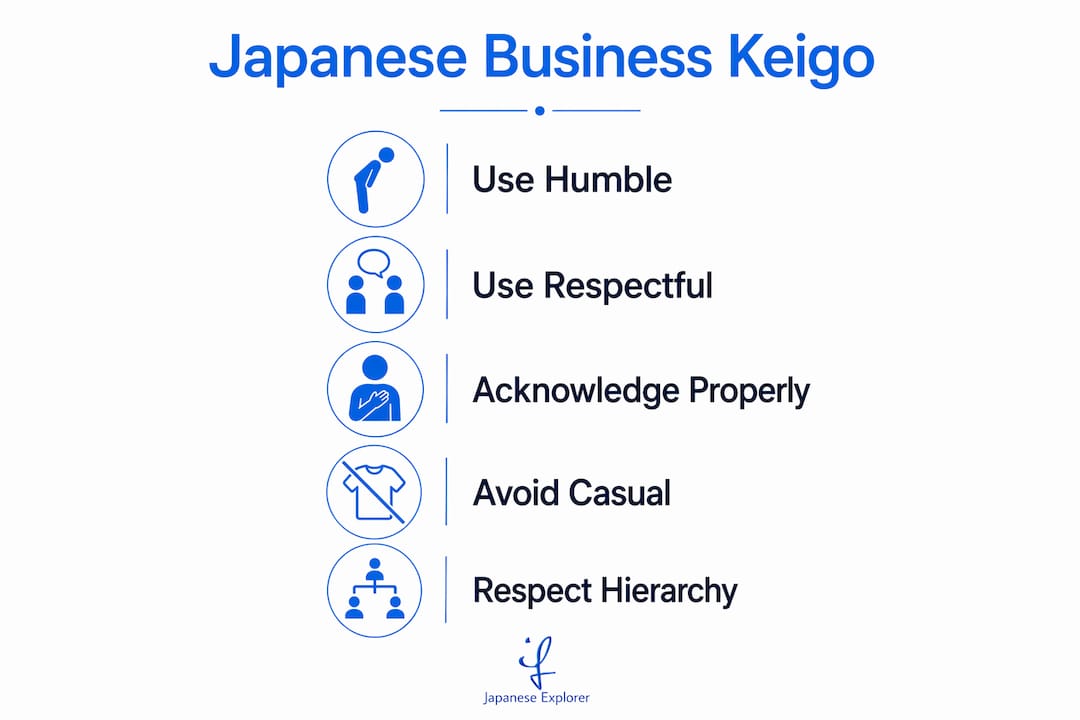
Kashikomarimashita (かしこまりました) is the most deferential acknowledgement phrase available and is the correct choice when responding to a client request. The more casual “ryoukai” (了解) is appropriate only with peers inside your own team. Using ryoukai with a client reads as dismissive, even if that is not the intent.
Business Japanese phrases every professional should know for client work
A handful of phrases carry most of the weight in daily client communication. Learning these well, including when NOT to use them, is more useful than memorizing a long vocabulary list.
The four highest-frequency phrases in client-facing work are:
- Otsukaresama desu (お疲れ様です): An all-purpose workplace greeting meaning roughly “thanks for your hard work.” Use it with colleagues. Do not open an external client email with it; that register belongs inside your own organization.
- Osewa ni natte orimasu (お世話になっております): The standard opener for external emails and phone calls with clients, meaning “thank you for your continued support.” This is the phrase that signals you understand professional Japanese communication.
- Yoroshiku onegai shimasu (よろしくお願いします): A versatile closer used in requests, introductions, and sign-offs. The more formal version, “yoroshiku onegai itashimasu,” is appropriate for client correspondence.
- Shouchi shimashita (承知しました): “Understood,” used when acknowledging a client’s instruction or request. This is the correct form for upward and outward communication.
Beyond those four, these phrases round out a solid client-communication toolkit:
- Kashikomarimashita (かしこまりました): The most formal acknowledgement, one level above shouchi shimashita. Use it when a client makes a specific request you are committing to fulfill.
- Moushiwake gozaimasen (申し訳ございません): A sincere, formal apology. Use this with clients, not the lighter “sumimasen,” which is better suited to casual situations.
- Osewa ni narimasu (お世話になります): The forward-looking version of osewa ni natte orimasu, used when contacting a new client for the first time.
- Shoushou omachi kudasai (少々お待ちください): “One moment, please.” The correct phrase for phone calls and front-desk interactions with clients.
Pro Tip: The acknowledgement ladder runs from “wakarimashita” (casual, peers only) up through “shouchi shimashita” to “kashikomarimashita” (most deferential). With clients, never go below shouchi shimashita.
The difference between client-facing phrases and internal phrases is not subtle. Sending “otsukaresama desu” to a client in an email, or using “ryoukai” to confirm a client’s request, are common mistakes that signal unfamiliarity with professional Japanese norms. The phrases themselves are not wrong; they are simply wrong for the context.
How to write a Japanese business email to a corporate client
Japanese business email structure follows a fixed eight-part format. Deviating from it signals unprofessionalism before the recipient reads a single word of your content.
The eight parts, in order:
- Subject line (件名, kenmei): Use a bracketed category tag followed by the specific topic. Examples: 【ご確認】for a confirmation request, 【お詫び】for an apology, 【日程調整】for scheduling. This lets the recipient sort and prioritize at a glance.
- TO/CC/BCC selection: TO goes to the person you expect a reply from. CC is for awareness only; no reply is expected. BCC is for external mass sends where recipient addresses must not be visible to each other. A common error is placing multiple external clients in the TO field, which exposes their addresses to each other.
- Recipient line (宛名, atena): Write the full company name, department, title, and family name followed by “sama” (様). For a company or department with no specific individual, use “onchuu” (御中) instead of sama.
- Opening greeting: For external client emails, write “itsumo osewa ni natte orimasu” on its own line. For a first-contact email, use “hajimete go-renraku itashimasu” instead. Using “itsumo” (always) with someone you have never contacted before is grammatically awkward and signals inattention.
- Self-introduction: Re-introduce yourself in every external email, even in a long thread. Write your company name and your name in the humble register.
- Body: State the purpose first, then provide background. Japanese business emails follow a conclusion-first principle, which is a courtesy to busy readers.
- Closing: For client emails, use “nanitozo yoroshiku onegai moushiagemasu” (何卒よろしくお願い申し上げます). This is the highest-register closing and the default for all external correspondence.
- Signature: Include company name, department, full name, phone number, and URL.
One formatting rule that catches nearly every non-native writer off guard: Japanese business emails require manual line breaks every 15–25 full-width characters within the body. English emails wrap automatically at the paragraph level. In Japanese professional email, a paragraph-length sentence without manual breaks renders as a wall of text and reads as careless.
Pro Tip: Write your email body in a text editor that shows character count per line, then insert hard returns at natural meaning breaks within the 15–25 character range. It takes practice but becomes second nature quickly.
For apology emails, never open with the routine pleasantry. Lead directly with the apology, then provide the cause, your response, and the revised schedule as a set. Opening an apology email with “thank you for your continued support” reads as tone-deaf.
Cultural etiquette you need to know before meeting a Japanese corporate client
Language accuracy alone will not carry you through a client relationship in Japan. The cultural layer is just as specific, and missteps here can undermine even technically correct Japanese.
Hierarchy shapes every interaction. Japanese organizations operate on clear seniority structures, and your communication must reflect them. Greet the most senior person in the room first. When exchanging business cards (meishi), receive the card with both hands, read it carefully, and place it on the table in front of you during the meeting. Never write on a card or put it in your back pocket.
Indirect communication is the norm. A Japanese client who says “that might be a little difficult” (chotto muzukashii desu ne) is almost certainly saying no. Pushing for a direct answer after this response damages the relationship. Harmony preservation (wa, 和) is a genuine value in Japanese business culture, not a communication style to work around.
Here are the key do’s and don’ts for client meetings and communication:
- Do bow when greeting, matching the depth of the client’s bow or going slightly deeper to show respect.
- Do use the client’s family name with “san” or “sama” in speech; never use first names unless explicitly invited to.
- Do wait for the most senior person to sit before you take your seat.
- Do confirm understanding by summarizing key points at the end of a meeting.
- Don’t interrupt a client mid-sentence, even to agree.
- Don’t use casual language (plain form verbs, slang) in any client-facing setting.
- Don’t make direct criticisms or disagree bluntly; frame concerns as questions instead.
- Don’t use “gokurousama” (ご苦労様) with clients or anyone senior to you. It carries a top-down tone and reads as condescending.
Indirect communication and group harmony are not obstacles to doing business in Japan. They are the business culture. A client who trusts that you understand these values will communicate more openly, not less. The professionals who build the strongest Japanese client relationships are those who stop trying to get a direct answer and start listening to what is being said between the lines.
Industry and company size do create variations. Large corporations (大企業, daikigyou) tend to follow the most formal protocols, with strict hierarchy and extensive documentation. Smaller companies and startups may be somewhat more relaxed in tone, but the baseline expectation of keigo and respectful address remains. In sectors like finance and legal services, formality levels are consistently high regardless of company size.
Resources and training that actually build corporate Japanese communication skills
Vocabulary lists and phrase guides are a starting point, not a finish line. The professionals who communicate most effectively with Japanese corporate clients have practiced in context, received correction from native speakers, and built the muscle memory that makes keigo feel natural rather than effortful.
Here is what genuinely moves the needle:
- Corporate Japanese training with native instructors: Real-time correction of honorific usage is the fastest way to fix the errors that textbooks do not catch. Business Japanese training is most effective when customized by job function, so a sales professional’s curriculum looks different from an HR manager’s or an engineer’s.
- Role-specific vocabulary building: Industry-specific terms matter. Sales teams need contract and proposal vocabulary (契約, keiyaku; 提案, teian). Finance teams need budget and settlement terms (予算, yosan; 決算, kessan). Generic business Japanese courses cover the overlap, but role-specific practice closes the gap.
- Email writing practice with feedback: Writing a Japanese business email correctly requires understanding the structure, the keigo level, and the formatting conventions simultaneously. Guided practice with a native instructor who can flag errors in real time is far more effective than template memorization.
- Meeting phrase collections: Phrases for opening a meeting, handing over the floor, confirming decisions, and closing are a distinct skill set from email writing. Japanese Explorer’s guide to business meeting phrases covers the terminology used in live client interactions.
- Online and group learning options: Flexible formats, including online Zoom classes and small group sessions, make it practical to build these skills around a working professional’s schedule. Japanese Explorer offers both formats for adult learners at the business level.
- Association for Japanese-Language Teaching guidelines: Japanese Explorer’s curriculum follows the Association for Japanese-Language Teaching framework, which structures grammar, speaking, and listening together rather than treating them as separate tracks. This integrated approach builds the kind of fluency that holds up in real client conversations.
- Corporate training programs for teams: For companies with multiple employees working with Japanese clients, group corporate training aligned to shared business goals produces faster results than individual study. Programs at Honor U and Japanese Explorer both offer team-based formats tailored to professional contexts.
The most common gap for business professionals learning Japanese for corporate work is not vocabulary. It is the ability to switch registers smoothly, moving from internal team communication to client-facing keigo without hesitation. That skill comes from practice in realistic scenarios, not from reading about it.
Japanese Explorer makes business Japanese practical for professionals
If you are working with Japanese corporate clients and need language skills that hold up in real meetings and emails, Japanese Explorer offers exactly the kind of training that closes the gap between textbook knowledge and professional fluency.

Japanese Explorer’s business Japanese courses and corporate training programs are built for working adults, not students. Lessons are taught by certified bilingual instructors who focus on the specific scenarios you face: client emails, meeting phrases, honorific usage, and the cultural context that makes language choices land correctly. The curriculum follows the Association for Japanese-Language Teaching framework, so the structure is sound and the progression is deliberate. Classes run in small groups, private sessions, and online via Zoom, all at 10 Anson Road, Level 22, International Plaza, Singapore 079903, right above Tanjong Pagar MRT. Whether you need to sharpen your keigo before a client visit or build your team’s communication skills from the ground up, Japanese Explorer has a format that fits your schedule and your goals. Reach out to find the right course for your professional situation.
FAQ
How do you address a Japanese corporate client in speech?
Use onsha (御社) when referring to the client’s company in spoken conversation, such as in meetings or phone calls. Pair it with keigo verb forms and the client’s family name followed by “sama” for respectful direct address.
How do you say “customers” in Japanese?
The general word for customers or clients is kokyaku (顧客). For corporate clients specifically, use houjin kokyaku (法人顧客) or kokyaku kigyou (顧客企業) in formal written contexts.
What is the Japanese word for “corporate”?
The Cambridge Dictionary translates “corporate” as relating to a company or business organization. In Japanese business contexts, the most common term is houjin (法人), meaning a legal corporate entity, as in houjin kokyaku (corporate client).
What is the Japanese term for customer service?
Customer service in Japanese is kokyaku taiou (顧客対応) in a general business context, or afutaa saabisu (アフターサービス) for after-sales service. In formal client-facing communication, the phrase osewa ni natte orimasu signals ongoing service and relationship maintenance.
What is the difference between kisha and onsha?
Both mean “your company” as a respectful address for a client’s organization. Kisha (貴社) is the written form used in emails and documents; onsha (御社) is the spoken form used in meetings and calls. Using the wrong one for the medium is a minor but noticeable error in professional Japanese.
Key Takeaways
Mastering Japanese for corporate clients requires knowing the right terms, applying keigo correctly, and following the cultural protocols that govern every client interaction.
| Point | Details |
|---|---|
| Core corporate client terms | Use houjin kokyaku or kokyaku kigyou in formal documents; kokyaku for general client references. |
| Written vs. spoken address | Write kisha (貴社) in emails and documents; say onsha (御社) in meetings and calls. |
| Keigo direction rule | Apply humble forms to your own actions and respectful forms to the client’s actions, always. |
| Email structure | Japanese business emails follow a fixed eight-part format; deviating signals unprofessionalism. |
| Japanese Explorer training | Japanese Explorer’s business Japanese and corporate courses build real client-communication fluency with native instructors. |