
TL;DR:
- Japanese language proficiency enhances career prospects by building trust and credibility through keigo. It removes the invisible career ceiling by enabling foreign professionals to participate in leadership and decision-making roles. Mastering business registers and workplace communication is essential for long-term professional growth in Japan.
Japanese language proficiency is defined as a direct career accelerator for professionals working in or with Japanese organizations. Understanding how Japanese helps professional development goes well beyond basic conversation. It shapes your credibility, your access to decision-making, and your long-term career trajectory. From mastering keigo, the formal speech system at the heart of Japanese business culture, to participating confidently in daily workplace meetings, your language skills determine how far you can go. This article breaks down exactly what you need to know to use Japanese as a real career tool.
How Japanese helps professional development through keigo
Keigo is the cornerstone of trust in Japanese enterprise relationships. It is not simply polite language. Keigo is a structured system of speech registers that signals your understanding of social hierarchy, role, and context. Getting it right tells your Japanese colleagues and clients that you respect how they operate.
Keigo breaks down into three main types:
- Sonkeigo (respectful language): Used to elevate the actions of the person you are speaking to or about. For example, saying a client “graced you with their visit” rather than simply “came.”
- Kenjougo (humble language): Used to lower your own actions in relation to others. You would say you “humbly received” a document rather than just “got” it.
- Teineigo (polite language): The standard polite register used in most professional settings, built on the familiar desu/masu verb forms.
Business Japanese training organizes workplace communication into six key areas, including meeting etiquette, email writing, phone calls, and formal requests. All of these areas build on keigo as the foundation. Without it, your communication reads as careless regardless of how technically accurate your grammar is.
Keigo is better understood as a flexible social toolkit that signals social distance rather than a fixed set of rules. This means you need to read context, not just memorize phrases. A phrase that works perfectly in an internal team meeting may sound stiff or even rude in a client presentation.

Pro Tip: When you feel uncertain about which keigo register to use, pause and identify who is performing the action. If it is your client or a senior colleague, reach for sonkeigo. If it is you, use kenjougo. That one mental check prevents the most common errors.
Mastering keigo also protects you in client-facing roles. Sales teams in Japanese companies emphasize keigo use as the primary way to reduce misalignment and demonstrate respect for hierarchy. A single register mistake in a formal proposal meeting can undermine weeks of relationship-building. You can read more about polite language in business to see how these distinctions play out in real workplace scenarios.
Does Japanese proficiency remove the invisible career ceiling?
Japanese language skills remove a real and specific barrier that technical skills alone cannot. Foreign professionals in Japanese companies frequently hit what researchers describe as an invisible career ceiling. They perform well in their technical roles but remain excluded from the informal conversations, consensus-building sessions, and leadership pathways that actually drive promotion.
“Japanese language training enables foreign professionals to access core coordination work, including facilitating meetings, consensus building, and relationship management. These are the skills essential for career growth.” — COMASJAPAN
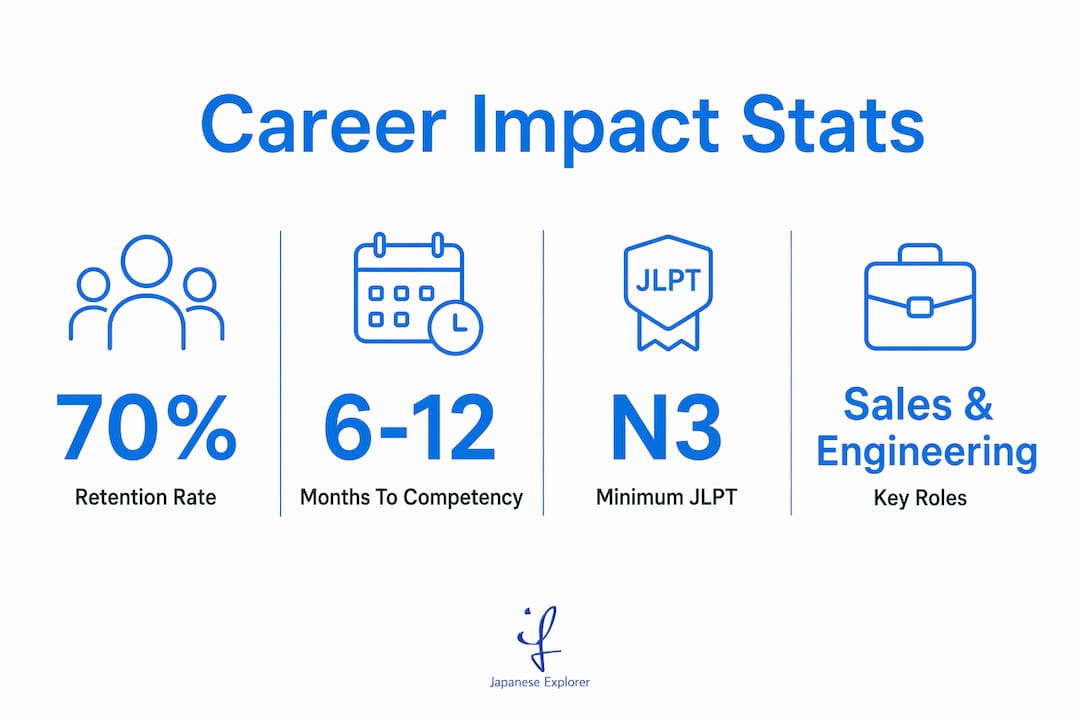
Companies that invest in Japanese training for foreign employees see a 70% retention rate among those staff. That number reflects something important. Professionals who can communicate in Japanese feel integrated rather than sidelined. They stay because they can grow.
The impact shows up clearly in engineering and sales roles. An engineer who cannot follow a real-time design discussion in Japanese gets cut out of decisions even when the company officially operates in English. A sales professional who cannot read the room during a Japanese client dinner loses deals that never appear in any CRM report. Language proficiency closes those gaps.
Workplace-specific Japanese registers matter far more than JLPT preparation alone. Working professionals benefit most from focusing on business register and workplace tasks rather than exam study in isolation. The JLPT measures reading and grammar. Your colleagues measure whether you can hold your own in a Monday morning standup. Those are different skills, and you need to train for both.
How does Japanese improve daily workplace participation and networking?
Active participation in Japanese workplaces requires language skills across several daily scenarios. Each one demands a slightly different register and vocabulary set.
- Daily standups and team meetings: You need N3-level comprehension at minimum to follow fast-paced spoken Japanese in a real meeting. Below N3 level, engineers and other professionals are routinely excluded from real-time decisions even in companies with “English OK” policies.
- Email and Slack communication: Reading workflow tools like Slack, Jira, and internal wikis requires strong reading comprehension of technical and business Japanese. Most workplace Japanese learning should prioritize reading comprehension of documents and messages over spoken output alone.
- Client calls and formal meetings: Phone etiquette in Japanese follows strict conventions. Knowing the correct opening and closing phrases signals professionalism immediately.
- Networking events and job fairs: Career programs like Kyoto University’s Career Support program sequence language skill-building first, then transition students to recruiting events and internships. That order matters. You need functional Japanese before networking events can actually open doors.
| Proficiency Level | Workplace Capability |
|---|---|
| N4 | Basic greetings, simple written messages, limited meeting comprehension |
| N3 | Active meeting participation, reading internal documents, email writing |
| N2 | Full business communication, client-facing roles, formal presentations |
| N1 | Leadership communication, complex negotiations, native-level documents |
Pro Tip: Do not wait until you reach N2 to attend Japanese professional networking events. Go at N3 and focus on listening. You will pick up industry vocabulary and cultural cues that no textbook covers, and you will build relationships before your language skills are “perfect.”
The role of Japanese in career growth becomes most visible at networking events where your language confidence directly determines the quality of connections you make. A professional who can exchange business cards, ask a follow-up question in Japanese, and remember a colleague’s name in context stands out immediately.
What strategies help professionals learn business Japanese effectively?
Basic workplace competency with intermediate Japanese can be achieved within 6–12 months with structured instruction. That timeline assumes you focus on business-relevant content rather than general language study. Here is what an effective approach looks like:
- Prioritize workplace scenarios over general vocabulary lists. Study the language of meetings, emails, and client calls. Japan’s 2026 initiative supports the creation of industry-specific Japanese materials for highly skilled foreign professionals, targeting polite expressions, technical vocabulary, and keigo. These resources are now more available than they were even two years ago.
- Balance reading and speaking practice. Many professionals underestimate how much workplace participation depends on reading comprehension of tools like Slack and Jira. Build both skills in parallel rather than focusing only on spoken Japanese.
- Use structured programs with keigo built in. General language apps rarely teach keigo in context. Look for courses that integrate business scenarios, role-play exercises, and feedback from experienced instructors.
- Practice with real workplace tasks. Write a mock email to a client. Summarize a meeting in Japanese. These exercises build the pragmatic competence that vocabulary lists cannot. Keigo competence develops through social learning and feedback, not memorization alone.
| Learning Approach | Best For | Limitation |
|---|---|---|
| General language app | Building vocabulary and hiragana/katakana | No keigo, no business context |
| JLPT exam prep course | Grammar structure and reading | Limited speaking and workplace application |
| Business Japanese course | Keigo, meetings, emails, client communication | Requires intermediate baseline |
| Corporate training program | Team-wide language alignment | Needs organizational commitment |
The most effective path combines a structured business Japanese course with deliberate practice on real workplace tasks. You can explore how Japanese improves business relationships to understand how language skills translate into tangible professional outcomes.
Key Takeaways
Japanese language proficiency removes career barriers, builds workplace credibility, and opens leadership pathways that technical skills alone cannot unlock.
| Point | Details |
|---|---|
| Keigo is non-negotiable | Correct use of keigo signals respect for hierarchy and builds client trust in Japanese business settings. |
| N3 is the participation threshold | Professionals below JLPT N3 are routinely excluded from real-time decisions in Japanese workplaces. |
| Language removes the career ceiling | Companies investing in Japanese training see a 70% retention rate among foreign employees. |
| Reading comprehension matters as much as speaking | Workplace tools like Slack and Jira require strong Japanese reading skills for daily participation. |
| Structure beats self-study | A focused business Japanese course with keigo integration delivers faster workplace results than general app-based learning. |
What I have learned about Japanese and career growth
The professionals I have seen advance fastest in Japanese workplaces share one trait. They stopped treating Japanese as a side project and started treating it as a core job skill. That shift changes how you study, how you practice, and how you show up at work.
The most common mistake I see is professionals who study hard for the JLPT and then freeze in actual workplace conversations. The exam tests what you know. The workplace tests what you can do under pressure, in real time, with real stakes. Those are genuinely different challenges. Keigo especially requires pragmatic competence developed through feedback and social practice, not just vocabulary drills.
My honest view is that integrating language study with actual workplace tasks is the only approach that sticks. Write emails in Japanese. Attend meetings and take notes in Japanese. Ask a Japanese colleague to correct your keigo. That kind of deliberate, context-rich practice compounds quickly. Six months of that beats two years of flashcard apps.
The long-term career impact goes beyond language proficiency. Professionals who invest in Japanese signal cultural seriousness to Japanese employers and clients. That signal opens doors that credentials alone do not.
— Paul
Japanese Explorer’s business Japanese courses for professionals
Japanese Explorer offers business Japanese courses designed specifically for working professionals in Singapore. The curriculum covers keigo, meeting communication, email writing, and client-facing language, all taught by certified bilingual instructors with real workplace experience.

Flexible options include small group classes at the International Plaza center above Tanjong Pagar MRT, online Japanese courses via Zoom for professionals with demanding schedules, and corporate training programs for teams. The curriculum follows the Association for Japanese-Language Teaching framework, so your learning is structured, measurable, and directly applicable to your career goals. Whether you are starting from zero or building toward business-level fluency, Japanese Explorer has a program that fits where you are right now.
FAQ
What is keigo and why does it matter at work?
Keigo is the formal speech register system in Japanese that signals respect for hierarchy and social roles. Correct keigo use builds trust with clients and colleagues and is considered the foundation of professional communication in Japanese business settings.
What JLPT level do I need for Japanese workplace participation?
JLPT N3 is the minimum level for active participation in Japanese workplace meetings and discussions. Below N3, professionals are often excluded from real-time decisions even in companies with English-friendly policies.
How long does it take to learn business Japanese?
Basic workplace competency with intermediate Japanese can be achieved within 6–12 months with structured instruction focused on business scenarios and keigo rather than general language study.
Does learning Japanese actually improve career prospects?
Companies that invest in Japanese training for foreign employees report a 70% retention rate, reflecting stronger integration, access to leadership roles, and expanded career pathways for language-proficient professionals.
Is business Japanese different from conversational Japanese?
Business Japanese includes specialized registers for meetings, emails, phone calls, and client communication, all built on keigo. Conversational Japanese does not prepare you for these workplace demands without additional focused study.