TL;DR:
- Mastering all three Japanese scripts—hiragana, katakana, and kanji—is essential for fluent reading and writing, with each serving a distinct role in the language.
- Practicing correct stroke order from day one enhances handwriting speed, legibility, and digital recognition accuracy, forming a vital foundation.
- Regular use of genkō yōshi manuscript paper and calligraphy techniques develops neat formatting skills, stroke control, and aesthetic sensitivity vital for formal and academic writing.
Japanese writing is defined as a multi-script system combining hiragana, katakana, and kanji within a single sentence, making it one of the most layered writing systems any adult learner will encounter. This Japanese writing practices list covers every core skill you need, from phonetic script mastery and stroke order discipline to calligraphy techniques and manuscript formatting. Whether you are studying conversational Japanese, preparing for business communication, or working toward JLPT certification, the practices below give you a structured path from beginner to confident writer.
1. The Japanese writing practices list: master all three scripts first
Modern Japanese writing uses a mixture of three scripts within the same sentence. Each script carries a distinct job, and skipping any one of them creates gaps that slow down your reading and writing for years.
The three scripts and their roles:
- Hiragana (ひらがな): 46 base characters used for native Japanese words, verb endings, and grammatical particles. This is always the first script you learn.
- Katakana (カタカナ): 46 parallel characters used for foreign loanwords, scientific terms, and stylistic emphasis. It looks angular compared to hiragana’s curves.
- Kanji (漢字): Chinese-derived characters that carry meaning. The Japanese Ministry of Education designates 2,136 jōyō kanji for general use, and literacy in formal writing requires a working knowledge of most of them.
Starting with hiragana and katakana before advancing to sentences and paragraphs is the most effective progression for beginners. This sequence builds phonetic confidence before you layer in the complexity of kanji. Think of hiragana as your foundation, katakana as your second tool, and kanji as the vocabulary that gives your writing precision and depth. You can explore how these scripts interact in detail through this Japanese writing overview from Japanese Explorer.
2. Learn stroke order from day one
Stroke order is codified by Japan’s education guidelines since 1958, and it directly affects writing speed, natural flow, and legibility. This is not an optional refinement. It is a foundational habit that shapes every character you write.
The four core stroke order rules are:
- Top to bottom: Start at the top of a character and move downward.
- Left to right: When strokes run parallel, write the leftmost stroke first.
- Horizontal before vertical: In most cases, horizontal strokes precede vertical ones.
- Frame before contents: Draw the outer enclosure of a character before filling in the interior strokes.
Practicing stroke order early prevents hard-to-fix motor habits and improves handwriting recognition accuracy on digital devices. This matters practically because Japanese input on smartphones and tablets often uses handwriting recognition, and incorrect stroke sequences produce wrong character suggestions. Apps like Kanji Study, Skritter, and the KanjiVG database all provide animated stroke order guides with immediate feedback. Use them alongside paper practice, not as a replacement for it.
Pro Tip: Write each new kana or kanji five times with full attention to stroke order before moving to speed drills. Rushing this stage is the single most common beginner mistake.
3. Practice with genkō yōshi manuscript paper
Genkō yōshi is a grid-format manuscript paper with one square per character, used widely by students and in formal exams across Japan. Practicing on it trains neat, consistent handwriting and teaches you the formatting conventions expected in academic and professional Japanese writing.
Each square on genkō yōshi holds exactly one character, whether that character is a kanji, a kana, or a punctuation mark. Titles go in specific columns, author names occupy designated positions, and paragraph indentation follows fixed rules. Vertical column reading direction and correct punctuation placement are built into the format, so you absorb them through repetition rather than memorization.
| Genkō yōshi element | Correct practice |
|---|---|
| Character placement | One character per square, centered within the box |
| Title position | Starts several squares from the top of the first column |
| Paragraph indent | First character of each paragraph sits one square down |
| Punctuation marks | Placed in the lower-right corner of their own square |
| Furigana | Written in smaller script in the right margin of the character’s square |
Using genkō yōshi regularly prepares you for JLPT essay sections and formal business documents. It also slows you down in a productive way, forcing you to think about each character’s proportions before committing pen to paper.
4. Incorporate Japanese calligraphy (shodō) techniques
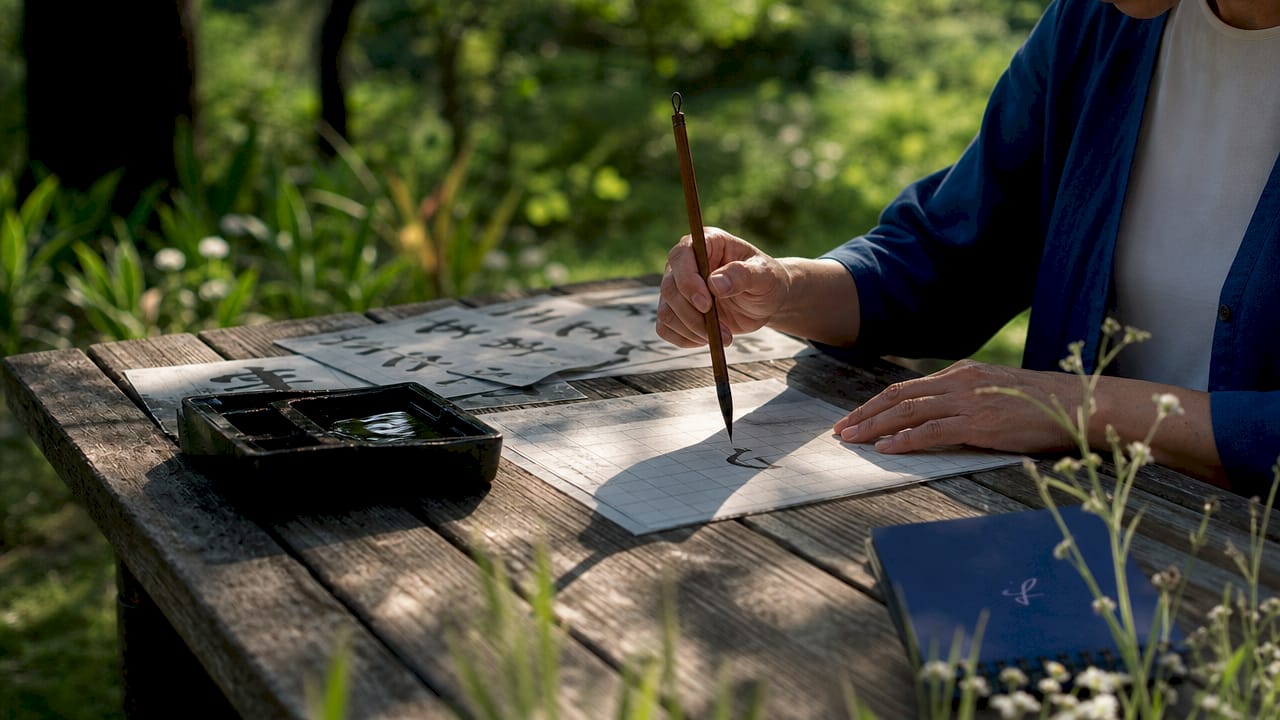
Shodō is the traditional Japanese art of calligraphy, combining physical technique with aesthetic sensitivity to improve stroke control and rhythm far beyond what standard writing practice achieves. Even a basic introduction to shodō changes how you see and write kanji.
The five major script styles in shodō offer a progression from structured to expressive:
- Kaisho (楷書): Block script. Each stroke is clear and separate. Best for beginners and formal documents.
- Gyōsho (行書): Semi-cursive. Strokes begin to connect. Used in everyday handwriting.
- Sōsho (草書): Cursive. Highly abbreviated and fluid. Requires strong foundational knowledge to read.
- Reisho (隷書): Clerical script. Flat, wide characters derived from ancient Chinese administrative writing.
- Tensho (篆書): Seal script. The oldest style, used mainly for name seals (hanko) and artistic work.
Calligraphy teaches you that every stroke has a beginning, a middle, and an end. The stop (tome), hook (hane), and sweep (harai) are not decorative details. They are the difference between a character that reads as confident and one that looks uncertain.
Stroke control aspects like pressure changes, tome, hane, and harai affect the visual depth of kanji in ways that go beyond copying shapes. Even practicing kaisho with a standard brush for 20 minutes a week builds muscle memory that carries directly into your everyday pen writing.
5. Understand Japanese writing styles and formatting conventions
Japanese writing direction is not fixed. Tategaki (縦書き) is vertical writing, read from top to bottom and right to left. Yokogumi (横組み) is horizontal writing, read left to right like English. Novels, newspapers, and formal documents often use tategaki. Websites, textbooks, and business emails typically use yokogumi. Knowing which format applies to your context is part of writing correctly in Japanese.
Japanese text contains no spaces between words. Readers parse meaning through the natural alternation of kanji and kana, which is why mastering all three scripts together matters so much. A sentence written entirely in hiragana becomes difficult to read quickly because the visual cues that kanji provide are absent.
Pro Tip: When practicing yokogumi writing, read published Japanese newspaper articles and copy short paragraphs by hand. This trains your eye to recognize natural word boundaries without spaces, which is a skill that takes deliberate practice to develop.
Furigana (small kana printed above or beside kanji) appears in materials aimed at learners and in children’s publications, but formal adult writing omits it. Punctuation in Japanese includes the ideographic period (。) and comma (、), both of which occupy their own character square in genkō yōshi. Understanding these formatting conventions reduces confusion and aids communication in academic and business contexts.
6. Build a daily writing routine with spaced repetition
Spaced repetition is the practice of reviewing material at increasing intervals to move it from short-term to long-term memory. Applied to Japanese writing, it means you do not write each kanji 50 times in one sitting. You write it today, review it tomorrow, then again in three days, then a week later. Apps like Anki and WaniKani use spaced repetition algorithms to schedule your kanji reviews automatically.
The key is pairing digital review with physical writing. Use Anki to flag which kanji need review, then write those characters by hand on paper. This combination reinforces both visual recognition and motor memory. A step-by-step approach to building this habit makes the process far less overwhelming than trying to tackle hundreds of characters at once.
Set a minimum daily target you can actually keep. Ten minutes of focused writing practice every day produces better results than two hours on weekends. Consistency matters more than volume at the beginner and intermediate stages.
7. Copy native Japanese texts by hand
Copying (書き写し, kakiutsushi) is a traditional study method used in Japanese schools and still recommended by language educators. You select a short passage from a novel, newspaper, or textbook and reproduce it by hand, paying attention to character proportions, spacing, and punctuation placement.
This practice works because it removes the cognitive load of composition. You are not thinking about what to write. You are focused entirely on how to write it. That focused attention accelerates the internalization of character shapes, stroke sequences, and formatting conventions simultaneously. The 4 proven methods for approaching Japanese characters all point back to this kind of deliberate, attentive repetition as a core technique.
Choose texts slightly above your current reading level. The mild challenge keeps your attention engaged and exposes you to kanji and vocabulary you are about to need.
8. Use writing to reinforce speaking and listening skills
Writing and speaking in Japanese are more connected than most learners expect. When you write a sentence by hand, you subvocalize it, which reinforces pitch accent patterns and sentence rhythm. Writing linked to speaking practice accelerates overall fluency because the two skills share the same grammatical structures and vocabulary.
A practical method: write a short paragraph in Japanese about your day, then read it aloud. Record yourself, compare your pronunciation to a native speaker’s version, and revise the written text based on what you notice. This loop of writing, speaking, and listening creates multiple memory pathways for the same material.
Business Japanese learners benefit especially from this approach. Formal written Japanese uses different grammatical structures than casual speech, and practicing both in parallel prevents the common problem of writing formally but speaking too casually in professional settings.
Key takeaways
Mastering Japanese writing requires consistent practice across all three scripts, correct stroke order from the start, and deliberate use of traditional tools like genkō yōshi and shodō techniques.
| Point | Details |
|---|---|
| Learn all three scripts together | Hiragana, katakana, and kanji each serve distinct roles and must be practiced as a system, not in isolation. |
| Stroke order is non-negotiable | Correct stroke sequences, codified since 1958, affect legibility, writing speed, and digital handwriting recognition. |
| Use genkō yōshi for formatting | Grid manuscript paper trains neat characters and teaches the punctuation and layout conventions used in exams and formal documents. |
| Add shodō for stroke precision | Even basic calligraphy practice builds the stroke control (tome, hane, harai) that improves everyday handwriting quality. |
| Combine digital tools with paper | Apps like Anki, Skritter, and Kanji Study schedule reviews efficiently, but physical writing cements motor memory. |
Why I think most learners underestimate the writing side of Japanese
Most adult learners I have worked with focus heavily on speaking and listening in the early months. That makes sense. Conversation is immediately rewarding. But the learners who plateau fastest are almost always the ones who neglected writing practice early on.
Here is what I have observed: when you write a kanji correctly by hand, you remember it differently than when you recognize it on a screen. The motor memory adds a second retrieval pathway. When kanji start to blur together in your reading, it is often because you never wrote them enough to distinguish their internal structure. The trickiest hurdles in Japanese learning almost always trace back to this gap.
I also think calligraphy gets dismissed too quickly as an advanced or artistic pursuit. Even one shodō session changes how you look at stroke endings. You stop seeing kanji as shapes to copy and start seeing them as sequences of intentional movements. That shift in perception makes everything faster.
The practical advice I give every learner: start genkō yōshi practice in your first month, not your third. The formatting habits it builds are much harder to correct later than they are to learn correctly from the beginning.
— Paul
Start building your Japanese writing skills with Japanese Explorer
Japanese Explorer offers structured adult courses in Singapore that develop writing skills progressively alongside speaking and listening, so no skill gets left behind.

Whether you prefer small group classes in the city center at International Plaza above Tanjong Pagar MRT, or flexible online Japanese lessons via Zoom, Japanese Explorer’s certified bilingual instructors guide you through hiragana, katakana, kanji, and formal writing conventions at a pace that works for you. Courses range from beginner to business Japanese, all designed around practical communication and real-world writing contexts. Reach out to Japanese Explorer today and take the first step toward writing Japanese with confidence.
FAQ
What are the three Japanese writing systems?
The three Japanese writing systems are hiragana, katakana, and kanji. Hiragana handles native words and grammar, katakana covers foreign loanwords and emphasis, and kanji conveys meaning through Chinese-derived characters.
Why does stroke order matter in Japanese writing?
Stroke order affects writing speed, legibility, and handwriting recognition on digital devices. Learning correct sequences from the start prevents motor habits that are difficult to correct later.
What is genkō yōshi and why should learners use it?
Genkō yōshi is a grid manuscript paper with one square per character, used in Japanese schools and formal exams. Practicing on it trains neat handwriting and teaches correct formatting conventions for academic and professional writing.
How does shodō calligraphy help everyday Japanese writing?
Shodō builds stroke control through techniques like tome (stop), hane (hook), and harai (sweep), which improve the legibility and aesthetic quality of standard handwritten Japanese beyond what pen practice alone achieves.
How long does it take to learn to write in Japanese?
Most adult learners can write hiragana and katakana fluently within four to eight weeks of daily practice. Reaching functional kanji literacy for conversational and business contexts typically takes one to two years of consistent study.