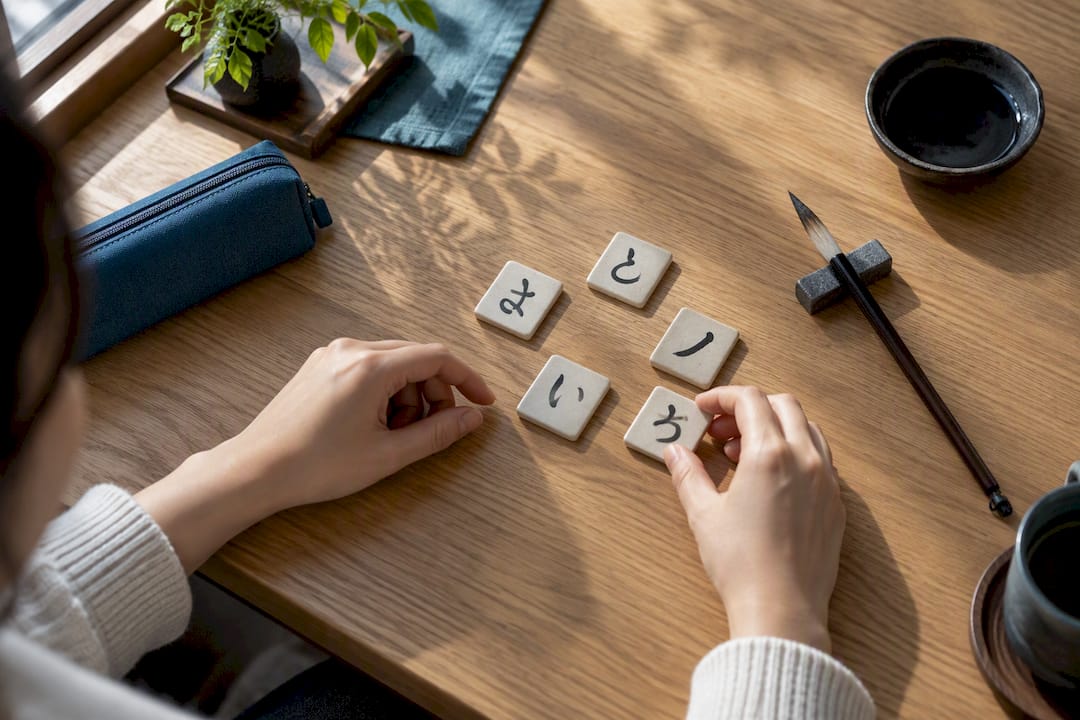
Without a doubt, the Kanji writing script is one of, if not the biggest, hurdles learners must overcome in their Japanese language studies. As many have already experienced, “learning Kanji” is not exactly straightforward, given that the statement is similar to saying “I learned a car” or “I learned a computer”. In short, the writing system has many parts to simply say that you “learned” it. So, what does learning Kanji mean? Below, we break down the core aspects you learn with Japanese Kanji.
1. Learning the stroke order
There are too many reasons why memorising the correct stroke order is vital when learning Kanji characters, but the most important ones are that it assists you in intuitively understanding the way of writing new characters and affects how you understand and remember them.
After getting the hang of the basics and stroke order of all the radicals, the stroke order for most characters is easy and consistent enough that you will rarely need to look them up — save for the odd Kanji every once in a while, such as 「鬱」 and 「飛」. Since you will eventually tackle writing in Japanese during your studies, getting your stroke order right early helps you avoid bad habits.
2. Learning how to write the character
Just know that learning to write any word in Kanji takes so much time to achieve. If you expect to write Japanese by hand a lot given your goals, the necessity and practice will naturally lead to being better at writing. Beginners should put time into writing (especially kana) to develop their muscle memory for stroke order and get that sense of character balance.
3. Learning the meaning(s)
Learning a character’s meaning is great if it is a word by itself, such as 「力」whose meaning translates directly to “strength” and is something you can use often. But since 「力」is also a word, one could argue that you learned the meaning of the word, which ultimately means it counts as learning words and not Kanji.
With that said, knowing the meanings of Kanji undoubtedly comes in handy for simpler concepts and words. For example, learning what 「連」or 「続」means will help in remembering words like 連続, 連中, and 接続. In short, learning the meanings of Kanji is certainly useful and worth the effort.
4. Learning all possible readings
As a general rule of thumb, single Kanji use the kun-reading of characters while Kanji compounds use the on-reading, but this is far from being consistent to make it anything more than a lucky guess. For example, 「大」is often confused given its two possible readings of だい or おお.
There is also the fact that numerous Kanji are associated with multiple on or kun-readings. A good example is the character 「生」which has numerous readings that there is no point in memorising them since you will have a hard time knowing which to use in words like 生粋、 芝生、生涯、 and 生ビール. Moreover, various words only use Kanji characters for their meaning and completely disregard their reading, such as お土産、素人、仲人.
Learners should always search the reading of new words they encounter to learn their proper combination. Do not worry too much about the readings, as remembering them becomes much easier in the context of the real words you actually use.
Conclusion
Learning Kanji should ideally be compared to learning a word, which requires learning the definition, Kanji, reading, and any relevant Okurigana. Veteran learners generally agree that they have learned a Kanji only when they know the most common words that use that character, their correct readings, and can write them at random months after initially memorising it.
To help make your Kanji studies much more efficient, consider signing up for Japanese classes in Singapore today at Japanese Explorer! With native Japanese teachers at the helm and teaching methods tailored to your preferences, you can count on us to accelerate your language learning progress through group, private, and online Japanese lessons.