TL;DR:
- Private language tutors provide personalized instruction that accelerates Japanese learning by tailoring lessons to individual goals and needs. Regular weekly sessions and active participation lead to faster progress, higher confidence, and practical fluency in real-world situations. Online tutoring makes consistent, adaptive, one-on-one lessons accessible and highly effective for adult learners.
A private language tutor is defined as a qualified instructor who delivers one-on-one, personalized instruction tailored to a single learner’s goals, pace, and gaps. For adults learning Japanese in Singapore, whether for business meetings, travel conversations, or personal enrichment, this role is the single most efficient path to real fluency. The Education Endowment Foundation’s analysis of over 100 studies confirms that one-to-one tutoring produces an average of five months’ additional academic progress per year compared to group settings. That gap is not marginal. It reflects a fundamentally different learning experience, one where every minute of class time is built around you.
What does the role of a private language tutor actually involve?
The private language instructor role goes well beyond delivering scripted lessons. A skilled tutor begins with a diagnostic assessment to identify exactly where your Japanese breaks down. Are you strong in reading hiragana but weak in pitch accent? Comfortable with basic greetings but lost in keigo, the formal register used in Japanese business settings? That diagnosis shapes every lesson that follows.

From there, the tutor builds a lesson plan aligned to your specific goal. A learner preparing for business negotiations in Tokyo needs different vocabulary and cultural etiquette training than someone planning a two-week trip to Kyoto. Tutors who carry domain expertise in business or travel contexts consistently produce better learner outcomes because their examples, drills, and corrections stay relevant to what you actually need to say.
Pacing is another core function. In a group class, the instructor moves at the average student’s speed. Your tutor moves at yours. If you need three sessions to internalize the te-form verb conjugation before moving forward, that is exactly what happens. This flexibility is not a luxury. It is the mechanism that prevents the frustration and stagnation that cause most adult learners to quit.
Private lessons also remove the social pressure that silences learners in group settings. Psychological safety in private lessons allows you to ask the questions you would never raise in front of ten classmates, practice pronunciation without embarrassment, and make mistakes freely. That freedom accelerates progress faster than any textbook.
- Diagnostic assessment to map your current level and identify specific gaps
- Goal-aligned lesson plans built around business, travel, or conversational targets
- Flexible pacing that adjusts week by week based on your progress
- Psychological safety that encourages free practice and honest feedback
Pro Tip: Before your first session, write down three specific situations where you want to use Japanese. Hand that list to your tutor. It gives them a concrete starting point for building lessons that feel immediately useful.
What evidence supports the effectiveness of private language tutoring?
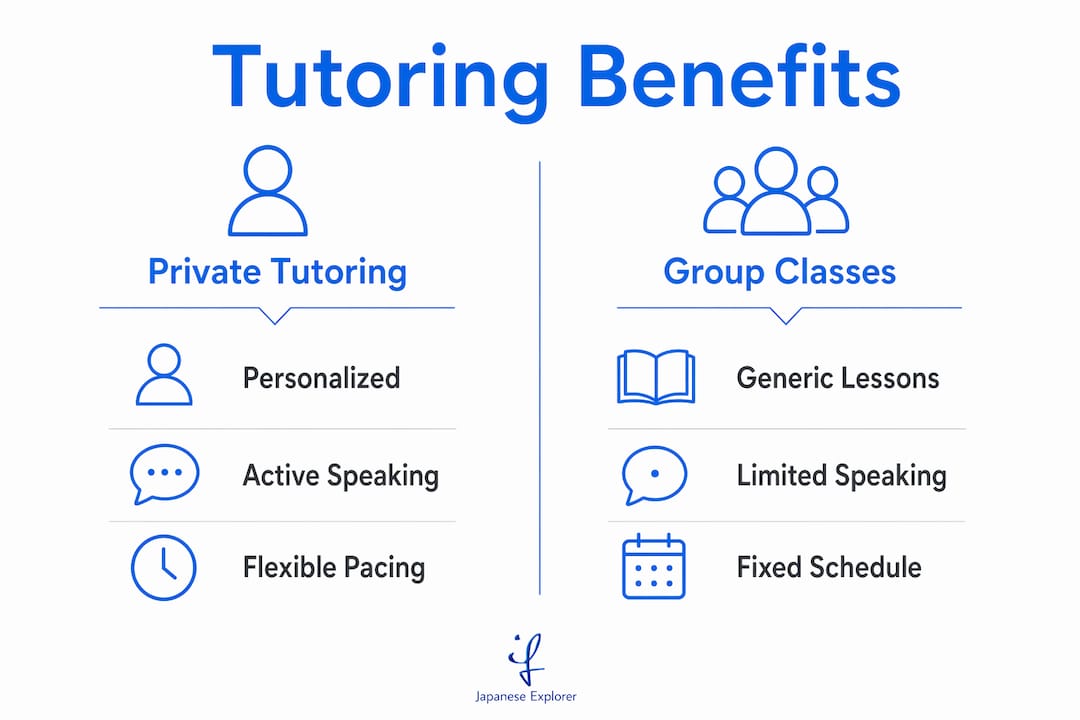
The research case for private tutoring is strong and specific. The Education Endowment Foundation’s 2026 analysis of more than 100 studies found that individual tutoring outperforms both group instruction and no tutoring by a measurable margin. Five months of additional progress per year is the average gain. For adult learners with limited study time, that efficiency matters enormously.
Frequency and consistency drive that result. Research published in june 2026 confirms that regular weekly sessions sustained over a full term produce significantly better outcomes than sporadic or short-term engagements. One session per week for three months outperforms six sessions crammed into two weeks. The brain needs spaced repetition to consolidate new vocabulary and grammar, and a tutor who sees you weekly can track that consolidation in real time.
The National Tutoring Authority’s 2026 findings add another dimension. Private tutoring delivers measurable confidence gains alongside academic progress. For adult learners who need to speak Japanese in professional or public settings, that self-efficacy boost is not a side benefit. It is the outcome that makes the language actually usable.
“Private tutoring’s value extends significantly into social-emotional development, including self-efficacy gains that support adult learners’ professional challenges.” — National Tutoring Authority, 2026
Compared to group classes, private lessons also provide 100% active speaking time. In a group of ten, each learner gets a fraction of the speaking opportunities. Private lessons yield faster spoken fluency in fewer total hours because every minute involves active production, not passive listening. For Japanese, where speaking confidence and pronunciation precision matter deeply, that active time is irreplaceable.
| Learning Format | Active Speaking Time | Pacing Control | Personalized Feedback |
|---|---|---|---|
| Group class (8–12 learners) | Low | Fixed | Minimal |
| Small group (3–5 learners) | Moderate | Limited | Occasional |
| Private one-on-one tutoring | 100% | Full | Immediate |
Why does active learner participation determine tutoring outcomes?
Active participation is the single biggest variable in whether private tutoring works. Learner engagement determines the ROI of every session. A tutor provides the roadmap, the corrections, and the structure. The learner does the heavy lifting between sessions.
Think of it this way. Your tutor teaches you how to use the particle “wa” versus “ga” in a session. But internalizing that distinction requires you to write example sentences, review them with spaced repetition flashcards, and notice the pattern in native Japanese content before the next session. Pairing tutoring with self-study is what locks vocabulary and grammar into long-term memory. The session plants the seed. Your independent practice makes it grow.
Common pitfalls are predictable. Learners who treat sessions as passive experiences, sitting back and waiting to be taught, plateau quickly. Learners who skip self-study between sessions forget 60–70% of new material before the next class. Learners who avoid asking questions out of politeness miss the corrections that would have saved them weeks of practicing the wrong pattern.
Your tutor helps you overcome these pitfalls by building accountability into the structure. A good tutor assigns specific tasks, checks completion at the start of each session, and adjusts the lesson based on what you actually retained. That feedback loop is what separates tutoring from self-study apps.
- Show up prepared. Review the previous session’s notes for ten minutes before each class.
- Ask every question. No question is too basic. Unanswered confusion compounds over time.
- Practice speaking aloud daily. Even five minutes of self-directed speaking practice between sessions builds fluency faster than silent review.
- Apply new vocabulary immediately. Use new words in sentences you write yourself, not just in the tutor’s examples.
- Track your goals. Revisit your original learning goals monthly with your tutor to measure real progress.
Pro Tip: Use a spaced repetition system like Anki to review vocabulary between sessions. Set a daily review target of 15–20 cards. This one habit dramatically reduces the forgetting curve and makes each tutoring session more productive.
How does private tutoring benefit adult learners pursuing Japanese for business or travel?
Adult learners have specific, high-stakes reasons for learning Japanese. A private tutor addresses those reasons directly, which is something a standardized group curriculum cannot do. The benefits of tailored language courses for adult learners are well documented, and private instruction takes that tailoring to its logical conclusion.
For business learners, the tutor focuses on keigo, the formal speech register that Japanese professional culture requires. Getting keigo wrong in a client meeting signals disrespect, even when the intent is polite. A tutor who understands Japanese business etiquette teaches you not just the words but the cultural logic behind them. That context is what makes the language land correctly in a real meeting room.
For travel learners, the priorities shift to pronunciation clarity, directional vocabulary, and the social scripts used in restaurants, train stations, and hotels. Japanese pitch accent, where the rise and fall of your voice changes word meaning, is notoriously difficult for English speakers. A tutor catches and corrects pitch accent errors in real time, something a language app cannot do.
For learners with anxiety or neurodivergence, one-on-one tutoring removes peer pressure and allows real-time instructional adaptation. There is no performance anxiety, no fear of judgment, and no fixed pace that leaves you behind. The session adapts to your energy and comfort level on that specific day.
- Business learners gain keigo fluency, professional email writing skills, and meeting etiquette
- Travel learners build pronunciation accuracy, directional vocabulary, and social scripts for real situations
- Conversational learners develop natural speaking rhythm and the confidence to hold unscripted conversations
- Anxious or neurodivergent learners benefit from a judgment-free space with fully adaptive instruction
Private tutoring also pairs naturally with accent reduction techniques used in professional language coaching, where personalized feedback on pronunciation is the core driver of fluency gains. The principle applies directly to Japanese: targeted, real-time correction of your specific pronunciation errors is far more effective than generic listening exercises.
Key Takeaways
A private language tutor accelerates Japanese acquisition by combining personalized instruction, immediate feedback, and consistent weekly sessions that group classes cannot replicate.
| Point | Details |
|---|---|
| Personalization drives results | Tutors diagnose your specific gaps and build lessons around your exact business, travel, or personal goals. |
| Five months’ extra progress | Education Endowment Foundation data shows one-to-one tutoring produces five months of additional progress per year. |
| Consistency is non-negotiable | Weekly sessions sustained over a full term outperform sporadic intensive bursts every time. |
| Active participation multiplies gains | Learners who apply feedback and complete self-study between sessions progress significantly faster than passive attendees. |
| Confidence is a measurable outcome | National Tutoring Authority data confirms private tutoring produces self-efficacy gains alongside language proficiency. |
Why I believe the private tutor is the most underrated tool in Japanese learning
After years of observing how adult learners in Singapore approach Japanese, one pattern stands out clearly. The learners who reach conversational fluency fastest are almost never the ones who studied the hardest in group classes. They are the ones who invested in a private tutor early and showed up consistently.
What surprises most people is that the tutor’s subject knowledge matters less than their ability to read the learner. The best Japanese tutors I have seen are not the ones with the most impressive credentials. They are the ones who notice when a learner is confused before the learner says anything, who shift their explanation mid-sentence when they see a blank expression, and who know when to push and when to slow down. That responsiveness is impossible to replicate in a group setting.
The rise of online tutoring has made this more accessible than ever. A learner in Singapore can now work with a native Japanese instructor over Zoom on a schedule that fits around work and family commitments. The discipline required for online learning is real, but the flexibility makes sustained weekly sessions far easier to maintain. Regularity, not intensity, is what produces fluency.
My honest advice: do not wait until you feel “ready” for private lessons. The tutor’s job is to meet you exactly where you are. The sooner you start, the sooner your Japanese becomes genuinely useful.
— Paul
Private Japanese tutoring at Japanese Explorer
Japanese Explorer offers private Japanese classes designed specifically for adult learners in Singapore, with instruction focused on conversational fluency, business communication, and real-world application. Every private session is led by a certified, bilingual Japanese instructor whose curriculum follows the Association for Japanese-Language Teaching standards.
Whether your goal is to hold a professional meeting in Japanese, navigate a trip to Japan with confidence, or simply build a skill you have always wanted, Japanese Explorer’s private tutoring program structures your learning around that specific target. Sessions are available in person at 10 Anson Road, Level 22, International Plaza, above Tanjong Pagar MRT, and online via Zoom. You can also explore business Japanese courses if professional communication is your primary focus. Contact Japanese Explorer today to book a consultation and find the right fit for your goals.
FAQ
What is the role of a private language tutor in Japanese learning?
A private language tutor diagnoses your specific gaps, builds a personalized lesson plan aligned to your goals, and delivers immediate feedback during every session. This one-on-one structure accelerates progress faster than group instruction.
How many sessions per week do I need to see real progress?
Research confirms that one session per week sustained over a full term produces the strongest outcomes. Consistency over time matters more than session frequency in any single week.
Are private Japanese lessons worth the cost compared to group classes?
Private lessons provide 100% active speaking time per session, compared to a fraction of that in group classes. The Education Endowment Foundation’s data shows individual tutoring produces five months of additional progress per year, making the investment highly efficient for adult learners with specific goals.
How do I choose a language tutor for Japanese?
Choose a tutor with experience in your target context, whether business, travel, or conversational Japanese. Tutors with domain expertise in your specific area consistently produce better learner outcomes than generalist instructors.
Can private Japanese tutoring help if I have language anxiety?
Private tutoring removes the peer pressure and performance anxiety present in group settings. The National Tutoring Authority confirms measurable confidence gains alongside academic progress, making one-on-one instruction particularly effective for anxious or shy learners.