TL;DR:
- Interactive language lessons promote active practice and immediate feedback, significantly improving Japanese communication skills.
- They focus on real-life scenarios, collaboration, and purposeful interaction to enhance retention and confidence.
Interactive language lessons are defined as structured learning sessions where you actively produce, respond, and negotiate meaning in the target language rather than passively absorbing information. For Japanese learners, this distinction matters enormously. Students retain approximately 75% of information when actively practicing, compared to just 5% from passive listening. That gap explains why so many learners who spend months with textbooks still freeze when a native speaker says “はじめまして.” Interactive lessons close that gap by putting you inside real communication from day one.
What are interactive language lessons and how do they differ from traditional study?
Interactive language lessons are built on active participation. You speak, respond, create, and problem-solve in Japanese rather than copying grammar rules into a notebook. The standard industry term for this approach is communicative language teaching, and it has guided modern language education for decades. What are interactive language lessons in practice? They are sessions structured around role-plays, group discussions, simulations, and multimedia tasks that mirror real-life communication.

The contrast with passive study is stark. A traditional lesson might ask you to memorize a verb conjugation table. An interactive lesson asks you to use that conjugation in a conversation about booking a restaurant in Tokyo. The context makes the grammar stick.
Four core components define every effective interactive session:
- Active participation: You produce language, not just recognize it.
- Collaboration: You work with peers or a teacher in real exchanges.
- Real-life scenarios: Tasks reflect situations you will actually face.
- Immediate feedback: Errors are corrected in the moment, not days later.
Immediate feedback loops are especially critical for adult learners correcting misconceptions and building confidence in spoken and written Japanese. Without that real-time correction, bad habits calcify fast.
Pro Tip: Record yourself during role-play exercises. Listening back reveals pronunciation patterns, like pitch accent errors in Japanese, that you cannot catch in the moment.
Technology has expanded what interactive lessons can include. AI-powered conversation tools, mixed-reality environments, and adaptive feedback systems now sit alongside traditional classroom activities. Each adds a layer of engagement that keeps you cognitively active throughout the session.
What are the benefits of interactive language learning for Japanese proficiency?
The benefits of interactive language learning go well beyond better test scores. Interactive teaching methods improve speaking fluency, learner participation, and intercultural communication skills by creating student-centered environments. For Japanese specifically, intercultural competence matters because the language is deeply tied to social context, politeness levels, and cultural expectations.
The retention advantage alone justifies the approach. Passive listening produces a 5% retention rate. Active practice produces 75%. That is not a marginal improvement. It means you learn in one interactive hour what would take roughly fifteen hours of passive study to absorb at the same level.
The specific gains you can expect from interactive lessons include:
- Speaking fluency: Regular production practice builds the automatic recall needed for natural conversation.
- Listening comprehension: Responding to live speech trains your ear faster than audio recordings alone.
- Writing accuracy: Collaborative writing tasks and immediate correction sharpen grammar and kanji usage.
- Motivation: Emotional engagement, including curiosity and accomplishment, sustains attention and supports memory in interactive learning. When a lesson feels rewarding, you come back.
- Confidence: Repeated successful communication in a safe classroom environment transfers directly to real-world conversations.
Moving from textbooks to real-life interactions is where these benefits become tangible. You stop translating in your head and start thinking in Japanese, even at a basic level. That shift is the clearest sign that interactive methods are working.
Which interactive language learning methods work best for Japanese?
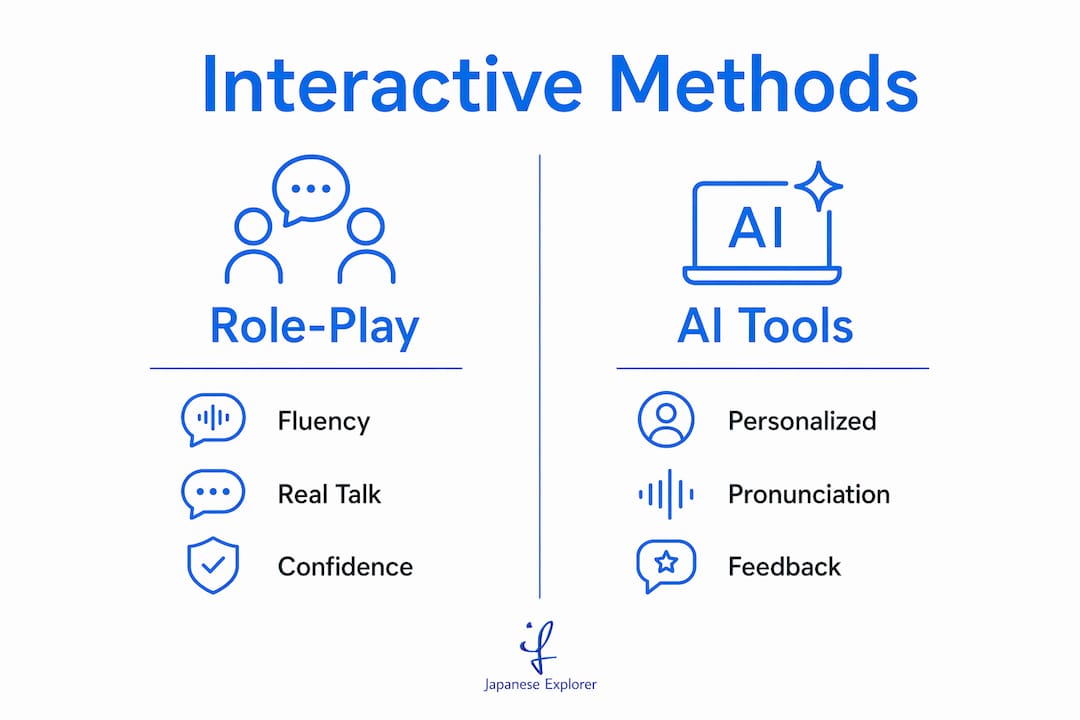
Not all interactive methods deliver equal results. The most effective approaches for Japanese learners combine cognitive challenge with emotional engagement and targeted feedback. Research and classroom experience point to four methods that consistently produce strong outcomes.
| Method | Primary benefit | Best suited for |
|---|---|---|
| Role-play and simulation | Speaking fluency and real-world confidence | Conversational and business Japanese |
| Inquiry-based learning | Long-term retention and transfer | Intermediate to advanced learners |
| Game-based modules | Motivation and vocabulary acquisition | Beginners and early intermediate learners |
| Mixed-reality interaction | Speaking gains through virtual character dialogue | Technology-comfortable adult learners |
Inquiry-based learning promotes long-term retention and transfer in interactive language learning environments. This method works by giving you a problem to solve in Japanese, such as planning a business trip itinerary or resolving a customer complaint, rather than drilling isolated vocabulary.
A six-week game-based learning module significantly increased language achievement and enjoyment among vocational students. The key insight is that games work not because they are fun but because they create repeated, low-stakes production opportunities. You practice the same grammar structure twenty times without noticing.
Mixed-reality interactive learning over 16 weeks improved language proficiency, with virtual character interaction showing the highest speaking gains. For Japanese learners who feel self-conscious speaking with native speakers early on, virtual characters offer a pressure-free first step.
AI-powered tools add another layer. Generative AI tools work best when tailored to learner proficiency and focused on productive skills like speaking and writing. Generic AI chatbots are less effective than AI integrated as a scaffold within a structured lesson plan. The difference is context and goal alignment.
Pro Tip: Match your method to your goal. If you are preparing for a business meeting in Japanese, prioritize role-play simulations over game-based vocabulary apps. Specificity accelerates progress.
Exploring language games you can create yourself is a practical way to extend interactive practice beyond the classroom without needing expensive technology.
How can you apply interactive lessons to everyday Japanese communication?
Applying what you learn in interactive lessons to daily life requires deliberate practice outside the classroom. The skills transfer only when you create conditions that mirror the lesson structure. Here is a practical sequence for building that habit:
- Recreate role-play scenarios at home. Take a dialogue from class and replay it with a language partner or record yourself taking both sides. This forces active production without the safety net of a teacher.
- Join a conversation group. Peer teaching and group discussion are among the most effective interactive activities. Explaining a grammar point to a classmate in Japanese consolidates your own understanding faster than reviewing notes.
- Use AI conversation tools as scaffolds, not substitutes. Set a specific goal for each AI session, such as practicing keigo (formal Japanese) for a workplace context. Open-ended chatting produces less measurable progress.
- Listen and respond, not just listen. Passive audio consumption is not interactive. Shadow native speakers, then respond aloud to what they say as if in a real conversation.
- Avoid the immersion illusion. Interactive environments alone do not guarantee progress. Learners who spend hours in digital Japanese environments without targeted goals often plateau. Every session needs a clear communication objective.
Tailored language courses for adult learners address this directly by building goal-oriented activities into every lesson. The structure prevents the drift that self-directed learners often experience.
Interactive lessons require active cognitive processing, with learners negotiating meaning by problem-solving, debating, or creating. That standard applies outside the classroom too. If you are not producing language with a purpose, you are not practicing interactively.
Key Takeaways
Interactive language lessons produce measurably better Japanese proficiency outcomes than passive study because they combine active production, immediate feedback, and real-life communication scenarios into every session.
| Point | Details |
|---|---|
| Active practice drives retention | Learners retain 75% of information through active practice versus 5% from passive listening. |
| Feedback accelerates accuracy | Immediate correction in interactive lessons prevents errors from becoming permanent habits. |
| Method choice matters | Role-play, inquiry-based learning, and game-based modules each target different proficiency goals. |
| Avoid passive interactivity | Time in interactive environments without clear goals leads to plateaus, not progress. |
| Emotional engagement sustains learning | Curiosity and accomplishment keep adult learners motivated and attentive across sessions. |
Why meaningful interaction beats gamification alone
I have watched adult learners spend months on beautifully designed language apps and still struggle to order coffee in Japanese. The apps were interactive in a technical sense. They had streaks, points, and animated characters. But they were not interactive in the way that actually builds communication skill.
Real interaction requires you to negotiate meaning with another person or a system that responds unpredictably. A multiple-choice quiz does not do that. A role-play where your teacher responds in character, pushes back, and corrects your pitch accent in real time does. The cognitive load of genuine interaction is what makes the language stick.
What I have found with adult learners specifically is that confidence is the bottleneck, not knowledge. Most intermediate Japanese learners know more grammar than they think. What they lack is the experience of using it under mild pressure and succeeding. Interactive lessons create that experience repeatedly until the confidence becomes automatic.
The feedback piece is non-negotiable. Learners who practice without correction often build fluency in incorrect Japanese. They become fast and confident at saying things wrong. Structured interactive lessons with qualified teachers prevent that outcome. The discomfort of being corrected in the moment is far less costly than unlearning a bad habit six months later.
My recommendation for adult learners in Singapore is to prioritize small group classes over solo app-based study, at least for the first year. The peer dynamic, the teacher feedback, and the structured scenarios combine in a way that no solo method replicates. Use apps and AI tools to extend your practice between sessions, not as your primary learning environment.
— Paul
Japanese Explorer’s interactive Japanese courses in Singapore
Japanese Explorer offers small group Japanese classes designed specifically for adult learners who want real communication skills, not just textbook knowledge. Every session integrates speaking, listening, and grammar through interactive activities guided by certified bilingual instructors.
Whether you prefer the energy of a group setting or the flexibility of an online Japanese course via Zoom, Japanese Explorer structures each lesson around the communicative principles that research consistently supports. Business professionals can also explore dedicated business Japanese courses and corporate training programs tailored to workplace communication. Classes run from beginner to advanced levels at 10 Anson Road, Level 22, International Plaza, Singapore 079903, right above Tanjong Pagar MRT.
FAQ
What are interactive language lessons exactly?
Interactive language lessons are structured sessions where learners actively produce and respond in the target language through role-plays, discussions, and real-life simulations. The industry term for this approach is communicative language teaching.
How do interactive lessons improve Japanese speaking skills?
Interactive lessons create repeated, low-stakes speaking opportunities with immediate feedback, which builds the automatic recall needed for natural Japanese conversation. Research confirms these methods improve speaking fluency and intercultural communication skills.
Are online interactive Japanese lessons as effective as in-person classes?
Online interactive lessons are effective when they include live teacher interaction, real-time feedback, and structured communicative tasks. Passive video-based courses do not deliver the same results as live, responsive online sessions.
What is the immersion illusion in language learning?
The immersion illusion occurs when learners overestimate their progress because they spend time in interactive digital environments without clear, goal-driven activities. Targeted objectives in every session are what produce measurable improvement.
How quickly can interactive lessons improve Japanese proficiency?
Progress depends on lesson frequency, goal clarity, and practice outside class. Learners who combine structured interactive lessons with deliberate daily practice typically see measurable speaking gains within a few months of consistent study.