
Corporate Japanese training in the U.S. typically runs at moderate costs per learner for ongoing group programs and private instruction, with structured pilot or short courses charging higher rates depending on program specifics. Those ranges shift based on class size, instructor credentials, delivery mode, and how much the curriculum is customized for your industry.
Here is what those numbers include in a typical package: a certified bilingual instructor, 8–16 contact hours per month, and core learning materials. Platform fees, setup costs, and assessments are often quoted separately, so your real budget line should be 10–15% higher than the headline rate.
The fastest next step is to run a 4–8 week pilot with one cohort of 8–12 employees before committing to a full rollout. Pilots give you attendance data, instructor fit, and early proficiency signals, all of which make internal budget approval much easier. Alternatively, request written quotes from at least three providers simultaneously, specifying headcount, current JLPT-equivalent levels, objectives, and preferred delivery mode so you can compare apples to apples.
The Foreign Service Institute classifies Japanese as one of the most time-intensive languages for English speakers, which means program length and total contact hours matter more for Japanese than for most European languages. Budget accordingly.
Key Takeaways
Corporate Japanese training in the U.S. costs $150–$300 per learner per month for ongoing group programs, and a pilot-first procurement approach with clear KPIs gives you the fastest, lowest-risk path to CFO approval.
| Point | Details |
|---|---|
| Typical cost range | Group programs run $150–$300/learner/month; private instruction runs $80–$200/hr in the U.S. |
| Pilot before full rollout | A 4–8 week pilot with 8–12 learners gives you attendance data and proficiency signals before committing. |
| Budget for hidden fees | Add 10–15% to headline rates for setup, materials, and platform costs like Zoom pro licenses. |
| ROI framing for finance | Model training against translation fees, decision delays, and bilingual hiring premiums for a CFO-ready case. |
| Japanese Explorer | Offers corporate programs with free lesson observation, certified bilingual instructors, and online delivery for U.S. teams. |
Table of Contents
- How corporate Japanese training cost breaks down by pricing model
- What actually drives your vendor quote up or down
- Sample packages you can copy into your RFP
- How Japanese Explorer structures a corporate program
- Your procurement checklist and realistic timeline
- How to measure ROI and build a CFO-ready business case
- Negotiation levers and contract terms that protect your budget
- An honest perspective on what corporate Japanese training actually delivers
- Japanese Explorer’s corporate training: how to request a quote
- Sources
- FAQ
How corporate Japanese training cost breaks down by pricing model
Four pricing models dominate the U.S. market. Understanding which one a vendor is quoting helps you convert any proposal into a per-learner, per-hour figure for internal comparison.
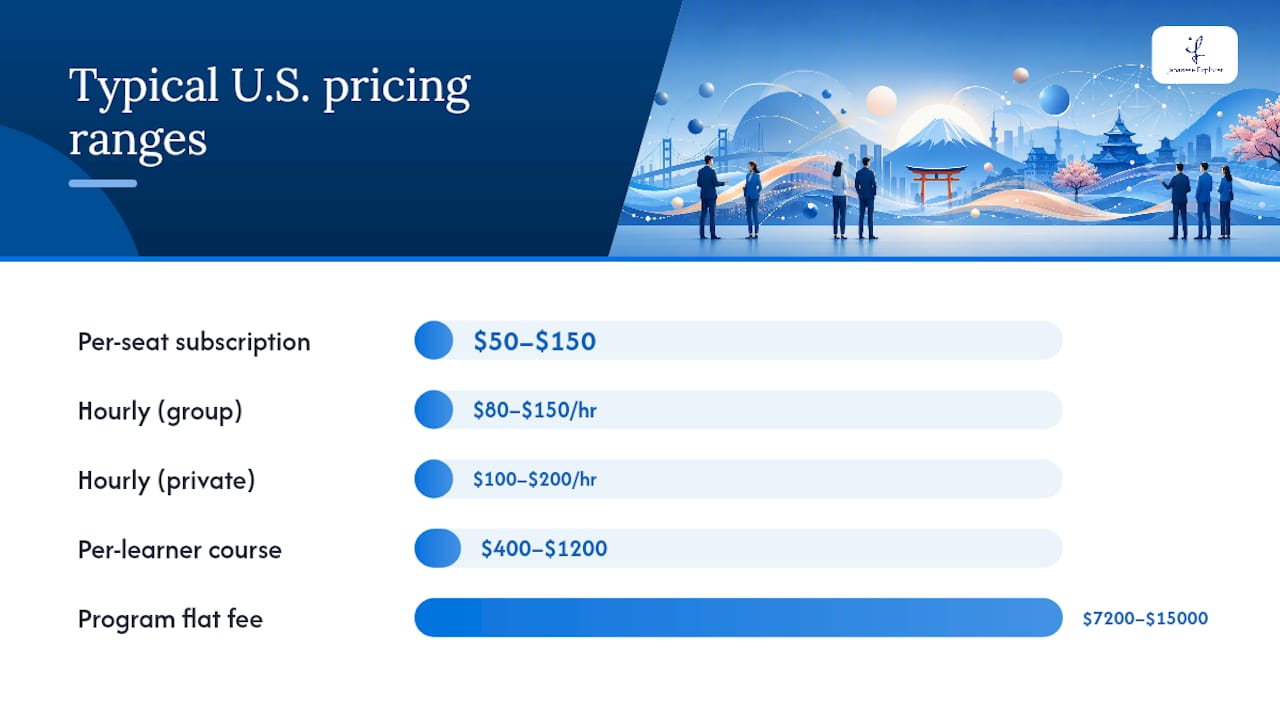
| Pricing Model | Typical U.S. Range | Best Fit |
|---|---|---|
| Hourly instructor rate | $80–$150/hr (group); $100–$200/hr (private) | Flexible, low-commitment programs |
| Per-learner per-course | $400–$1,200/learner (8–12 week course) | Cohort-based rollouts |
| Per-seat subscription | $50–$150 per learner per course | Ongoing programs, 6–12 months |
| Program flat fee | $7,200–$15,000 total | Custom enterprise programs |
Hourly rates suit teams that need occasional coaching or executive prep. The per-learner model works well when you are running a defined cohort through a fixed curriculum. Subscriptions make sense for ongoing programs where attendance fluctuates month to month. Flat-fee program pricing is what most enterprise providers quote for fully customized, multi-module corporate curricula.
For reference, a 10-week live online business Japanese course at Kudan Institute is listed at 88,000 JPY (approximately $580 USD at current exchange rates), which gives you a useful Japan-market benchmark for structured online delivery. European-market data from Silkdrive shows half-day virtual workshops at €800–1,500 and multi-session programs at €8,000–25,000, illustrating how scope and delivery mode drive price across markets.
Private lesson blocks follow a similar pattern globally. JM&C’s pricing lists 16 private lessons (24 hours) at ¥139,920, while pair lessons per person drop to ¥80,520 for the same block, showing how adding even one more learner meaningfully reduces per-person cost.
Sample U.S. package estimates:
- 12-week group online pilot (10 learners, 2x/week, 1.5 hrs/session): approximately $600–$900 per learner
- Ongoing monthly group program (15 learners, 4 sessions/month): approximately $150–$250 per learner/month
- Private 1:1 intensive (executive prep, 10 hours): approximately $1,000–$2,000 total
What actually drives your vendor quote up or down
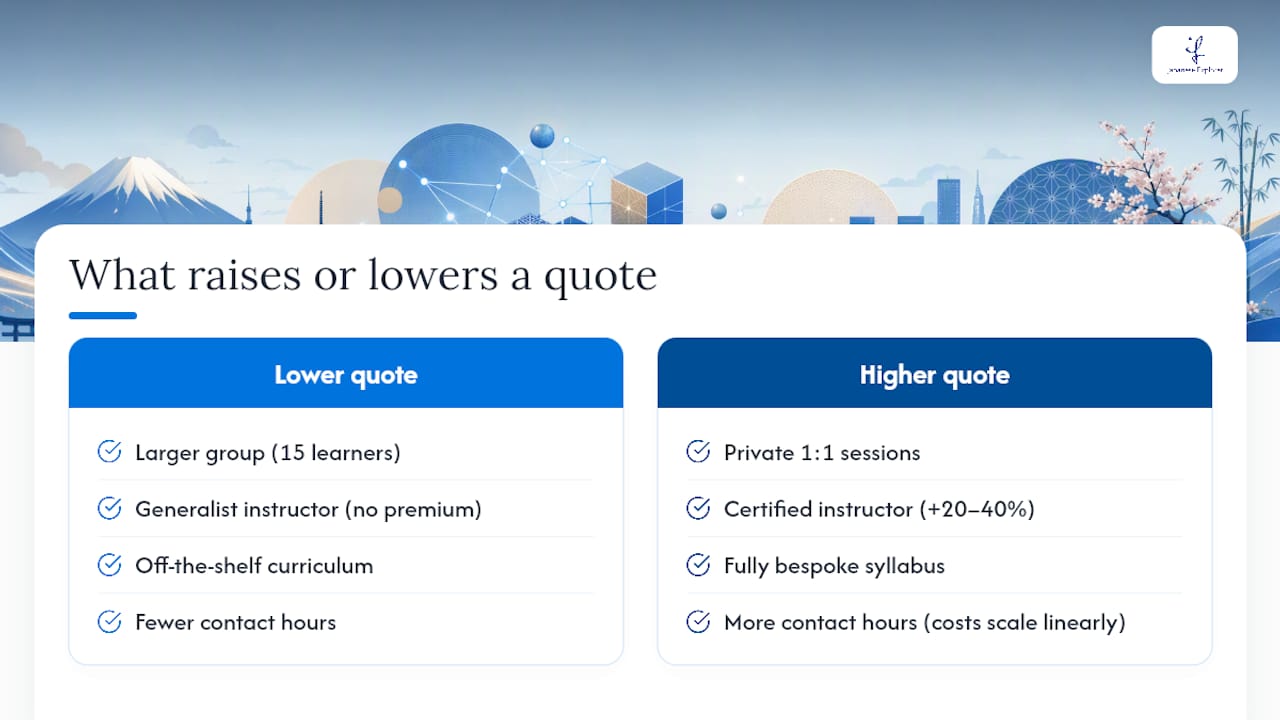
Most of the variance in Japanese language training pricing comes down to six factors. Knowing them lets you read a quote critically and identify which line items are negotiable.
Class size is the single biggest lever. A group of 15 learners sharing one instructor costs a fraction of what 15 individual private sessions would. Halving your cohort from 20 to 10 often doubles the per-learner cost, even though the instructor fee stays roughly the same.
Instructor credentials and seniority matter more for Japanese than for many other languages because native-speaker bilingual instructors with corporate teaching experience are genuinely scarce. Expect to pay a premium of 20–40% for a certified instructor with industry-specific vocabulary knowledge (manufacturing, finance, logistics) versus a generalist teacher.
Customization depth is where budgets quietly balloon. An off-the-shelf business Japanese curriculum costs far less than a bespoke syllabus built around your company’s actual meeting scripts, email templates, and client relationship protocols. If your team only needs keigo (formal speech) and meeting phrases, a semi-custom module is usually enough and costs significantly less than a fully bespoke program.
Contact hours and program length scale cost linearly. A 24-contact-hour program costs roughly twice a 12-hour one, all else equal. The Foreign Service Institute estimates 2,200 class hours for professional working proficiency in Japanese, so be realistic about what a 20-hour pilot can achieve: functional phrases and cultural confidence, not fluency.
Travel and onsite delivery add a flat cost that online programs avoid entirely. Onsite sessions typically carry a travel fee of $150–$500 per session depending on instructor location, plus any venue costs you absorb. For distributed teams, online delivery via Zoom or a similar platform is almost always the more cost-effective choice, though you should budget for a pro-account license if your sessions exceed 40 minutes with more than two participants.
Materials and assessments are often quoted separately. Textbooks, workbooks, and JLPT-aligned progress tests can add $50–$150 per learner per course. Ask vendors upfront whether materials are included or billed as a separate line item.
Pro Tip: Ask every vendor to quote with and without customization. The delta tells you exactly what bespoke content costs, and you can often negotiate a semi-custom option that uses their existing curriculum as a base with your company’s vocabulary and scenarios layered on top.
Sample packages you can copy into your RFP
These three packages represent common corporate program structures. Use them as starting templates in your procurement documents, adjusting headcount and hours to fit your situation.
Package A: Enterprise pilot (4–8 weeks)
- 8 learners, 8 sessions x 1.5 hours = 12 contact hours
- Online delivery, group format
- Off-the-shelf business Japanese curriculum (keigo, meetings, email)
- Estimated cost: $600–$900 per learner; $4,800–$7,200 total
- Hidden fees to confirm: setup/onboarding fee ($200–$500), materials ($50–$100/learner)
Package B: Ongoing monthly program (6–12 months)
- 15 learners, 4 sessions x 1.5 hours/month = 6 contact hours/month
- Online or blended delivery
- Structured curriculum with monthly progress checks
- Estimated cost: $150–$250 per learner/month; $2,250–$3,750/month total
- Hidden fees to confirm: cancellation terms (typically 30–60 days notice), platform license
Package C: Intensive upskill (2 weeks, pre-assignment or pre-project)
- 6 learners, daily 2-hour sessions x 10 days = 20 contact hours
- Private or small-group, high-customization
- Industry-specific vocabulary, role-play scenarios, cultural briefing
- Estimated cost: $1,200–$2,500 per learner; $7,200–$15,000 total
- Hidden fees to confirm: instructor travel (if onsite), rush-booking premium
Per-learner cost at different headcounts for Package B (ongoing monthly):
Larger cohorts benefit from economies of scale, but only up to a point. Beyond 15–20 learners per class, learning quality typically drops unless you split into parallel sections with separate instructors.
How Japanese Explorer structures a corporate program
Japanese Explorer offers corporate Japanese training with flexible delivery across group, private, and online formats, taught by bilingual certified instructors. Their curriculum follows the Association for Japanese-Language Teaching framework, which means lessons integrate grammar, speaking, and listening in every session rather than treating them as separate modules.
A typical Japanese Explorer corporate pilot would look like this:
- Objectives: Functional business communication (keigo, meetings, introductions, email)
- Duration: 8 weeks, 2 sessions per week
- Class size: 8–12 learners per group
- Instructor: Certified bilingual instructor with corporate teaching experience
- Sample syllabus items: Self-introduction in keigo, meeting openers and closers, polite request forms, reading business cards, email sign-offs
- Delivery: Online via Zoom or in-person (Singapore center at 10 Anson Road, Level 22, International Plaza, above Tanjong Pagar MRT)
For U.S.-based teams, online delivery is the practical route. Japanese Explorer’s online program structure is well-suited to distributed corporate cohorts, and the online Japanese course format removes travel cost from the equation entirely.
Trust signals to look for on any provider quote, and which Japanese Explorer provides:
- Free lesson observation or pilot session before contract commitment
- Instructor CVs or profiles (see Japanese Explorer’s instructor page)
- Sample syllabus or lesson plan for the first 4 weeks
- Clear class capacity limits (typically 8–15 for group programs)
- Defined progress metrics tied to JLPT-equivalent levels
Pro Tip: When requesting a quote from Japanese Explorer or any provider, include your team’s current proficiency level (even a rough self-assessment), your primary communication goal (meetings, email, client relationship), and your preferred session frequency. A provider who asks clarifying questions before quoting is almost always more reliable than one who sends a generic rate card.
Your procurement checklist and realistic timeline
A realistic corporate Japanese training procurement takes 8–14 weeks from needs assessment to first live session. Here is a step-by-step plan with time estimates:
- Needs assessment (Week 1–2): Survey employees on current Japanese proficiency, identify communication gaps, and define success metrics. Resource owner: HR/L&D lead.
- Stakeholder signoff (Week 2–3): Present a one-page business case with estimated costs and ROI framing to finance and department heads. Resource owner: HR director.
- RFP design and vendor outreach (Week 3–4): Send written RFPs to at least three providers. Include headcount, levels, objectives, schedule preferences, and delivery mode.
- Pilot design and vendor selection (Week 4–5): Review proposals, shortlist two vendors, and negotiate pilot terms. Confirm free lesson observation availability.
- Pilot execution (Week 5–10): Run a 4–8 week pilot with one cohort. Track attendance, session completion, and early proficiency signals.
- Measurement and review (Week 10–12): Collect data, survey participants, and present findings to stakeholders.
- Full rollout decision and contract (Week 12–14): Finalize vendor, negotiate contract terms, and schedule full program launch.
RFP checklist: what to request in every vendor quote
- Program objectives and JLPT-equivalent level targets
- Total contact hours and session frequency
- Sample lesson plan for the first two sessions
- Instructor CV or profile
- Class size limits and policy for makeup sessions
- Setup fee, materials cost, and cancellation terms
- Platform or technology requirements (and who pays for them)
Pro Tip: Request a written quote that separates instructor fees, materials, platform costs, and setup fees as individual line items. A bundled “all-in” quote makes it nearly impossible to compare vendors or identify what you are actually paying for.
How to measure ROI and build a CFO-ready business case
Finance teams respond to numbers, not learning outcomes. The most persuasive business case for corporate Japanese training quantifies the current language gap in dollar terms, then shows that training costs less than the alternatives.
The Sakuraa Nihongo Resource Centre framework recommends modeling three cost categories:
- Translation and interpretation fees: What does your company currently spend on external translators or interpreters for Japanese client communications? Even $500/month in avoided fees adds up to $6,000/year per team.
- Decision cycle delays: How many deals or projects are slowed by language barriers? A single delayed contract worth $200,000 that closes two weeks faster because your team can communicate directly is a measurable return.
- Bilingual hiring premiums: Hiring an externally bilingual Japanese-English employee typically commands a 15–25% salary premium. Training an existing employee to functional business Japanese often costs less than one year of that premium.
KPIs to track:
- Attendance and session completion rate (target: 80%+)
- JLPT-equivalent level progression (e.g., N5 to N4 in 12 weeks)
- Reduction in external translation requests
- Employee self-reported confidence in Japanese business communication
- Deal cycle time for Japan-facing accounts (before vs. after training)
Simple ROI example: A 10-person cohort completes a 12-week program at $800 per learner ($8,000 total). If the team reduces external interpretation costs by $1,000/month and closes one Japan-market deal two weeks faster (estimated value: $15,000), the program pays for itself within the first quarter.
Measurement cadence: run a proficiency check at the end of the pilot, at the 3-month mark, and at the 6-month mark. HR owns attendance and completion data; department managers own deal-cycle and translation-cost metrics.
Negotiation levers and contract terms that protect your budget
Most corporate training vendors have more flexibility than their rate cards suggest. Here are the levers that actually move price:
- Start with a pilot: A short paid pilot (4–8 weeks) almost always comes at a lower per-hour rate than a full contract because vendors want to earn the long-term relationship. Use the pilot as your negotiation anchor.
- Pool hours across departments: Buying a block of 100 hours across multiple teams is cheaper per hour than buying 20 hours per department separately.
- Cap travel fees: Negotiate a fixed travel allowance per session rather than open-ended reimbursement. For online delivery, this is a non-issue.
- Request measurable milestones: Tie payment tranches to attendance thresholds or proficiency checkpoints. This protects you if the program underdelivers.
- Lower instructor seniority for standard lessons: Reserve senior or specialist instructors for executive coaching or high-stakes preparation. Standard group lessons do not require the most expensive instructor on the roster.
Contract checklist:
- Setup fee cap (ask for a maximum of $500 for programs under $10,000)
- Cancellation terms (30-day notice is standard; 60-day is a red flag)
- IP ownership of custom materials (you should own any content built for your company)
- Minimum commitment period (avoid contracts longer than 6 months until after a successful pilot)
- Trial/pilot terms in writing, including what happens if you do not proceed to full rollout
Red flags in vendor quotes: vague deliverables (“business Japanese training” with no syllabus), no instructor CVs or profiles, open-ended travel fees, and no mention of progress measurement or reporting.
An honest perspective on what corporate Japanese training actually delivers
The pilot-first approach is not just a procurement best practice. It is the only way to find out whether your employees will actually show up. Attendance is the single biggest variable in corporate language training, and it is almost never discussed honestly in vendor proposals.
One practical negotiation tactic that works: ask the vendor to include one free observation session before the pilot contract is signed. Providers like Kudan Institute advertise this as a standard trust signal. If a vendor refuses, that tells you something.
On timelines: expect meaningful behavior change, meaning employees using Japanese confidently in real work contexts, to take 6–12 months of consistent practice. A 12-week pilot will give you proficiency signals and engagement data, but it will not produce fluent communicators. Set that expectation with stakeholders before the program starts, or you will be defending the investment at the 3-month mark when the results look modest.
The strategic value of Japanese in business relationships is real and measurable, particularly for companies working with Japan’s major industrial groups where long-term relationship norms make language capability a genuine differentiator. That is the business case worth making to your CFO, not just “employee development.”
Japanese Explorer’s corporate training: how to request a quote
Japanese Explorer offers business Japanese courses and dedicated corporate programs delivered by certified bilingual instructors, with flexible group, private, and online options. For U.S.-based teams, the online format means your employees can join live sessions from anywhere without travel cost adding to your budget.
Getting an accurate quote is straightforward. Contact Japanese Explorer with the following details: number of employees, current proficiency levels (even a rough estimate), primary communication objectives, preferred session frequency, and whether you want online or in-person delivery. Japanese Explorer offers a free lesson observation so your team can validate instructor fit and delivery style before signing anything. That single step removes most of the procurement risk.
Reach out via the corporate training page to start the conversation and request a tailored program proposal.
Sources
- Corporate Japanese Language Training ROI India — A CFO-Approved Business Case – Sakuraa Nihongo Resource Centre®
- Business Japanese Training for Companies & Professionals | Kudan Institute
- Japan Business Etiquette Training | Silkdrive
- Japanese Lessons with JM&C – 株式会社JM&C
- Zoom download
FAQ
How much does corporate Japanese training cost per employee?
Group programs in the U.S. typically run $150–$300 per learner per month for ongoing delivery, or $400–$1,200 per learner for a structured 8–12 week course. Private instruction runs $80–$200 per hour depending on instructor credentials and customization level.
Is Japanese worth learning for business purposes?
Yes, particularly for companies working with Japanese clients or partners. Language capability reduces reliance on interpreters, shortens decision cycles, and signals long-term commitment to Japanese business relationships, all of which translate to measurable cost savings and deal value.
How long does a corporate Japanese program take to show results?
A 4–8 week pilot delivers early proficiency signals and engagement data. Meaningful behavior change in real work contexts, such as employees confidently using Japanese in meetings or emails, typically takes 6–12 months of consistent practice.
How much should you charge for private Japanese lessons?
Private Japanese instruction in the U.S. typically runs $80–$200 per hour. Block pricing (e.g., 16 lessons at a fixed rate) is common and usually offers a lower effective hourly rate than booking sessions individually.